
CPX controls delta kinematics
Robotic controller with CPX
CPX controls delta kinematics. Machines and plants with decentralised automation – this vision is coming closer to reality due to the CPX automation platform from Festo.
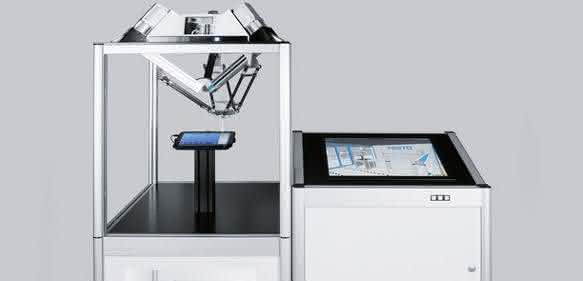
Packaging machines as an example feature the CPX automation platform from Festo as controller. It integrates all pneumatic and electrical control chains, thereby opening up completely new horizons for machine and plant planners for the layout of their production lines. They now have more space and greater flexibility for integrating other plant components into the production line. This development project comprising – different from the standard product – the high-speed handling system EXPT with CPX and the new „integrated drive” EMCA is now building on the trend. The robotic solution delivering more than 100 picks per minute with delta kinematics permits free movement in three dimensions. The CPX automation platform integrates the entire electropneumatic control chain via a codesys controller: From the I/O signal and simple electrical and pneumatic movements through to transformation of the tripod models using automatic calibration. What makes this revolutionary is the robotic controller with CPX. Originally designed as a valve terminal with remote I/O, Festo is making a quantum leap with regard to decentralised automation in the machine. Thanks to protection to IP65/67, the controller and the tripod manage without a control cabinet for the first time ever.
Also crucial for this development project are the electrical drives EMCA with integrated maintenance-free EC motors to IP54/65. The brushless DC motors with absolute position recording, integrated regulator, power electronics, absolute encoders – and the option of absolute multiturn encoders as well as integrated holding brakes and fieldbus interfaces – together with the CPX do away with the need for a control cabinet.
The handling system EXPT is a standard product from Festo and characterised above all by a high dynamic response due to a low moving mass and high rigidity thanks to its pyramid-shaped, closed structure. This is created using three double rods, which ensure that the flange plate is always in a horizontal position. Axes and motors are fixed.
The tripod kinematics take handling technology requirements such as short cycle times, dynamic response, function integration, fast plug and work, low acquisition and operating costs as well as faster time to market into account. The design of the tripod offers better accessibility in the working space than conventional cartesian or scara robots. pb


Das könnte Sie auch interessieren
Siemens investiert 300 Millionen Euro in Fertigungskapazitäten für Schaltanlagen
Siemens investiert 300 Millionen Euro in den Ausbau seiner Schaltanlagenfertigung in Frankfurt und Offenbach. Bis 2030 sollen 700 neue Arbeitsplätze entstehen.
 mehr...
Alles im Kasten
Mit dem raschen Fortschritt neuer Technologien und der stetigen Einführung von Innovationen in der industriellen Automatisierung steht die Planung von Schaltschränken vor neuen Herausforderungen.
mehr...INDUSTRIAL Production Produkte des Jahres 2025
3. Platz, Kategorie Energietechnik und Elektromechanik: Rittal
Rittal belegt mit seinen Sockel-Systemen für den Großschrank VX und den Kompakt-Schaltschrank AX Platz 3. Ein Modulbaukasten sorgt für individuelle und schnelle Ausbaumöglichkeiten sowie von hohe Stabilität und Verlässlichkeit.
mehr...Nominierung Produkte des Jahres 2025
Rittal: Sockel-Systeme für die Schaltschränke VX und AX
Rittal stellt neue Sockel-Systeme für den Großschrank VX und den Kompakt-Schaltschrank AX vor. Steuerungs- und Schaltanlagenbauer profitieren von einem variablen Modulbaukasten für individuelle und schnelle Ausbaumöglichkeiten sowie von hoher...
mehr...Steuerschrank aus grünem Stahl
Aus Altmetall und mit Windenergie
Siemens Smart Infrastructure erweitert über die Tochtergesellschaft Alpha Verteilertechnik sein Angebot an nachhaltigen elektrotechnischen Produkten.
mehr...Automatisierte Schaltschrankverdrahtung
Weidmüller hat auf der SPS 2023 Lösungen im Bereich der elektrischen Automatisierungstechnik gezeigt. Im Fokus standen ein neues Betriebssystem, eine neue Anschlusstechnologie sowie Lösungen für erneuerbare Energien, zum Beispiel für Windenergie,...
mehr...Alles formgenau im Schaltschrankbau
Um reibungslose Arbeitsabläufe zu gewährleisten, muss Werkzeug für die Bearbeitung von Schaltschränken und Gehäusen fehlerlos und zuverlässig funktionieren. Mit der Multi-Press 500 rundet Häwa das Angebot im Bereich Stanzen ab.
mehr...Ulrich Engenhardt neuer CBO bei Rittal
Neu in der Geschäftsführung bei Rittal: Ulrich Engenhardt verantwortet seit 1. Juni 2023 die Business Units beim Schaltschrank-, IT- und Energy-Systemspezialisten.
mehr...Schaltschranklos automatisieren
Mit dem Automatisierungsbaukasten MX-System möchte Beckhoff den Markt revolutionieren. Welche Möglichkeiten sich Anwendenden durch das System ergeben, welche Erfahrungen bereits gemacht wurden und wo die Reise hingeht, darüber sprach Andrea...
mehr...