
New tool design
Milling threads instead of drilling
In many cases, tapping or thread forming is preferred to thread milling. A new tool concept is intended to make thread milling more attractive. Walter has opted for a tool design with fewer teeth. However, the tooth feed is increased.
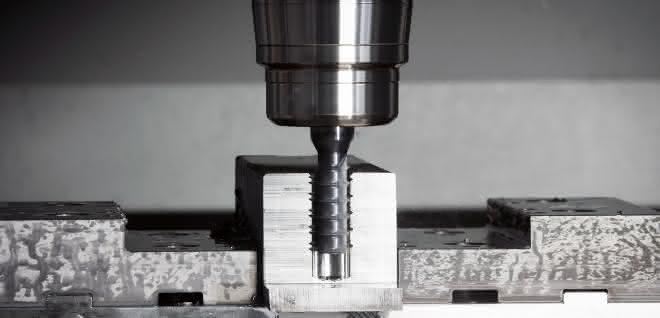
Thread milling cutters made of solid carbide quickly reach their productivity limits: The higher the feed rate per tooth fZ, the higher the cutting pressure and the greater the displacement of the milling cutter. This results in threads that are too narrow or even tool breakage. Low feed rates or cutting pitches, on the other hand, guarantee the reliability of the process and the desired quality, but lead to longer machining times and therefore higher costs per thread. For this reason, tapping or thread forming is still the first choice in many cases.
Many suppliers of thread milling cutters try to offer a solution to this problem. The classic approach is to improve tool life and machining time by increasing the number of teeth on the milling cutter, installing unequal helix angles or optimizing the substrate and coating. If you look at the information provided by many manufacturers of thread milling cutters optimized in this way, you will see that the recommended feed rates are still relatively low.
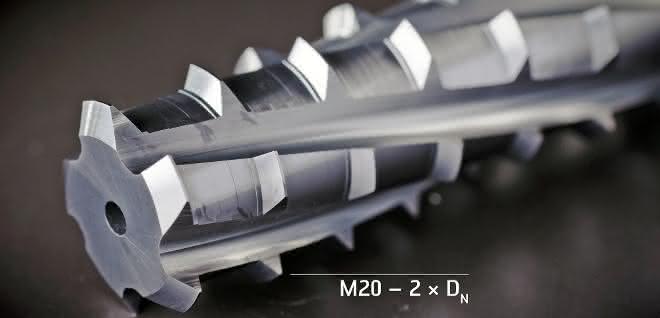
The improvements in the key performance indicators resulting from the typical measures were too small for Walter, which is why the company decided to tackle the problem differently. Instead of increasing the contact points with the material, the number of teeth on the TC620 Supreme thread milling cutter was reduced and the teeth arranged in multiple rows. This significantly reduces the cutting forces acting on the tool. The feed rate can now be increased accordingly. When machining 42CrMo4 heat-treated steel for M8 threads with a depth of 16 mm at 1,050 N/mm2, for example, Walter recommends a feed rate of 0.093 mm/min. This is over 40 percent more than the fastest competitor recommends.
From indexable insert to solid carbide milling cutter
The Walter T2711 indexable insert thread milling cutter already works according to the principle of multi-row arrangement with a reduced number of teeth. It is designed for milling threads from M20. The development engineers have now been able to transfer the principle to solid carbide tools for milling smaller thread diameters: With the TC620 Supreme, large tooth feeds (fZ) can be achieved with high process reliability due to the low cutting forces. Tool breakage and threads that are too narrow are no longer an issue. Further advantages of the thread milling cutter: The wear on the tool is significantly reduced due to the large tooth feeds. The dimensional accuracy of the thread is thus maintained over the entire tool life. Radius corrections are only required at a very late stage.
Process reliability in different application situations
The new thread milling cutter is typically used in applications where high demands are placed on process reliability and thread precision without losing sight of productivity. In other words, the thread milling cutter can be used universally. It is currently used particularly frequently for tasks in which demanding materials such as high-strength steels, duplex materials or Inconel have to be machined. Here, companies from the aerospace industry, but also from mechanical engineering, are increasingly switching from tapping to milling threads. Walter has achieved a breakthrough with the TC620 Supreme: Thread milling can now also compete with tapping and thread forming in terms of machining time.
Milling versus drilling - when is it worth switching?
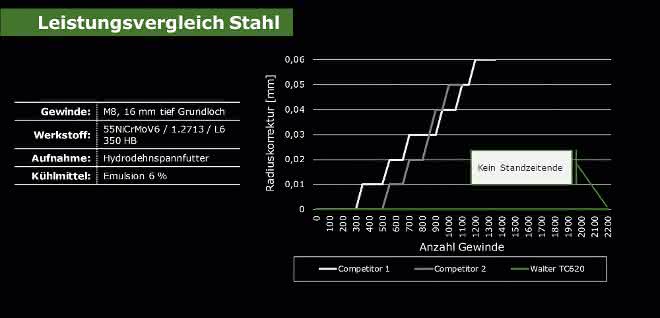
The extent to which switching from tapping to thread milling with the Walter TC620 Supreme affects efficiency and costs per thread depends on the user's specific circumstances. However, cost reductions of around 30 percent in terms of tool and machine costs are not unusual.
Thread milling in the application
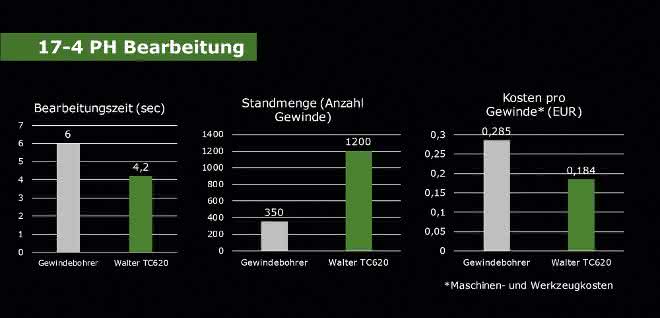
One example: A user from the general mechanical engineering sector was able to reduce costs by 35% when tapping M4, 6 mm deep blind hole threads using a new thread milling cutter - even though the thread milling cutter itself is significantly more expensive than the HSS-E tap previously used. With 1,200 threads, the TC620 Supreme achieves around three times the tool life of the taps with significantly increased process reliability. The material to be machined, 17-4 PH, a non-rusting martensitic, hardenable steel, is challenging to machine. The user turned to the Walter experts because tool breakages during tapping and the resulting additional costs jeopardized the cost and quality targets of the machining process.
With a machining time per thread of 4 s and a tool life of 1,200 threads per milling cutter, the Walter TC620 Supreme even exceeded expectations. A channel partner from Norway, who manages many projects in the oil and gas industry, also confirms the improvements in process reliability and speed. Particularly in difficult materials such as 316L or Inconel 718, the tool life was more than doubled, with a significant improvement in thread quality. There were only occasional minor vibrations. The only challenge with the new process is that the programmers have to rethink.
Martin Hellstern, Product Manager Thread Milling at Walter / ag


You might also be interested in
In-house exhibition Bielefeld 2026
How DMG Mori thinks about the factory of the future
DMG Mori will be showcasing turning and milling expertise, automation solutions and additive manufacturing along the Machining Transformation (MX) at the Bielefeld 2026 in-house exhibition.
 read more...
Up to 50 percent higher cutting speeds
The current market situation is putting pressure on companies that rely on carbide tools: Rising raw material costs, volatile supply chains and limited predictability are putting pressure on the industry. Fette Werkzeugtechnik, a member of the LMT...
read more...A robot for all occasions
Industrial robots take on many tasks. Even milling with accuracies in the sub-millimeter range is now possible.
read more...High metal removal rate for high maneuverability
Large module gears for ship drives place high demands on machining. Switching from skiving to 5-axis simultaneous milling with high-feed tools considerably shortens the roughing process. Process parameters and a well thought-out tool selection are...
read more...Schunk shows flexible systems for electronics production
Schunk Electronic Solutions will be exhibiting modular, flexible systems for electronics production at Productronica 2025 - from stand-alone depaneling systems to fully integrated inline solutions.
read more...Hydraulic 4-jaw chuck for automated workpiece clamping
HWR Spanntechnik presents a hydraulically actuated 4-jaw chuck for automated workpiece changing. The clamping device is designed to enable short set-up times, precise clamping and high productivity in automation.
read more...Corner, face and plunge milling
Paul Horn is expanding the DA milling system for corner, face and plunge milling. With the DA65 variant, the system offers a larger cutting insert compared to the existing DA62.
read more...World premieres at the EMO 2025
From September 22 to 26, 2025, Grob will be presenting several innovations at EMO Hannover. The focus of the trade fair appearance will be on the latest 4- and 5-axis universal machining centers and the associated automation solutions.
read more...Flexible and efficient processing
New high-performance CNC series
Fanuc's presentation at EMO will focus on the new FS500i-A CNC series. The new CNC generation offers high user-friendliness, process optimization as well as digital and network technologies.
read more...