
Sustainability Through Simulation
Digital material selection reduces CO2 emissions by 40 percent
The use of digital material simulations can significantly reduce CO₂ emissions during the development and manufacturing of components. A real-world project by Schunk and Cadfem demonstrates how data-driven material selection can yield savings of up to 40 percent.
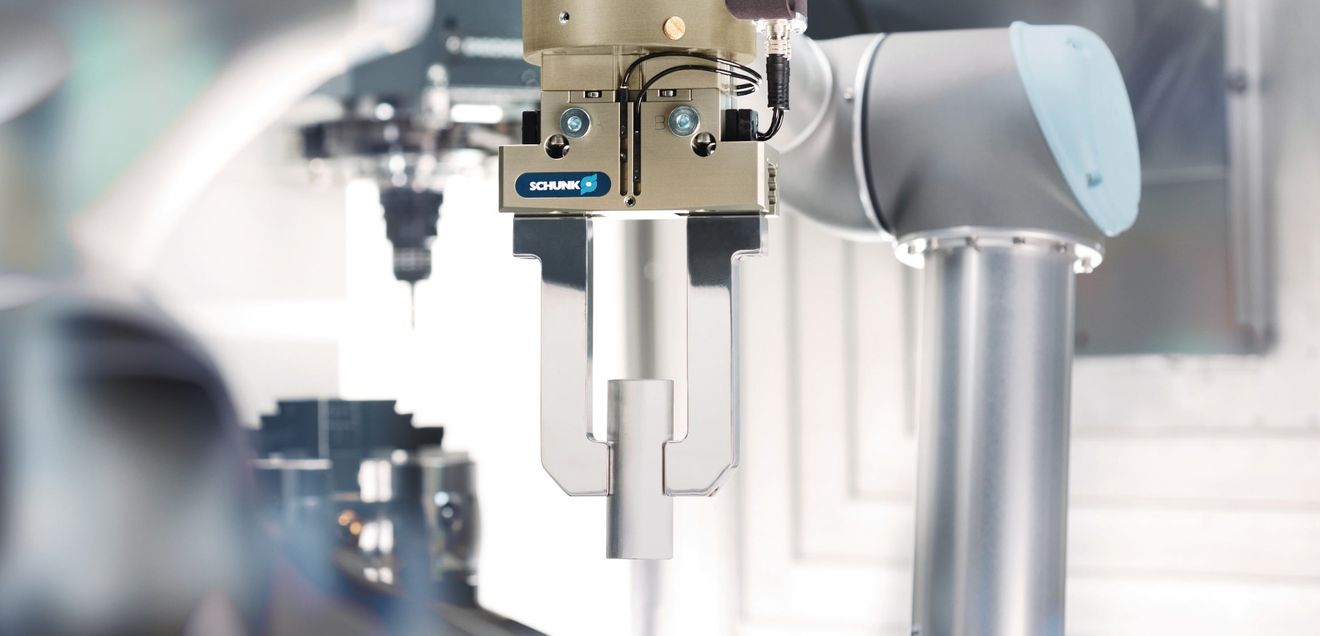
Material selection supported by digital simulation can reduceCO2 emissions by up to 40 percent in the production of components and devices. Schunk, a company specializing in gripping and clamping technology, and simulation specialist Cadfem demonstrated this in a pilot project involving the manufacture of an industrial gripper. The project was based on the Ansys Granta Selector simulation software, which contains detailed information on several thousand different materials and thus enables a much wider selection of suitable materials.
Daniel Barta, a development engineer at Schunk, explains the specific approach as well as the benefits and potential cost savings. In general, he notes, material selection is becoming increasingly complex today, while at the same time, demands on materials, manufacturing, and—above all—sustainability are rising. “We therefore removed the components with the highest emissions from the gripper and considered how we could reduceCO2 emissions by using alternative materials and manufacturing processes,” explains Daniel Barta. This led to the identification of two promising approaches: the use of secondary materials with a high recycled content, as well as the use of additive manufacturing processes powered by renewable energy, can result inCO2 savings of up to 40 percent in the gripper.
Materials: The Key to Innovation and Cost-Effectiveness
"Material data is the foundation for every technical decision," Barta emphasizes. Today, he says, it is "the key to innovation, cost-effectiveness, and sustainability." The Ansys Granta Selector material selection tool, along with the additional EcoAudit calculation module for assessing the environmental footprint, was crucial for evaluating and comparing the various material and manufacturing options.
At Schunk, the company sought ways to improve material selection, particularly in the context of digital transformation. For a long time, as is still common in many industrial and manufacturing facilities, this process relied primarily on past individual experience and established manual processes. Using the Ansys Granta Selector material database, the company has now been able to identify, among other things, various aluminum and steel alloys whose application, processability, load-bearing capacity, and environmental footprint could be extensively tested in the software—before they were implemented in actual production.
Sustainable materials offer a significant competitive advantage
"This allows all materials to be specifically evaluated against sustainability criteria, and the corresponding values to be reported," said Barta. Since Schunk's customers, for their part, must meet and demonstrate compliance with sustainability requirements, this objective information represents a significant competitive advantage.
In addition to the use of secondary materials, the production process using additive manufacturing methods powered by renewable energy was also examined in terms of itsCO2 reduction potential. This manufacturing approach was also analyzed in advance using an environmental simulation and optimized for the respective requirements and materials used.
Expansion to Other Business Units
In the next step,Schunk plans to use such digital tools to establish a centralized materials data management system so that it can analyze and optimize costs, process efficiency, and sustainability for other areas of the company as well. The material data management software Ansys Granta MI (MI for Material Intelligence), distributed by Cadfem for this purpose, not only supports material selection but also facilitates interfaces between engineering and other departments that interact with materials, such as procurement, quality assurance, and compliance. Such a centralized system, serving as a digital information source, reduces manual steps and creates even greater efficiency, transparency, and cost-effectiveness throughout the entire product development process.


You might also be interested in
Clever solutions for sensitive gripping
Innovative systems and exciting world premieres? That's what visitors will find at productronica in Munich from November 18 to 21. In Hall B3 at Stand 301, vacuum specialist Schmalz will be showcasing efficient and future-oriented handling systems -...
 read more...
Proprietary plastic compounds for extreme conditions
Cables must reliably transmit energy, data and signals, even in extreme cold or heat or under heavy mechanical stress. Specially developed plastics ensure that the cables remain robust and resistant. Lapp produces its own plastic compounds.
read more...Efficiency comparison of 3D printing, CNC manufacturing and injection molding
3D printing, CNC manufacturing or injection molding? When designers are looking for the most suitable manufacturing process for an individual component, they often lose time and also quickly lose track. Igus is changing this with the Triboteile...
read more...Heat transfer and additive manufacturing
Conflux Technology enters the hypercar sector
Pagani has announced the signing of a six-year contract with Conflux to integrate Conflux heat exchangers into the transmission of its latest exclusive model, the Pagani Utopia, further advancing additive manufacturing in the hypercar industry.
read more...Metal foam and PFAS replacement improve environmental balance
Metal foam contains up to 90 percent air and has amazing properties. In the factory, it ensures greater sustainability and helps to improve the environmental balance in industrial production.
read more...PFAS alternatives with high performance
Igus wants to set an example for innovation and sustainability and will be presenting new products at HMI 2025, including PTFE-free materials and products made from recycled material.
read more...No splinters, no maintenance
New properties also apply to load carriers in logistics and intralogistics processes. Craemer's portfolio includes high-quality returnable load carriers that are hard-wearing, versatile, maintenance-free and recyclable.
read more...Tensile strength of 3D components
Voxelfill strategy overcomes inhomogeneous strengths in 3D printing
The company AIM3D has succeeded in demonstrating the advantages of the patented voxelfill process. Strength tests now prove that this process can overcome inhomogeneous strengths of 3D components in the X, Y and Z axes and thus comes close to...
read more...Lubrication-free plain bearing materials...
Igus focuses on the development of PFAS-free materials
And again the topic of PFAS: The new "endurance material" Iglidur JPF complements the wide range of wear-resistant PFAS and PTFE-free polymer bearings. Igus is thus preparing for new regulations.
read more...