
Highly Automated Injection Molding
Six-axis robots automate the entire handling process
From part handoff to loading and unloading the injection molding machine to quality inspection: Yaskawa six-axis robots automate the entire handling process in a highly integrated production line for safety-critical sight domes.
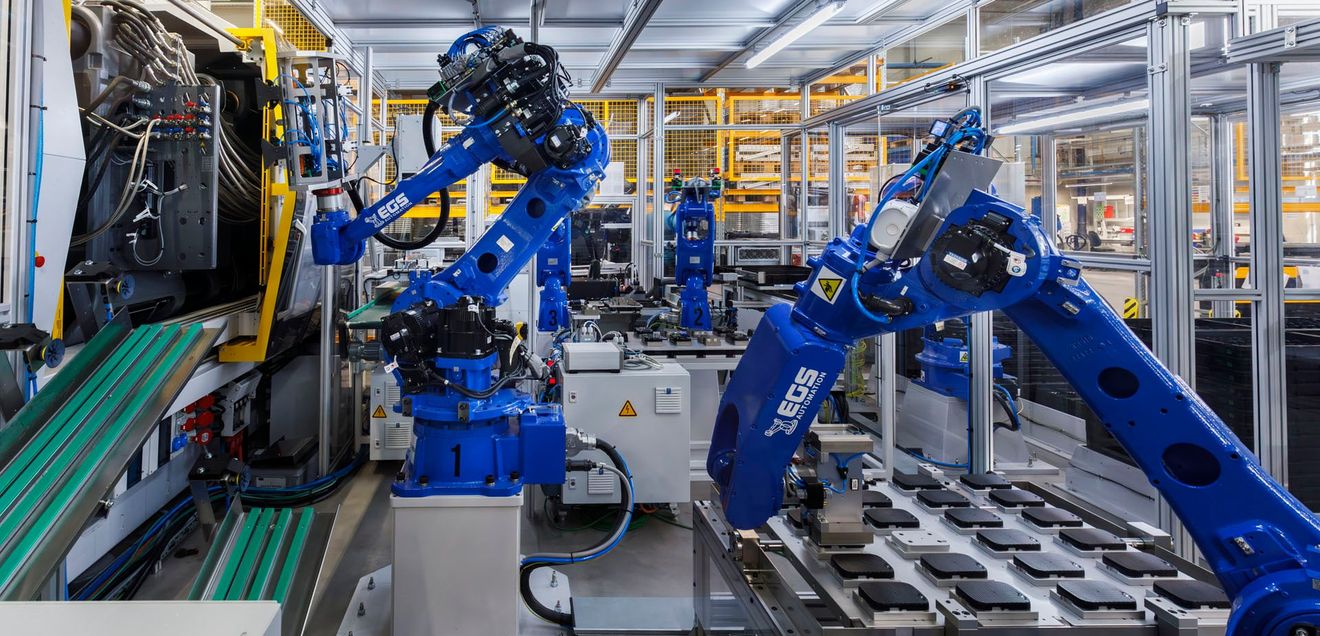
The annual production of approximately 1.4 million radar domes on two production lines is subject to the strictest quality requirements. These safety-critical components protect the sensitive electronics of radar sensors in premium vehicles. A 2K injection molding cell—complete with a host of upstream and downstream processes, highly innovative quality assurance, and sophisticated automation—demonstrates what state-of-the-art production lines are capable of today.
The fact that the production of these sensitive components—which are found in Audi and Porsche models—is taking place at Weißer + Grießhaber in Mönchweiler is anything but a coincidence. Founded in 1969, this family-owned company is now regarded as an innovative series supplier with its own mold-making division and, thanks to decades of experience, also sees itself as a development partner for demanding customers in the fields of automation, automotive, medical technology, and building services engineering.
The company employs about 340 people, operates 215 robots and 114 injection molding machines, and uses them to produce over 1.3 billion parts annually. At the helm is Martin Weißer, who is the third generation to lead the company and has big plans for the future: “Together with our customers, we want to develop groundbreaking manufacturing solutions with a high degree of functional integration and set new standards in line with our motto, ‘Excellence in Plastics.’ The new production line for the viewing domes clearly illustrates the direction we’re heading in.”
Time-Optimized Development in Simultaneous Engineering
Even before the production order was awarded, W+G’s engineers were closely involved in the development process at automotive supplier Bosch. At the same time, the first stations for automating the injection molding cell were being built by specialty equipment manufacturer EGS Automation in nearby Donaueschingen. “Due to the tight schedule, we had to start planning the automation in the middle of product development—that is, without final specifications. Nevertheless, we managed to draw up a rough plan by designing certain system components and processes very flexibly and ensuring they could be easily replaced and adapted,” said Hartmut Pfalzgraf, project manager at EGS Automation.
The use of simultaneous engineering played a decisive role in ensuring that the complex production line, featuring two interlinked injection molding processes, could be brought online on schedule. Here’s how the manufacturing process works: The first injection molding cell is responsible for producing the plastic base bodies with two contact pins, which is equipped with a punching line, a SCARA robot for separating and placing the contacts, a Yaskawa six-axis robot for loading and unloading the Arburg injection molding machine, and an inspection station. Here, the base bodies undergo 100% inspection before being placed in trays and stacked using a Sumo Ecoplex tray stacker from EGS Automation.
Fully automated injection molding cell with six robots
From here, the process proceeds manually directly to injection molding cell 2, where the operator returns the trays loaded with base bodies to the system via a second Ecoplex palletizing system. “Together with our trusted system integrator EGS Automation, we have succeeded in automating a complex manufacturing process with many upstream and downstream steps within a very confined space. With its total of six robots, one winding station, five integrated inspection stations, a wealth of sensor technology, and impressive manufacturing IT, this fully automated injection molding cell demonstrates what is possible today,” emphasizes Martin Weißer.
The extent of the functional integration here becomes clear when looking at the processes: First, the base body must be wound with a hair-thin copper wire, which is used for the subsequent heating of the sighting dome. This task is handled by a special winding system, which also welds the wire ends to the pins and performs an electrical continuity test. A SCARA robot handles the automation of this cell. The next step involves overmolding the wire-wrapped base body. This two-stage process is carried out by a fully electric Arburg 920-2K injection molding machine. This is followed by sophisticated inspection processes before the sight domes are marked with a Data Matrix code.
Reliable six-axis robots with high dynamics and precision
The system is so complex that only a few employees fully understand and master it down to the last detail. One of them is Emre Yeniay, Technical Engineer for Manufacturing Equipment at W+G: “The entire sequencing of all stations in the system is fully automated using five Yaskawa six-axis robots, including two GP25s for handling tasks, a large GP50 for automating the injection molding machine, and two GP7s that handle the downstream inspection processes. To ensure the gentlest possible handling of the radomes, all robots are equipped with vacuum grippers. The Yaskawa robots excel not only in precision but also in maximum uptime, which is crucial for our 24/7 operation.”
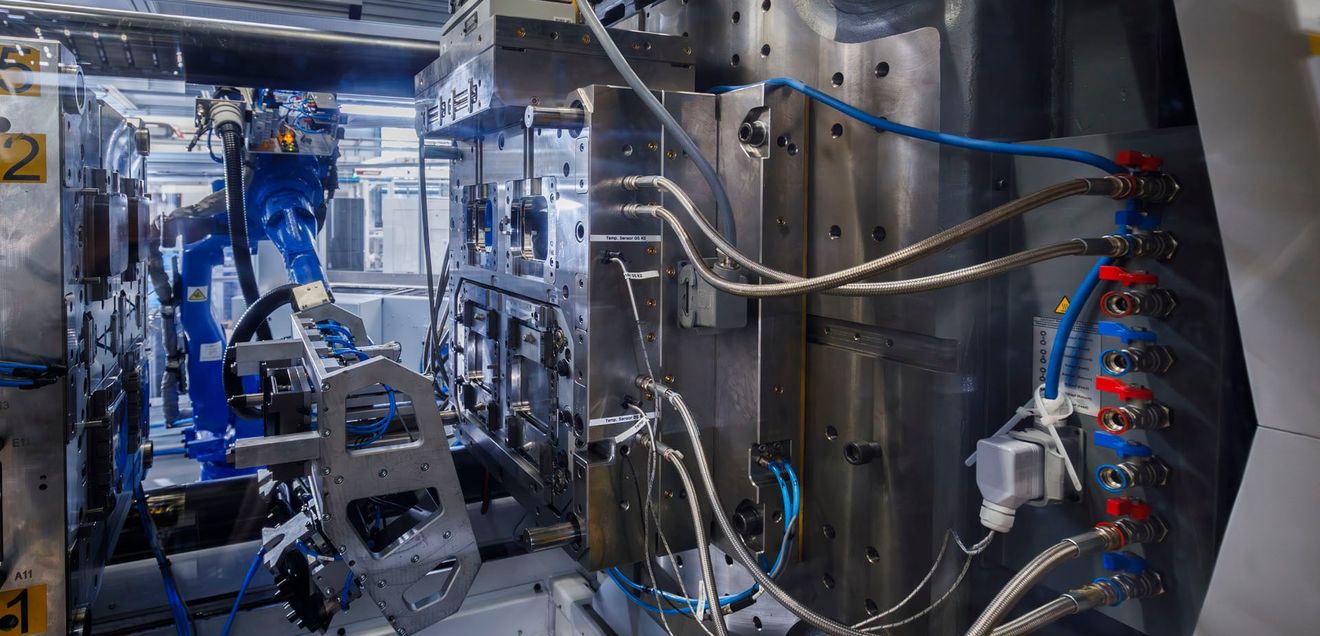
What stands out when looking at the system is the large transfer station in front of the injection molding machine, which is accessed by both the GP25 and the larger GP50. The smaller six-axis robot handles the loading of the base bodies coming from the winding system, while the larger GP50 picks them up in pairs from there and places them into the injection molding machine. With a capacity of 24 base bodies, the transfer station is generously sized. Emre Yeniay explains why: “This station also serves as a buffer. Should a malfunction occur in the upstream wire-winding process, the injection molding machine can continue production at full speed. The key here is thermal equilibrium. This gives our technicians valuable time to resolve the malfunction.”
State-of-the-art testing processes with complete transparency
After overmolding, the GP50 removes the parts from the SGM and immediately performs the first inspection step. In a wobble circle test, the robot moves the parts under a camera system that checks the exact alignment of the contact pins. The GP50 then transfers the parts to a second transfer station. Here, the journey of the sighting domes through additional inspection stations begins. Two compact yet precise Yaskawa GP7 robots handle the parts during this process. First, an electrical resistance test is performed to verify the proper functioning of the heating wire, followed by a flatness test with a tolerance of just ten micrometers. Finally, a complex radar attenuation test is conducted.
Last but not least, a GP7 six-axle robot transfers the parts to a laser marking station, where the inspected radomes are assigned their individual Data Matrix codes, which are then immediately checked for readability in the next step. This DMC code contains all information regarding manufacturing and quality assurance parameters, ensuring 100% documentation and traceability of every component. In the final step, the GP7 places the sight radomes into the customer’s KLT containers, which—once fully loaded—are de-stacked by a GP25 via another Ecoplex palletizing system and manually removed from the facility.
AI is expected to further minimize the error rate
The scrap rate plays a decisive role in the manufacturing costs of this safety-critical component. Martin Weißer comments: “We must have the best possible control over the process to keep the defect rate as low as possible. The safety domes are relatively expensive components, and every scrap part impacts our bottom line. That’s why every production and inspection step is monitored by sensors, and the data is displayed on a prominently placed screen at the machine via a production data acquisition system. We have real-time insight into every process, can identify trends, and take immediate corrective action.”
But that’s not enough for the company’s leader, who strives for perfection. To further optimize its processes, Weißer + Grießhaber employs manufacturing IT specialists whose job is to implement additional AI capabilities. The foundation for this is already in place in the form of the existing data sets from each process. “By using generative AI, we want to move from a reactive manufacturing model to a predictive one that, thanks to its intelligence, can also optimize itself. This will allow us to reduce the error rate even further in the near future,” emphasizes Martin Weißer.
Thinking ahead, pursuing visions, and advancing technologies—these are exactly the issues that drive Martin Weißer. “We must expand our role as a technological pioneer; this is the only way we can secure Germany’s position as a manufacturing hub. That is why, in the medium term, we will position our company as a provider of assembly and process solutions with in-house development expertise and pursue this path together with innovative partners such as EGS Automation. “The production of the sight domes—with its two interlinked injection molding processes featuring high vertical integration, a multitude of integrated processes, and high-tech automation—shows where we’re headed,” Martin Weißer concluded.
Ralf Högel, freelance technical journalist for EGS Automation


You might also be interested in
Conveyor systems that adapt
Modern conveyor systems must reliably transport different product sizes, shapes and materials. The new modular product system from Kipp offers flexible, modular solutions for this: Adjustable side guides ensure precise alignment and gentle...
 read more...
Handling and production logistics
Speed beats planning
Unpredictable fluctuations in demand pose new challenges for fulfillment logistics. Viral trends, political decisions and changing customer behavior are making traditional planning models obsolete.
read more...Loading and unloading machines
Artificial intelligence and ergonomic lifting
Loading and unloading machines ergonomically and efficiently - Schmalz supports metalworking companies in this. At Euroblech, the company will be presenting solutions for intelligent and ergonomic handling with vacuum.
read more...Products of the year 2025: the competition starts again
The INDUSTRIAL Production Products of the Year are entering a new round. This year, our readers can vote in eight categories. We are also awarding a special prize.
read more...Josko relies on vacuum technology from Schmalz
Lifting 80 kilograms 80 times in 8 hours: Vacuum expert Schmalz has developed a solution for the highly automated industrial company Josko that solves this task in the blink of an eye with the help of a suction spider.
read more...Interview with Dietmar Schlenker from Indeva
"Logimat is our in-house exhibition"
Indeva presents its latest products at Logimat 2024. However, Managing Director Dietmar Schlenker also looks further into the future in an interview.
read more...Efficient palletizing and depalletizing of KLT boxes
At Logimat 2024, the company from Gescher-Hochmoor in Münsterland will be demonstrating the palletizing and depalletizing of KLT containers within a line.
read more...INDUSTRIAL Production Products of the year...
3rd place, metalworking category: Schmalz
Schmalz automates sheet metal handling with the ivOS Sheet Metal Solution Kit. Companies can use it to automate the loading of machines - simply, flexibly and economically. The kit was awarded 3rd place in the metalworking category.
read more...Chancellor visits Schmalz
On Monday afternoon, Federal Chancellor Olaf Scholz visited the Schmalz company in Glatten. The head of government was given a tour of the family-run company, spoke to the management and then answered questions from employees.
read more...