
Hydrogen Put to the Test
Research Platform for the Energy Supply of the Future
Hydrogen is expected to play a central role on the path to a climate-neutral energy system. However, for this energy source to become a viable component of industry, mobility, and energy supply, numerous technologies must work together—from production, through liquefaction and storage, to transportation and use.
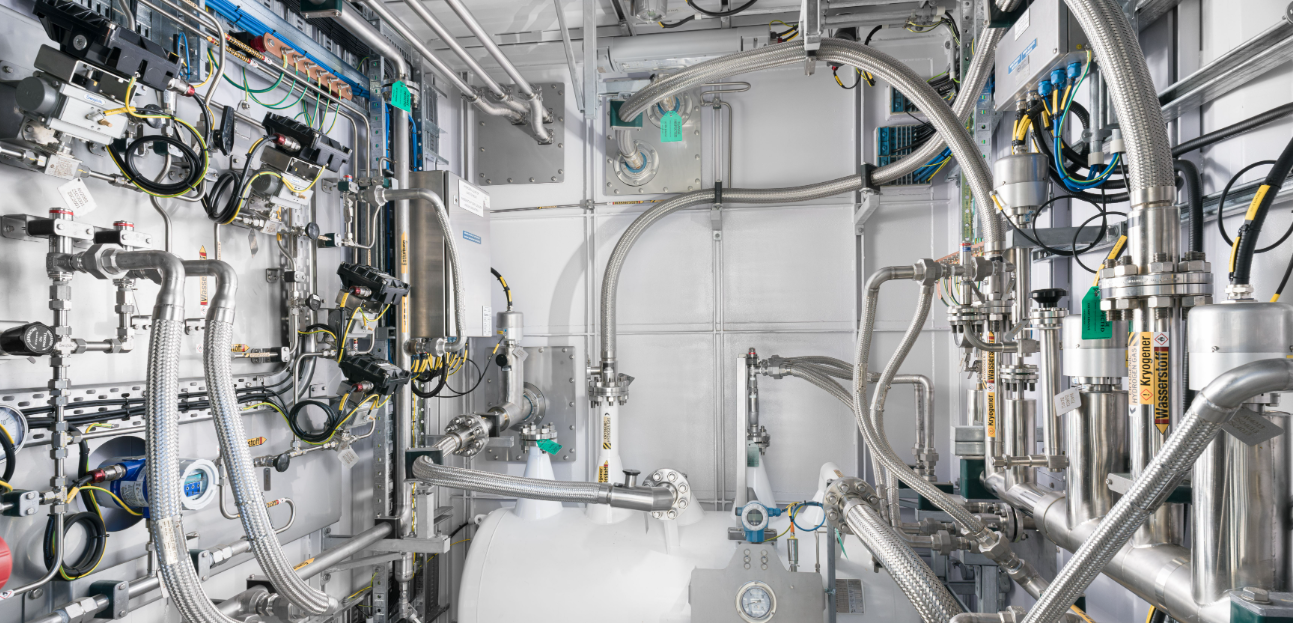
This is precisely where the new Hydrogen Integration Platform (HIP) at the Karlsruhe Institute of Technology (KIT) comes into play. With the launch of this research infrastructure on the North Campus, KIT is expanding its capabilities to study hydrogen technologies not only individually but also as an integrated system under real-world conditions.
The platform connects facilities and demonstration projects across the entire hydrogen value chain—from electrolysis and liquefaction through storage and transportation to use in the energy system. Researchers are investigating how hydrogen technologies can be reliably, flexibly, and efficiently integrated into a climate-neutral energy system in the future.
In June, KIT opened the new research facility on the Energy Lab campus.
“With the Hydrogen Integration Platform, we at KIT have created a highly innovative research environment because it allows us to study how different hydrogen technologies interact,” says Professor Oliver Kraft, Vice President for Research, Teaching, and Academic Affairs at KIT. “This makes it possible not only to develop new solutions for a climate-neutral energy system in the lab, but also to test them under conditions that closely resemble real-world scenarios.”
Infrastructure for the Integration of Technologies
The challenge of establishing a hydrogen economy lies not solely in individual technical components. What matters most is how production, storage, transportation, and use interact. The Hydrogen Integration Platform therefore brings together several demonstration facilities to store, distribute, and use hydrogen.
At the heart of HIP is Germany's largest non-commercial hydrogen liquefaction system. The facility can liquefy 50 kilograms of hydrogen per day and supplies it to both research projects at KIT and external partners.
In this way, the platform creates an infrastructure in which various technologies can be tested under conditions that more closely resemble their eventual industrial applications. It also provides test environments for energy storage systems, real-time simulations of their integration into future energy grids, and new electrolysis processes.
The researchers also plan to study hydrogen-powered rail vehicles under realistic conditions.
“With the HIP, we can test key components of the hydrogen value chain within an integrated infrastructure,” explains Professor Giovanni De Carne of the Institute of Technical Physics (ITEP) at KIT and future director of the facility. “This opens up new opportunities to further develop technologies in a targeted manner and tailor them to specific applications.”
Liquid hydrogen and electricity in a single pipeline
Another component of the research platform is a test track for a hybrid energy pipeline. The idea is that liquid hydrogen and electrical energy could be transported together over long distances in the future.
To achieve this, the researchers are combining a pipe for extremely cold, liquid hydrogen with superconducting power cables. At these low temperatures, these cables can transmit electrical energy with virtually no loss.
The infrastructure could efficiently transport large amounts of energy over long distances—for example, from wind and solar farms or port terminals to industrial facilities, airports, or logistics centers.
“Hybrid energy pipelines could become compact energy highways for a future hydrogen economy,” says Professor Tabea Arndt of ITEP. “The combination of hydrogen pipelines and superconducting cables makes it possible to flexibly integrate energy supply, industry, and mobility.”
The combination of liquid hydrogen and superconductivity also opens up further technical possibilities. For example, superconducting motors for large vehicles could benefit from being combined with liquid hydrogen. The project participants also intend to investigate this possibility experimentally.
Research as a Bridge to the Hydrogen Economy
With the Hydrogen Integration Platform, KIT is creating a platform where complex hydrogen systems can be studied and further developed under real-world conditions.
The infrastructure makes it possible to test new technologies at an early stage, develop operational strategies, and analyze their interaction with power grids and industrial applications. The goal is to bridge the gap between research and subsequent practical application.
In the future, the research infrastructure is expected to further strengthen collaboration with industry partners and help bring new hydrogen technologies to market more quickly.
The HIP thus sees itself not merely as a collection of individual facilities, but as a test environment for an energy system in which hydrogen could play a central role.
Source: Karlsruhe Institute of Technology


You might also be interested in
Hydrogen Pipelines Put to the Test
New real-world lab tests safety and resilience
The Federal Institute for Materials Research and Testing (BAM) is opening a real-world laboratory to study pipelines and components for the safe operation of future hydrogen networks.
 read more...
When the quantum computer arrives
The Research Race to Ensure the Security of Critical Infrastructure
How can we protect our critical infrastructure from attacks by quantum computers in the future? As part of the QUEST project, Darmstadt University of Applied Sciences is researching new methods—post-quantum cryptography—designed to withstand even...
read more...VDE study on electrical engineering
More retirements than graduations
According to a VDE analysis, more than 30,000 electrical engineers will retire by 2029 without enough graduates to replace them. This is due to falling student numbers and high drop-out rates.
read more...Giving lightweight construction a profile
Pultrusion: A process that forms fibers under tension
Pultrusion is developing from a niche process into a key process for lightweight construction and sustainable fiber composite structures. The Fraunhofer IWU shows applications from energy to mobility.
read more...Green hydrogen directly from the sun and water
A start-up project at the Karlsruhe Institute of Technology (KIT) aims to fundamentally simplify the production of green hydrogen: Mass-produced photoreactor panels are to be used to produce hydrogen directly from sunlight and water - without...
read more...Fraunhofer shows industrial future between AI, data and new materials
At Hannover Messe 2026, the Fraunhofer-Gesellschaft will be presenting solutions for a resilient industry: from AI and data rooms to hydrogen technologies and material and recycling innovations.
read more...The bottleneck is in the system
Is the transformation of the industry failing due to "German Angst"?
A recent ISF study examines what is slowing down change in German industrial companies. According to the results of the study, the causes of innovation bottlenecks often lie in internal structures and a lack of strategic orientation.
read more...Why a data-secure Germany needs joint implementation
Is 2026 a key year for a data-secure and networked Germany? Michael Fritz from the Fraunhofer Cluster CCIT explains why the coming year will be crucial for secure data spaces, common technical standards and Germany's digital future.
read more...Biodegradable label makes transportation conditions traceable
Researchers are developing a smart, compostable label that measures temperature and humidity and detects when limit values are exceeded.
read more...