
Autonomous Manufacturing
Case Study: Networked Manufacturing Platform for Toolmaking
Longer autonomous runtime, greater process reliability, and end-to-end digital order control: Escha GmbH & Co. KG, a manufacturer of industrial fastening technology, has comprehensively modernized its toolmaking operations with a networked manufacturing platform. According to the company, productive machine uptime increased by more than 70 percent, machining times were reduced by about 30 percent, and on-time delivery improved from 55 to 88 percent.
The project was driven by technical and organizational limitations in the existing manufacturing process. Two older high-speed machining (HSC) milling machines were required to machine a wide range of materials, from graphite and engineering plastics to tool steel and stainless steel. While they were suitable for finishing operations, they lacked the performance required for more demanding machining tasks. Added to this were frequent malfunctions due to inadequate chip removal, long tool change times, and limited magazine and pallet capacities, which made longer unmanned running times difficult to achieve.
The production organization also no longer met the requirements. “Tool management and production planning were largely based on manual processes. We had a veritable sea of Excel spreadsheets,” recalls Benjamin Unruh, project manager at ESCHA. “Tool variances were calculated once a day, and if anything came in after that, the order just had to wait.”
Digitalization as a Starting Point
Instead of simply replacing a milling machine, Escha first developed a digitalization strategy for toolmaking. At the end of 2021, the company implemented a manufacturing execution system (MES) and control system with tool and job management. At the same time, a set of specifications was developed that defined all requirements for the machine, automation, and digital integration.
The objectives were clearly defined: repair costs were to be reduced, process reliability increased, processing times cut by about 30 percent, and longer unattended operating times enabled. Another requirement was the full integration of the new manufacturing cell into the control system.
Machining center for various materials
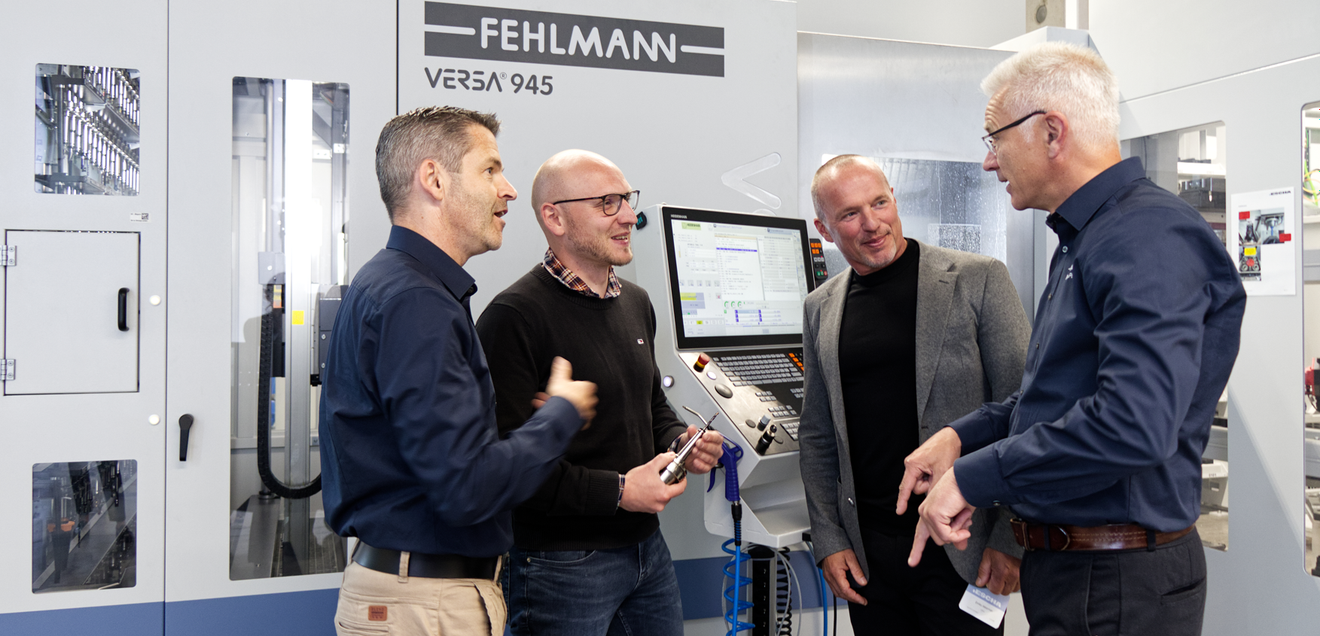
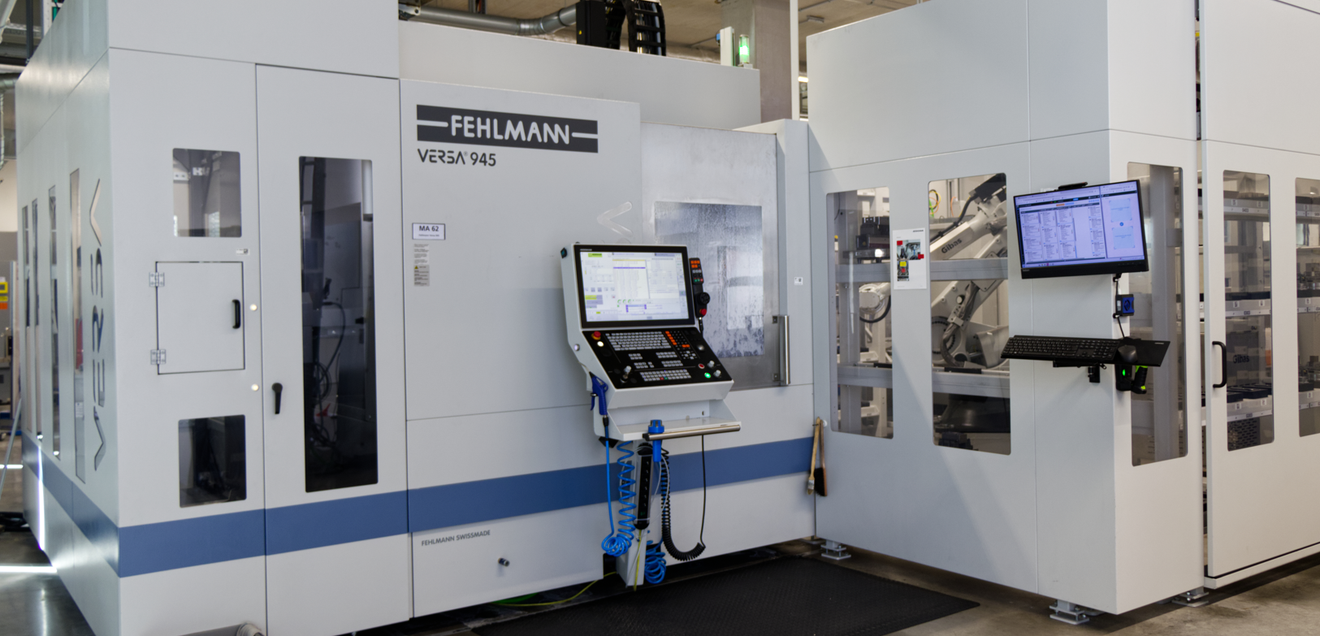
After conducting a market analysis, Escha decided to purchase the VersaVersa 945 machining center from Fehlmann.
“The Fehlmann solution had the highest degree of compliance with our requirements, at 94 percent,” explains Benjamin Unruh. “We also knew from past experience that we could rely on Fehlmann for both technology and service.”
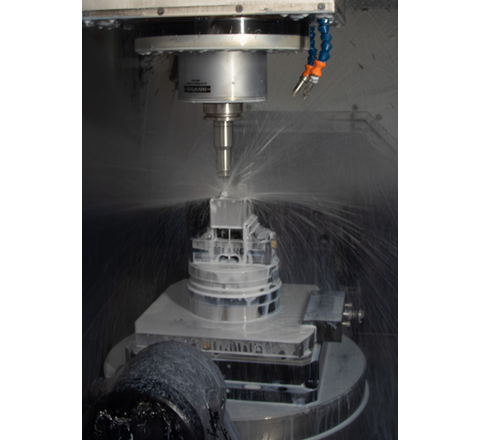
The machine combines a spindle speed of 24,000 min⁻¹ with a torque of 74 Nm, thereby covering the entire range of materials used in toolmaking. An abrasive protection package safeguards the guides during the machining of abrasive plastics. For automated operation, the machine features a tool magazine with 256 slots, an 80-bar internal cooling system, and a separate access point for automation.
“The customer doesn’t always need a racehorse,” says Alain Strebel, Sales Manager for Germany and Northern Europe at Fehlmann AG, describing the company’s machine philosophy. “Often, what they need is more like a galloper—that is, a machine that can reliably handle many different tasks.”
Flexible Automation
Fehlmann implemented the automation in collaboration with Gibas. The manufacturing cell processes the “ITS50,” “ITS148,” and “UPC320” clamping systems and is equipped with a Fanuc robot. A 2D optical code system verifies the identity and position of the pallets before each workpiece transfer.
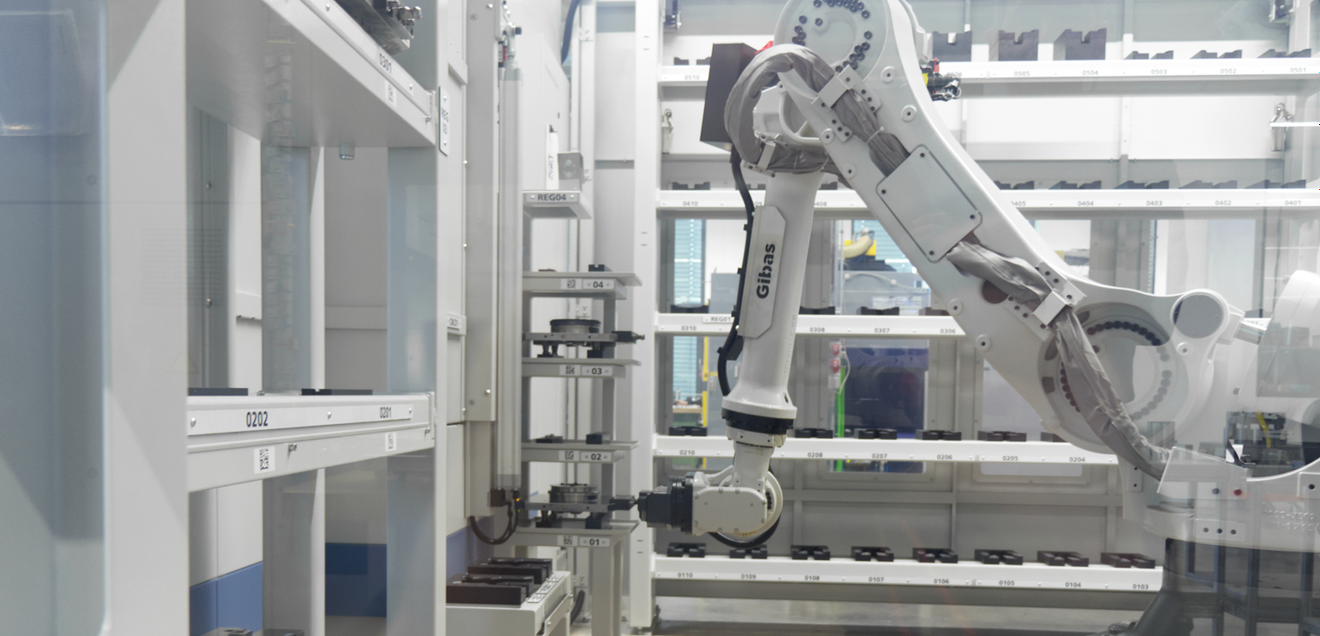
“The robot is equipped with a specialized barcode scanner and a laser sensor for presence detection. This system serves as a critical safety feature. Before each transfer to the Versa 945, the robot scans the pallet at the transfer station and verifies its identity and correct orientation,” explains Enrico Akkerman, CCO at Gibas.
The system is supplemented by a washing station that cleans tool components at ambient temperature and automatically selects the appropriate cleaning program via the MES and control system.
Digital Process Control
The "Evomecs" MES and control system handles order control, tool management, and machine scheduling. Tools are identified using 2D codes and monitored based on their service life.
“To prevent tool breakage, we used to play it safe and change tools early. Today, we make decisions based on real machine data. We know at all times which tool has been in use, how long it has been running, and how much remaining life it has. This gives us significantly more reliability and transparency throughout the entire manufacturing process,” explains Benjamin Unruh.
According to the company, productive machine uptime rose from an average of 8.75 to about 15 hours per day.
“That represents an increase of over 70 percent,” says Benjamin Unruh happily. “And the operating times are much more stable and predictable now.”
At the same time, tool breakages and scrap decreased. On-time delivery rates increased from about 55 to 88 percent.
“The processes are much more transparent and easier to plan today,” says Unruh. “This allows us to respond more flexibly to last-minute changes. And that’s how we’ve also started taking on projects from external clients.”
The rollout of the manufacturing platform was accompanied by a multi-stage training program.
“We wanted to fully involve the employees,” emphasizes Benjamin Unruh. “In my view, the high level of acceptance of the new systems is a key factor in the project’s success. After all, it is the combination of modern technology and qualified employees that enables the stable and largely autonomous production we sought to achieve with this project.”


You might also be interested in
Barcelona Declaration on Robotics and...
Robotics Associations Adopt Global Automation Strategy
The global robotics industry is stepping up its collaboration. The associations AER Automation, A3, IFR, and VDMA Robotics + Automation have formed a long-term alliance by signing the “Barcelona Declaration on Robotics and Automation 2026.” The...
 read more...
Jane Heffner is the new president of the International Federation of Robotics
Jane Heffner is the new president of the International Federation of Robotics. Adrien Brouillard has been appointed vice president of the global federation.
read more...Greater Transparency in the Robotics Market
RoboFinder Launches as an Independent Comparison Platform
Launch at Gitex Europe: 'RoboFinder' aims to bring more transparency to the professional service robotics market. In this interview, founder and CEO Brian Engels discusses market potential, challenges, and the goals of the new platform.
read more...Artificial Intelligence for the Physical Space
Alibaba Expands Qwen Model Family with a Robotics Suite for Physical AI
Alibaba is expanding its Qwen model family with a robotics suite for Physical AI. The three models—for manipulation, navigation, and simulation—are designed to assist autonomous robots with complex tasks in real-world environments.
read more...International Federation of Robotics
U.S. Robotics Industry Sees Double-Digit Growth
In the U.S., sales of industrial robots rose by 11% compared to the previous year: 38,000 units were newly installed in 2025. This significant recovery is driven by robust growth in the food industry and other non-manufacturing sectors. However, the...
read more...Development Collaboration for Humanoid Robotic Hands Launched
Schunk is entering into a new development partnership with Robert Bosch Robotics. Their shared goal is to develop an industrial-grade robotic hand that can be integrated into various humanoid robot systems.
read more...Robot-controlled packaging of rolls
Koch Robotersysteme, a company specializing in the integration of robotic systems, has developed a complete, automated packaging line for packaging rolls based on Tentoma’s RoRo StretchPack packaging machine.
read more...Highly Automated Injection Molding
Six-axis robots automate the entire handling process
From part handoff to loading and unloading the injection molding machine to quality inspection: Yaskawa six-axis robots automate the entire handling process in a highly integrated production line for safety-critical sight domes.
read more...Record funding for accelerated development of a physical AI platform
Neura Robotics has announced a Series C funding round worth up to $1.4 billion. This will help the company accelerate its mission to build the world’s leading physical AI platform.
read more...