
Manufacturing Technologies
New Resin Opens Up 3D Printing for the Optics Industry
With BMF Clear, Boston Micro Fabrication has introduced an optically transparent photopolymer resin for micro-precision 3D printing that achieves light transmittance of over 90 percent at layer heights of 10 micrometers or more and is suitable for applications in microfluidics, photonics, and medical technology.
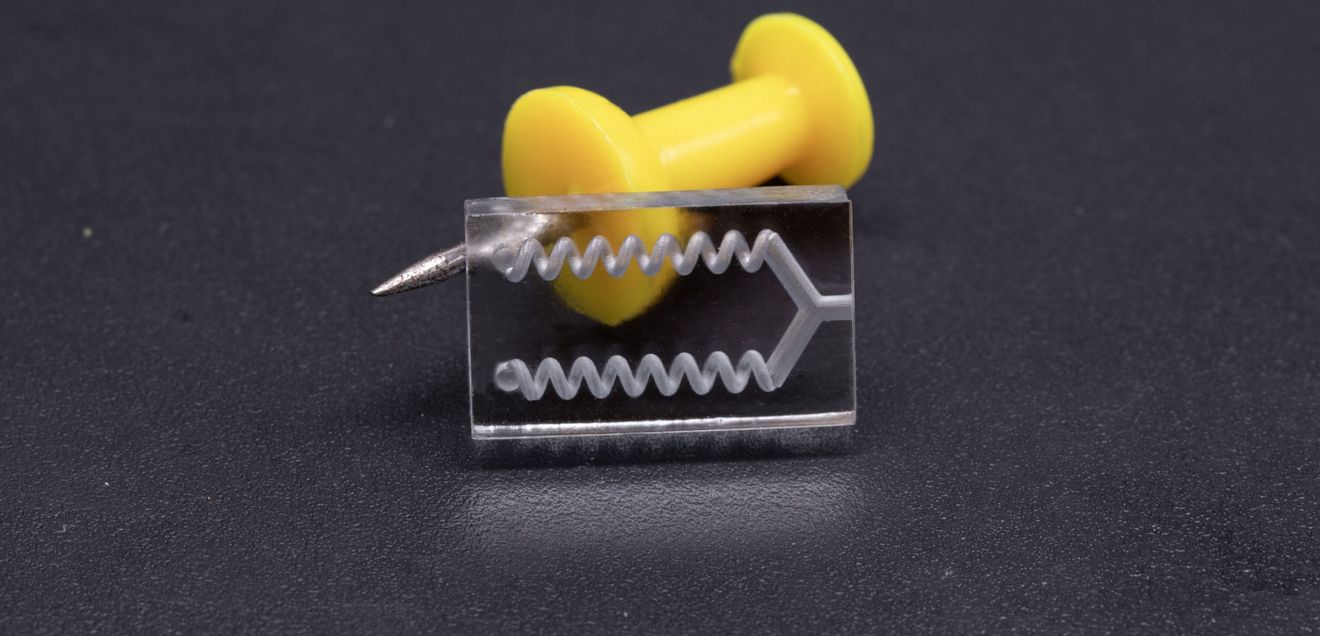
Boston Micro Fabrication (BMF) has introduced BMF Clear, a new optically transparent photopolymer resin developed specifically to meet the requirements of micro-precision 3D printing. The material is intended for applications such as microfluidics, photonics, optical components, and biomedical devices—in other words, wherever both light transmission and dimensional accuracy in the micrometer range are required.
With a light transmission of over 90 percent, BMF Clear fills a gap that has long existed in the industry: Until now, developers of transparent 3D printing materials have had to compromise either on optical quality or on print resolution. Especially at the micro level, material absorption and surface roughness regularly cause light scattering, thereby limiting the material’s applicability. BMF Clear is designed to address both issues—through an excellent surface finish that minimizes scattering and through its integration into the company’s proven projection microstereolithography (PµSL) technology.
The material is designed for BMF’s 10- and 25-micrometer systems and processes layer heights between 10 and 50 micrometers. It is compatible with the entire BMF platform, from high-end systems to the compact desktop model, the microArch S150. The high printing resolution ensures fine structures and smooth surfaces, which reduces light scattering and improves transmission through internal channels. A practical side effect: the amount of post-processing required is significantly reduced.
Overview of Areas of Application
Specifically, the material opens up new possibilities, for example, in microfluidic lab-on-a-chip systems with channels for fiber alignment, in free-form microlenses printed directly onto glass fiber tips or sensor arrays, and in integrated waveguides for sensor technology and data communication. Processes such as cell culture or the generation of high-resolution droplets benefit particularly from the precise visualization provided by optically clear, flow-permeable channels.
The material also offers potential in the fields of micro-optics and integrated photonics: fiber-to-chip couplers, complex microstructures for high-speed data communication, and imaging systems can all be manufactured in a single step using this material.
For biomedical applications, BMF Clear has also undergone rigorous biocompatibility testing, including tests for skin irritation, sensitization, and in vitro cytotoxicity. This qualifies the material for use in endoscopic systems, intraocular instruments, and minimally invasive drug delivery systems. In addition, it is suitable for optical waveguides, spectroscopy components, and integrated flow cells for UV/Vis or fluorescence analysis.


You might also be interested in
3D Printing in the Defense Sector
Formnext Launches 2026 Defense Summit
Formnext is expanding its program to include the security and defense sector and will host the first Formnext Defense Summit in 2026. The event will focus on the potential of additive manufacturing for resilient supply chains, industrial...
 read more...
UltiMaker Doubles Speed in Industrial 3D Printing
With the Factor 4 Plus, UltiMaker is introducing a new version of its industrial desktop 3D printing platform, which operates at up to twice the print speed of the standard model. The platform is designed for use in manufacturing and defense...
read more...In-house exhibition Bielefeld 2026
How DMG Mori thinks about the factory of the future
DMG Mori will be showcasing turning and milling expertise, automation solutions and additive manufacturing along the Machining Transformation (MX) at the Bielefeld 2026 in-house exhibition.
read more...Stratasys takes over MarkForged
Stratasys is acquiring MarkForged from Nano Dimension for USD 42.5 million, thereby expanding its portfolio in the field of fiber-reinforced composites. The acquisition also strengthens the company's software and materials expertise in industrial 3D...
read more...Timo Göbel, Head of BMW Additive Manufacturing
"Clearly on course for broad industrialization"
The BMW Group's Additive Manufacturing Campus (AMC) is setting the course for the next stage of industrialization. Under the leadership of Timo Göbel, additive manufacturing is being further integrated into all stages of the vehicle life cycle. In...
read more...Real-time control to make recycling materials economical
The Fraunhofer IAPT is researching AI-based closed-loop processes for industrial 3D printing with recycled plastics. The aim is to achieve less waste, greater process stability and profitable printer farms.
read more...Forum Solutions 4AMIndustry shows ways into industrial application
Additive manufacturing has developed dynamically in recent years and has long outgrown its status as a purely innovative technology in many industries. Nevertheless, companies still face the challenge of integrating AM into their production...
read more...Alliance aims to drive forward industrial 3D printing
Machine components, electrostatically shielded transport containers, large components for the automotive, rail and aviation industries or specific medical products straight from the printer - the potential applications of additive manufacturing are...
read more...Stratasys simplifies post-processing for 3D printing
Stratasys has launched a partner program for post-processing solutions to facilitate the creation of end-to-end AM workflows. The first partner is PostProcess Technologies, whose automated systems for FDM, PolyJet, SLA and P3 can now be purchased...
read more...