
Hydrogen Pipelines Put to the Test
New real-world lab tests safety and resilience
Germany is building new infrastructure. By 2032, a hydrogen backbone network with more than 9,000 kilometers of pipelines is to be established. However, a large part of this new infrastructure will not be built from scratch: Existing natural gas pipelines are to be converted and used to transport hydrogen in the future. The pipelines that currently carry natural gas could thus become a central component of tomorrow’s energy supply.
The plan is for the German hydrogen backbone network to become part of the “European Hydrogen Backbone.” This network is expected to reach a length of approximately 50,000 kilometers by 2040. The idea behind this is clear: Hydrogen is expected to play an important role in industry, energy supply, and the transition of the energy system in the future.
How secure is the hydrogen network?
But before hydrogen can flow through existing and new pipelines, many questions must be answered. This is because a network designed for natural gas cannot automatically be used for hydrogen. The issues at hand include the suitability of existing materials, the behavior of pipelines under changed operating conditions, and the safety of the entire system.
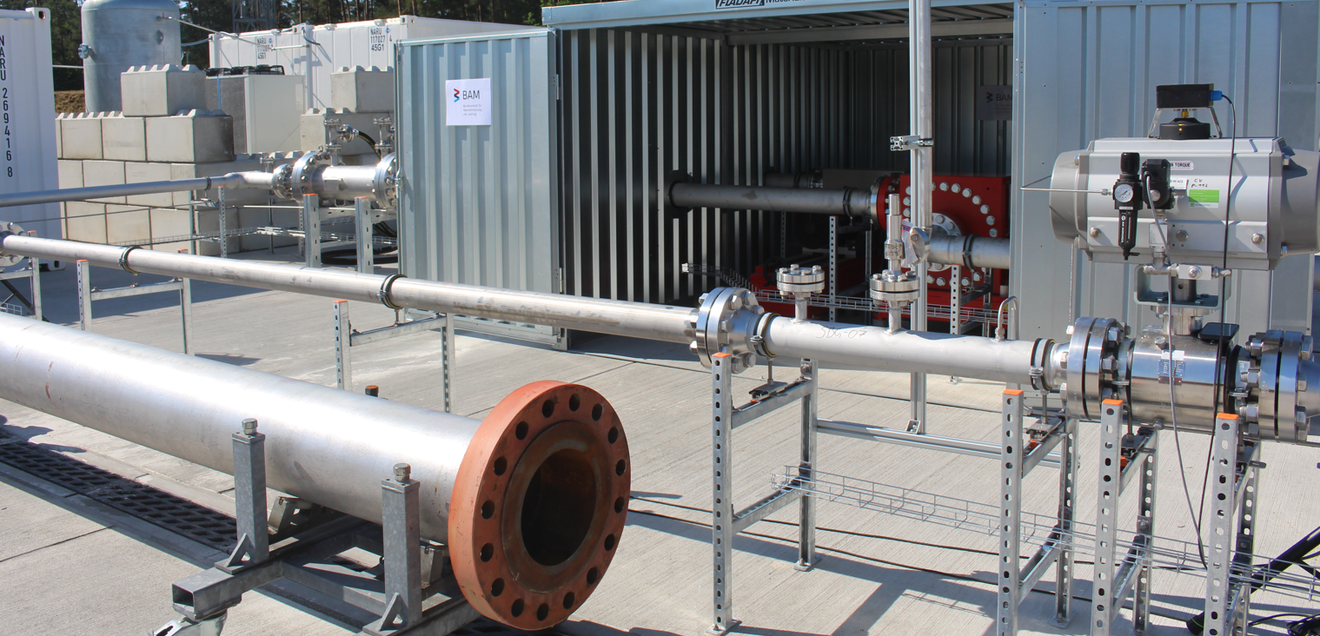
This is precisely where the new “ModuH2Pipe” test platform from the H2Safety Hydrogen Competence Center at the Federal Institute for Materials Research and Testing comes in. This “real-world laboratory”—arguably the first of its kind in Europe—creates an environment in which pipelines and their components can be tested under realistic yet extreme conditions.
The platform makes it possible to replicate the stresses that may occur during subsequent operation. For example, it can simulate significant pressure fluctuations or high flow rates. Pipelines are repeatedly subjected to pressures ranging from 10 bar to 85 bar. In this way, the startup and shutdown of a system can be simulated—a scenario that is relevant to the practical operation of hydrogen networks.
Non-destructive testing methods under real-world conditions
The quality of the transported medium can also be examined. Contaminants can be specifically added to analyze potential aging and damage processes in materials. At the same time, tests are conducted to determine whether the components used function reliably even under these conditions.
The focus is not limited to the materials themselves. ModuH2Pipe will also be used to test and validate manufacturing, welding, and repair processes. After all, a safe infrastructure depends not only on the quality of individual components, but also on how they are manufactured, joined, maintained, and repaired.
Another focus is on monitoring the equipment. Non-destructive testing methods are tested and refined under real-world conditions to enable the early detection of potential damage. The findings from these investigations will be incorporated into digital diagnostic and decision-making tools. These tools can, for example, help calculate the remaining service life of components or optimize maintenance cycles in a more targeted manner.
Tests Under Extreme Conditions: Pushing the Limits
The test platform is also used to explore the limits of performance. Components such as pipes and valves can be tested under extremely high pressures of up to 900 bar—far beyond normal operating limits. If a failure occurs during testing, the consequences can be examined in detail. The results provide important insights for further developing protective measures and safety concepts and for preventing or reducing potential damage.
At the opening of the real-world laboratory, Dr. Kai Holtappels, spokesperson for the H2Safety@BAM Hydrogen Competence Center, emphasized the importance of the new testing environment for the development of the hydrogen economy: “The testing platform is intended to become a driver of innovation for the hydrogen economy: Here, companies, grid operators, and research institutions can test new materials, components, monitoring procedures, and maintenance and repair concepts under real-world conditions. Together, we want to build confidence in hydrogen technologies and advance their widespread adoption.”
The test platform received 3.8 million euros in funding from the Federal Ministry for Economic Affairs and Energy (BMWE) as part of the federal government’s economic stimulus and crisis management package.


You might also be interested in
Research Platform for the Energy Supply of the Future
For the first time, the Karlsruhe Institute of Technology (KIT) is bringing together key hydrogen technologies in a single research environment. The facility is intended to demonstrate how the production, storage, transport, and use of hydrogen can...
 read more...
When the quantum computer arrives
The Research Race to Ensure the Security of Critical Infrastructure
How can we protect our critical infrastructure from attacks by quantum computers in the future? As part of the QUEST project, Darmstadt University of Applied Sciences is researching new methods—post-quantum cryptography—designed to withstand even...
read more...VDE study on electrical engineering
More retirements than graduations
According to a VDE analysis, more than 30,000 electrical engineers will retire by 2029 without enough graduates to replace them. This is due to falling student numbers and high drop-out rates.
read more...Giving lightweight construction a profile
Pultrusion: A process that forms fibers under tension
Pultrusion is developing from a niche process into a key process for lightweight construction and sustainable fiber composite structures. The Fraunhofer IWU shows applications from energy to mobility.
read more...Green hydrogen directly from the sun and water
A start-up project at the Karlsruhe Institute of Technology (KIT) aims to fundamentally simplify the production of green hydrogen: Mass-produced photoreactor panels are to be used to produce hydrogen directly from sunlight and water - without...
read more...Fraunhofer shows industrial future between AI, data and new materials
At Hannover Messe 2026, the Fraunhofer-Gesellschaft will be presenting solutions for a resilient industry: from AI and data rooms to hydrogen technologies and material and recycling innovations.
read more...The bottleneck is in the system
Is the transformation of the industry failing due to "German Angst"?
A recent ISF study examines what is slowing down change in German industrial companies. According to the results of the study, the causes of innovation bottlenecks often lie in internal structures and a lack of strategic orientation.
read more...Why a data-secure Germany needs joint implementation
Is 2026 a key year for a data-secure and networked Germany? Michael Fritz from the Fraunhofer Cluster CCIT explains why the coming year will be crucial for secure data spaces, common technical standards and Germany's digital future.
read more...Biodegradable label makes transportation conditions traceable
Researchers are developing a smart, compostable label that measures temperature and humidity and detects when limit values are exceeded.
read more...