
Wire Arc Additive Manufacturing
WAAM: How Additive Metal Manufacturing Is Becoming Suitable for Industrial Use
With Wire Arc Additive Manufacturing (WAAM), the focus is no longer on technical feasibility. At the third WAAMathon in Berlin, experts discussed primarily certification, standardization, and integration into industrial production processes.
Wire Arc Additive Manufacturing (WAAM) is currently one of the most productive processes in additive metal manufacturing. Instead of metal powder, metal wire is deposited layer by layer using an electric arc. The process is particularly well-suited for large components and is gaining importance in sectors such as aerospace, the energy sector, and rail transportation. At the third WAAMathon in Berlin, it became clear that the discussion surrounding the technology is shifting noticeably: The focus is no longer on technical feasibility, but rather on how WAAM can be reliably and cost-effectively integrated into industrial production processes.
About 150 experts from industry and research gathered in Berlin on June 11, 2026, for the third WAAMathon, organized by the Berlin.Industrial.Group. (B.I.G.). The presentations and discussions made it clear that many companies are now making the transition from initial demonstrators to concrete industrial applications.
“The momentum in Berlin was palpable. We’re no longer discussing ‘if,’ but rather ‘how.’ The integration of AI-supported process planning with real-world industrial applications across a wide range of industries shows that the WAAM community has moved beyond the laboratory development phase,” said Stefanie Brickwede, Mobility Goes Additive (MGA)/Head of Additive Manufacturing at Deutsche Bahn.
The bottleneck today lies in training and standardization
While the focus in recent years has primarily been on process stability, materials, and build rates, companies are now paying greater attention to the qualification and standardization of their processes.
Carl Hauser of ASTM International/Wohlers Associates pointed to differing qualification approaches, a lack of comparability between applications, and inconsistent data structures as major hurdles to industrial scaling. Carl Fruth of FIT AG made it clear that the adoption of additive manufacturing often fails not so much due to technical limitations as to a lack of trust and acceptance within companies.
Several presentations also showed that reproducible manufacturing processes begin with the raw material itself. Using titanium wires as an example, Tipro demonstrated the impact of material quality on process stability and component properties. For industrial applications, therefore, it is not only high-performance equipment that matters, but also reproducible materials, validated processes, and traceable testing criteria.
“WAAM has the potential to produce high-quality titanium-based components for the aerospace industry with a shape close to the final contour. Compared to other DED processes, WAAM stands out with significantly higher deposition rates. At the same time, the quality of the wire as the raw material plays a crucial role,” explains Terry Huang, an engineer at the Tipro Group.
AI Is Expected to Accelerate Process Development
Another key focus of the conference was the digitization of process development. Just a few years ago, the development of new WAAM processes was often based on empirical knowledge and extensive test series. In the future, artificial intelligence, simulations, and data-driven models are expected to increasingly supplement or replace this trial-and-error approach.
3D Components and Aibuild presented approaches that use AI and thermomechanical simulations to more quickly determine suitable process parameters. Siemens showcased agent-based systems and generative AI for automated process planning. Researchers from Brandenburg University of Applied Sciences and Sweden’s University West demonstrated methods for real-time monitoring of the melt bath. Despite differing approaches, these developments share a common goal: to make process knowledge digitally available and easier to transfer to new applications.
From Prototype to Industrial Application
The application examples also demonstrated just how widely WAAM has become established. The spectrum ranged from aerospace and energy and rail technology to construction and maritime applications. The focus was primarily on specific industrial challenges rather than purely theoretical proof-of-concept studies.
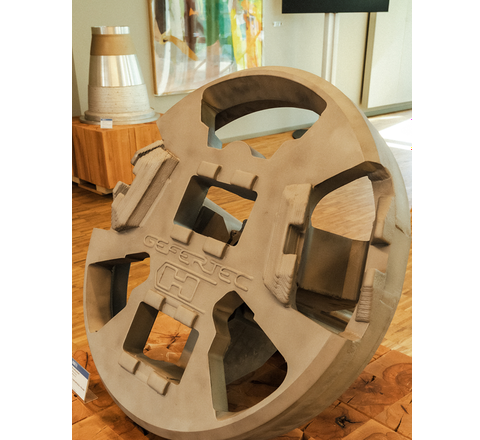
Alloy Additive reported on titanium components for aerospace applications. Guaranteed presented additively manufactured grid fins with complex geometries for rockets. Siemens Energy and GEFERTEC demonstrated the path to series production of high-load steam turbine blades. SNCF Voyageurs is working on the Additive4Rail project to qualify WAAM for the long-term supply of replacement parts in rail transport. These examples were complemented by presentations from the construction industry on material efficiency and sustainability, as well as from a European research project on architectural structures for cruise ships. Overall, the program made it clear that WAAM is now viewed as extending far beyond the traditional fields of application for additive metal manufacturing.
The focus is on the entire process chain
As industrial applications grow, the focus of development is also shifting. Many presentations no longer dealt exclusively with the actual manufacturing process, but rather with topics such as data management, simulation, material quality, qualification, and standardization. As a result, the focus is increasingly shifting to the entire process chain.
Whether it’s automated parameterization, digital process monitoring, the qualification of replacement parts, or the manufacture of safety-critical components for energy and aerospace applications—the industrial use of WAAM increasingly depends on the interaction of various disciplines. Material manufacturers, software providers, machine builders, users, and standardization organizations must work closely together to achieve this.
Uniform standards remain a key factor
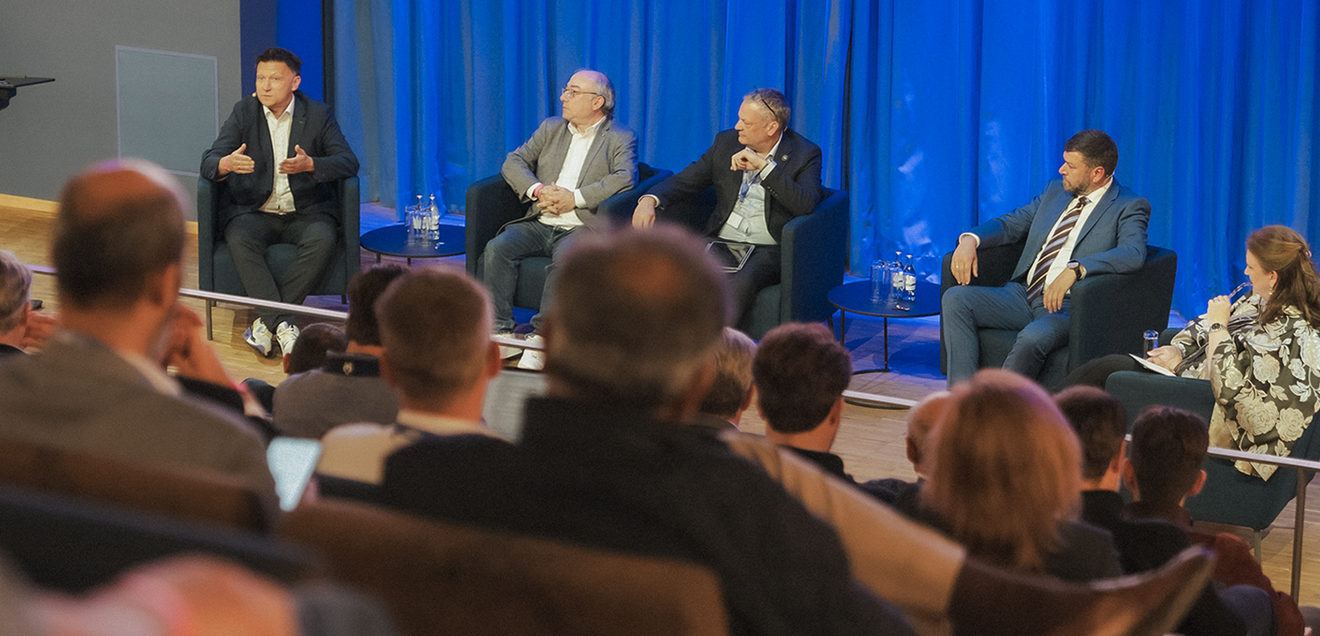
This trend was also reflected in the concluding panel discussion, “Standardization and Certification: What Else Is Needed for Scaling Up?” Moderated by Stefanie Brickwede (Mobility Goes Additive/Deutsche Bahn), representatives from KSB, Qualified AM, Siemens Energy, and ASTM International/Wohlers Associates discussed the prerequisites for broader industrial adoption.
There was agreement that harmonized standards and robust qualification processes—particularly in regulated and safety-critical industries—are prerequisites for the use of additive manufacturing processes in mass production. At the same time, the participants pointed out that existing regulations often fail to keep pace with technological developments. Accordingly, the further development of standards is a joint task for industry, research, and standardization organizations.
“The WAAMathon has now become a regular gathering for the WAAM community. The conversations during the breaks were extremely focused. You can tell that everyone here is deeply immersed in the topic and has a very clear understanding of the challenges we must tackle together as a community when it comes to industrial scaling,” said Stefan Angel, Business Development Manager for Additive Manufacturing Germany at Siemens AG.
The conference made it clear that the challenges facing WAAM are shifting. Technical feasibility is no longer the primary focus in many fields of application today. Rather, the key factor will be how the process can be integrated into existing industrial production environments using standardized processes, robust qualification, and digital tools.


You might also be interested in
Sculpture "The Thinker" in 3D metal print
The larger-than-life metal figure "The Thinker", designed by artist Moto Waganari, was exhibited at the Art Karlsruhe art fair. The sculpture was created entirely using a 3D metal printer from Berlin-based 3D metal printing experts Flying-parts.
 read more...
UltiMaker Doubles Speed in Industrial 3D Printing
With the Factor 4 Plus, UltiMaker is introducing a new version of its industrial desktop 3D printing platform, which operates at up to twice the print speed of the standard model. The platform is designed for use in manufacturing and defense...
read more...Stratasys takes over MarkForged
Stratasys is acquiring MarkForged from Nano Dimension for USD 42.5 million, thereby expanding its portfolio in the field of fiber-reinforced composites. The acquisition also strengthens the company's software and materials expertise in industrial 3D...
read more...Timo Göbel, Head of BMW Additive Manufacturing
"Clearly on course for broad industrialization"
The BMW Group's Additive Manufacturing Campus (AMC) is setting the course for the next stage of industrialization. Under the leadership of Timo Göbel, additive manufacturing is being further integrated into all stages of the vehicle life cycle. In...
read more...Forum Solutions 4AMIndustry shows ways into industrial application
Additive manufacturing has developed dynamically in recent years and has long outgrown its status as a purely innovative technology in many industries. Nevertheless, companies still face the challenge of integrating AM into their production...
read more...Alliance aims to drive forward industrial 3D printing
Machine components, electrostatically shielded transport containers, large components for the automotive, rail and aviation industries or specific medical products straight from the printer - the potential applications of additive manufacturing are...
read more...Stratasys simplifies post-processing for 3D printing
Stratasys has launched a partner program for post-processing solutions to facilitate the creation of end-to-end AM workflows. The first partner is PostProcess Technologies, whose automated systems for FDM, PolyJet, SLA and P3 can now be purchased...
read more...Formnext 2026 puts UK and key industries in the spotlight
Formnext 2026 will focus on the United Kingdom as the official partner country. At the same time, the leading trade fair for additive manufacturing is further expanding its involvement in key user industries, including orthopaedics, aerospace and...
read more...AM has arrived in the industry
Formnext 2025, which took place in Frankfurt am Main from November 18 to 21, showed just how dynamically additive manufacturing is developing. With numerous innovations and pioneering developments, the trade fair not only presented new solutions,...
read more...