
Machining
High metal removal rate for high maneuverability
Large module gears for ship drives place high demands on machining. Switching from skiving to 5-axis simultaneous milling with high-feed tools considerably shortens the roughing process. Process parameters and a well thought-out tool selection are crucial here.
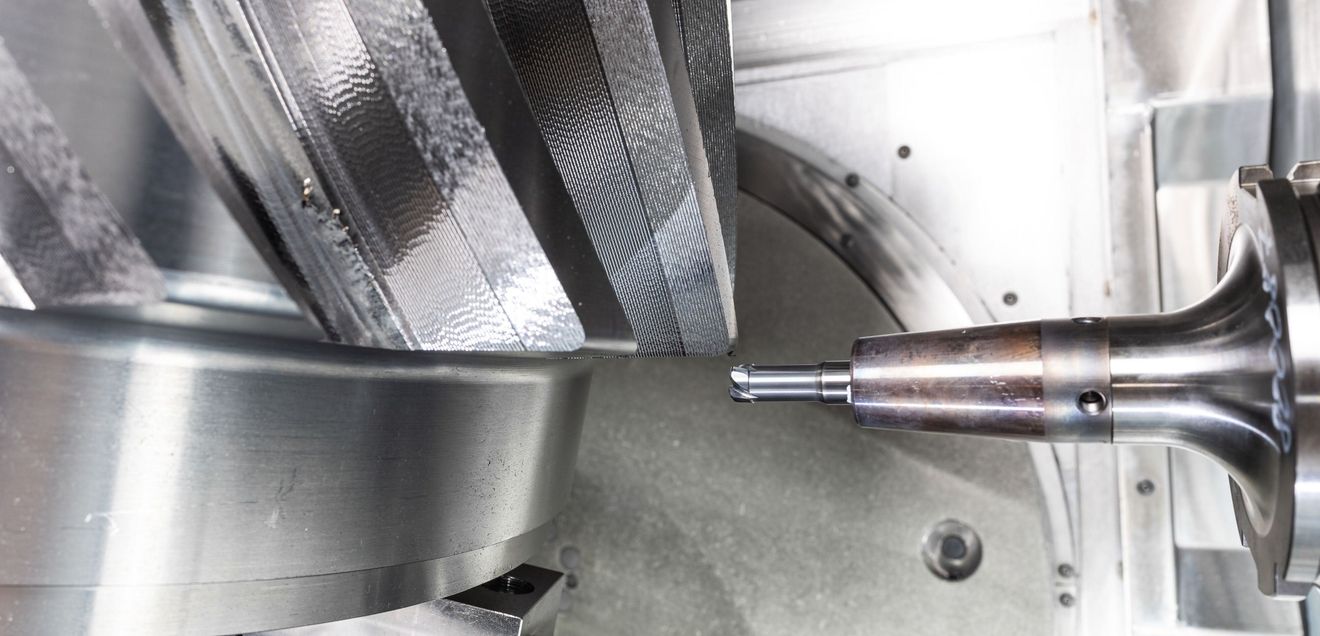
High waves, the wind storms against the port side and the spray whips across the deck. The supply ship is only a few meters away from the huge support legs of the offshore platform. The ship does not move a single meter from its position. The ship is steered with Voith-Schneider propellers. Voith has been producing this special drive in the Swabian town of Heidenheim for around 100 years. In the mechanical version, power is transmitted via enormous gearing components. The team led by process engineer Dr. Thomas Glaser uses high-feed milling systems from Paul Horn and Boehlerit to rough the gears.
Due to its design, a Voith-Schneider-Propeller (VSP) generates thrust in any direction. It is therefore propulsion and steering in one. Thanks to short response times to control commands, the VSP also enables fast, safe and precise maneuvering even under adverse conditions. This system even enables sideways movement (traversing). This drive concept is used for ships that require a high degree of maneuverability. These include, for example, harbor tugs, double-ended ferries, floating cranes and oil rig supply vessels.
Simple principle
Vertically movable and controllable blades are mounted in a wheel body. Depending on the type, the number of blades varies between four and eight. If the wheel body and the blades rotate while performing an oscillating movement, thrust is generated. The speed of the wheel body and the amplitude of the oscillation determine its force. The phase position of the blades determines the direction. The VSP works at low speeds during operation. These are only around 25 % of those of conventional ship propellers. The resulting high torques require a robust system design. The VSP is driven by diesel or electric motors.
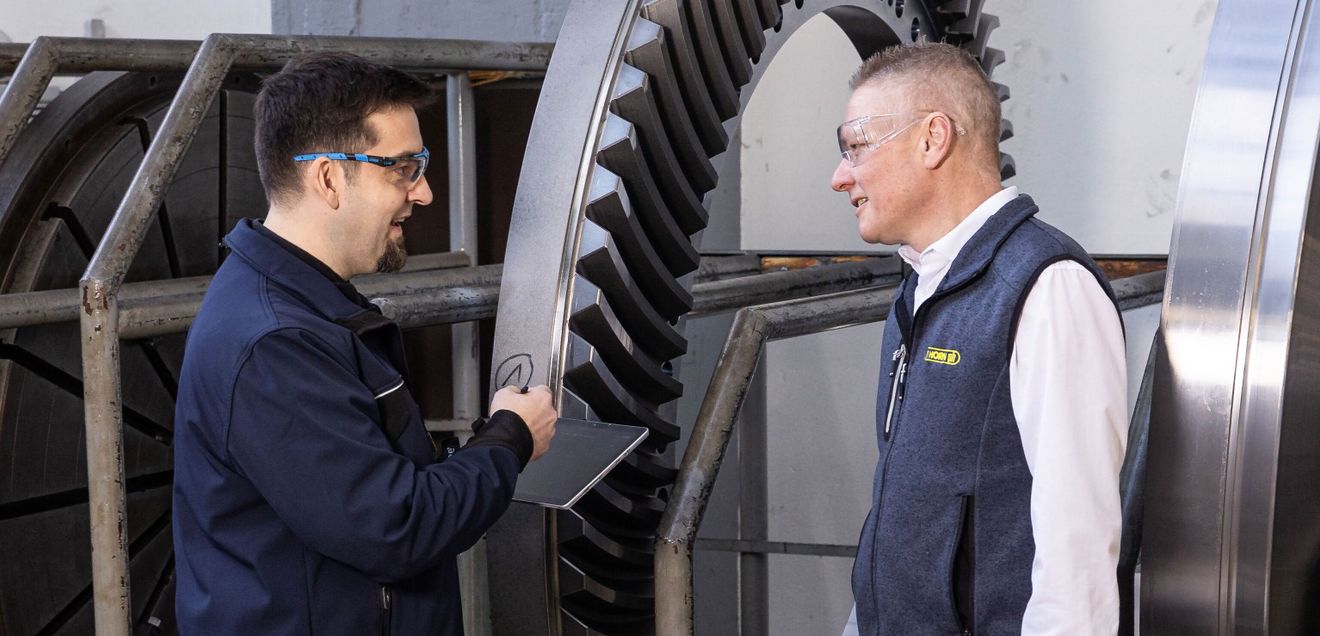
In the mechanical version, power is transmitted from the motor to the propeller via a bevel gear. The dimensions of the gearing components also depend on the size of the VSP. Due to the sometimes long machining times, Glaser is always looking for ways to optimize the machining processes. "The production of a bevel pinion with a module of 21.4 required an adjustment. We needed a very long machining time to pre-machine the pinion on a special skiving machine." The aim was to switch from skiving to 5-axis simultaneous rough milling in order to almost halve the machining time. "Another important point was the service life of the tools. We stipulated that the tool life of a tool must be at least one component," says Glaser.
High-feed milling cutters from Horn and Boehlerit
Due to the positive experience with Horn solid carbide milling cutters for hard and finish milling, the Tübingen-based tool manufacturer was the first point of contact for the milling process of the Modul 21.4 toothing. Due to the high cutting volume and the required 40% reduction in machining time, high-feed milling systems are used for roughing. Three different diameters and different milling cutter types were chosen due to the gear geometry. The first cut is performed by an indexable insert milling cutter with a diameter of 40 mm and six teeth from Boehlerit. The second cut is carried out by Horn interchangeable head cutters type DGH with four cutting edges and a cutting diameter of 20 mm. A solid carbide end mill from the DSH series with a diameter of 12 mm and also four teeth is used to rough the tooth base of the pinion.
High-feed milling cutters cut on the face side. Due to the load in the axial direction, the tool spindle is mainly subjected to pressure and the lateral forces are relatively low. Due to the low tendency to vibrate, the tools can safely absorb the high loads with the usual tooth feeds of fz = 1 mm at cutting depths ap to 1.5 mm. The large radius on the main cutting edge of the indexable inserts produces a soft cut, ensures an even distribution of the cutting forces and therefore a long tool life. On the inside, a small cutting edge radius ensures quick and easy plunging. A primary and secondary clearance angle results in a stable wedge angle and good cutting edge stability. Due to significantly higher feed rates than with conventional milling, the cutting volume is considerably higher with high-feed milling, despite the lower infeed depths.
Synergies through cooperation
The sales cooperation between Horn and Boehlerit has been in place since September 2016. The aim of this cooperation is to combine the product and sales synergies of two medium-sized companies and to grow together as family-run companies in targeted markets. For Horn, the Boehlerit milling range is a suitable addition to its own milling range. Horn is thus expanding its leading tool position in technically demanding applications to include general machining. The company will take over the distribution of Boehlerit tools for Germany.
Goal achieved
Voith relies on a new, fully automated production system from Grob for roughing the gearing. The system consists of three 5-axis machining centers with automatic linear storage and various set-up stations. By switching to the new tool concept, the machining time for pre-cutting has been reduced by 55% compared to skiving. The target of 40% was therefore exceeded. As required, the service life of the tools is one component per tool or one cutting edge for the indexable insert milling cutter. "The performance of the milling cutters has fully convinced us. But it's not just the tool solutions: The implementation of such projects also includes competent technical advice as well as a fast response and delivery time. Horn fulfills these characteristics for us as a tool partner," says Glaser.
Paul Horn, http://www.horn-group.com


You might also be interested in
Up to 50 percent higher cutting speeds
The current market situation is putting pressure on companies that rely on carbide tools: Rising raw material costs, volatile supply chains and limited predictability are putting pressure on the industry. Fette Werkzeugtechnik, a member of the LMT...
 read more...
Efficient machining of precious metals
Gold and platinum are among the most technically important precious metals. They perform important functions in industrial processes, electronics and the jewelry industry.
read more...Association of the German Turned Parts...
Turned parts industry looks cautiously to the future
Rising order intake, new members, cautious optimism: the members of the Association of the German Turned Parts Industry are confident. At the spring conference in Leipzig, around 150 participants discussed current market developments, strategic...
read more...Thinking loops in the system
Grinding is often used for high-precision component production or demanding surfaces. The combination of machine, measuring technology, expertise and tools is becoming increasingly important for this. Targeted developments for specific applications,...
read more...The bottom of the valley is no place to linger
Where the precision tool industry stands now
At the press conference of the VDMA Precision Tools Association, the precision tools industry presents the annual balance sheet for 2025: production decline, export development, shortage of raw materials and outlook for 2026.
read more...Drilling cycles optimized
A new replaceable head drill from Walter can reduce machining time in series production thanks to its patented interface and screwless design.
read more...Production, metalworking, robots
Precise 5-axis machining
The new Kern Fortis HD five-axis machining center will provide manufacturing companies with high precision requirements with a new machine from 2026.
read more...Review of the EMO Hannover 2025
About trends, innovations and sustainable production in metalworking
Almost three months after EMO Hannover 2025, we take a look at the most important innovations: smart machine tools, AI-supported assistance systems, additive manufacturing and sustainable production solutions for the industry of the future.
read more...Chip formation as the key to process...
Standardized chip breaker geometry for P and M steels
MAPAL presents standardized chip breaker geometries for unalloyed, alloyed and stainless steels. Optimum chip formation, higher process stability and reduced tool life in machining.
read more...