
The AKIMI Research Project at WZL
Agent-Based AI Aims to Simplify Robotics for Small and Medium-Sized Businesses
The AKIMI research project is developing an agent-based AI designed to significantly simplify the setup, programming, and reconfiguration of robotic systems for small and medium-sized enterprises. The goal is to make robotics more flexible and accessible without requiring in-depth programming knowledge, through natural language control and transparent AI decisions.
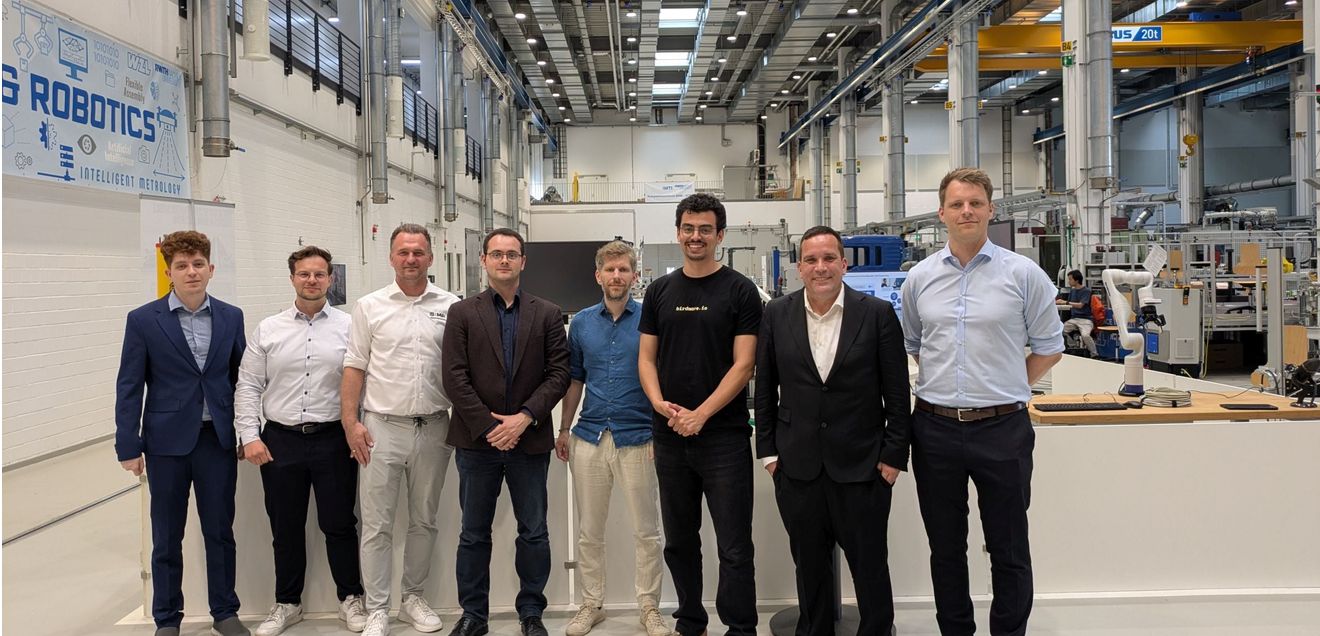
How can robotics be developed to the point where even smaller companies without their own automation experts can make use of it? Since July 2, 2026, the newly launched research project “AKIMI” has been dedicated to addressing precisely this question — “Agent-Based AI for Intuitively Reconfigurable Robotics in Small and Medium-Sized Enterprises.” The project kicked off with a kickoff meeting at the Chair of Information, Quality, and Sensor Systems in Production at the WZL Machine Tool Laboratory of RWTH Aachen University, where, together with the Institute for Business Cybernetics (IfU) and a broadly representative industry committee, the course was set for practical development.
The situation is likely familiar to many medium-sized manufacturing and logistics companies: volatile markets, shrinking batch sizes, and a noticeable shortage of skilled workers are putting them under increasing pressure. Traditional robot systems often reach their limits in this context because they require significant programming effort and offer little flexibility. This is where the AKIMI consortium aims to step in and develop a hybrid, agent-based artificial intelligence designed to significantly simplify the setup, programming, and reconfiguration of robotic systems.
A bridge between language models and physical implementation
At the heart of this is the idea of linking language models—that is, large language models—with structured domain knowledge and proven basic robotic functions. Unlike purely text-based AI applications, the system is designed to act proactively: it independently breaks down complex human instructions into comprehensible sub-steps and controls the robot’s kinematics accordingly. This would make it possible for the first time to solve assembly and logistics tasks using natural language—even for employees without programming experience. The project team places particular emphasis on the transparency and traceability of AI decisions. Since nothing can be left to chance in an industrial setting, the AKIMI system continuously verifies proposed action sequences against the laws of physics and defined safety limits.
The WZL Machine Tool Laboratory at RWTH Aachen University is contributing its expertise in intelligent assembly automation, led by the Chair of Information, Quality, and Sensor Systems in Production (WZL-IQS) under the direction of Prof. Dr.-Ing. Robert Schmitt. The institute’s own “Sense – Think – Act” framework serves as the methodological foundation: The researchers aim to integrate sensory perception, AI-supported decision-making, and robotic execution as seamlessly as possible. To ensure that the results are not merely theoretical, the developed models and software architectures will be tested on realistic demonstrators as the project progresses and applied to specific use cases of the participating industry partners.
“Small and medium-sized enterprises need flexible automation solutions that can be customized without in-depth programming knowledge. With AKIMI, we’re drastically lowering the barriers to robotics adoption: The agent-based AI acts as an intelligent assistant that translates complex tasks into understandable steps,” explains Prof. Dr.-Ing. Robert Schmitt, holder of the Chair of Information, Quality, and Sensor Systems in Production (IQS) at the WZL of RWTH Aachen University.
The AKIMI research project is funded by the Federal Ministry for Economic Affairs and Climate Action (BMWK) as part of the Joint Industrial Research (IGF) program, pursuant to a resolution of the German Bundestag. The project participants would like to express their gratitude for the support and the provision of research funding.


You might also be interested in
Eric Goos Appointed to the Board of Sumitomo Drive Technologies
Sumitomo Drive Technologies EMEIA continues to expand its leadership team: Eric Goos has been appointed to the board and will serve as managing director of Cyclo Drive Germany GmbH.
 read more...
Soft grippers for delicate foods
Irregularly shaped, fragile, and varying in size and weight: products such as potatoes, baked goods, and dairy products push mechanical grippers to their limits.
read more..."As rebar gets thicker, automation has to keep up."
Larger wire diameters, greater performance, higher efficiency: How can rebar processing machines be adapted to changing market requirements using new drive technology and an open automation architecture? A user report.
read more...Humanoid Robotics at BMW in Spartanburg
"Physical AI" combines digital AI with real machines and robots. This allows intelligent systems, such as humanoid robots, to be integrated into real-world production processes. Following the successful deployment of the Figure 02 humanoid robot at...
read more...5 Challenges for AI Projects in Manufacturing
Manufacturing companies have high hopes for AI. IFS highlights the five most common reasons why AI projects fail.
read more...From Theory to the Factory Floor
IT and OT are converging, thereby laying the foundation for the smart factory. Only through seamless data integration can AI, digital twins, and flexible production processes become a reality. Why IT/OT convergence is becoming a competitive...
read more...HIMA Is Growing Despite Challenging Markets
The HIMA Group will increase its revenue to 190.5 million euros in 2025. International business, digitalization, and partnerships are driving this growth.
read more...International Federation of Robotics
U.S. Robotics Industry Sees Double-Digit Growth
In the U.S., sales of industrial robots rose by 11% compared to the previous year: 38,000 units were newly installed in 2025. This significant recovery is driven by robust growth in the food industry and other non-manufacturing sectors. However, the...
read more...In-house exhibition Bielefeld 2026
How DMG Mori thinks about the factory of the future
DMG Mori will be showcasing turning and milling expertise, automation solutions and additive manufacturing along the Machining Transformation (MX) at the Bielefeld 2026 in-house exhibition.
read more...