
Research on Quantum Computers
A quantum computer that performs calculations using oscillations
Researchers at ETH Zurich are developing a quantum chip with mechanical memory. Instead of storing information electromagnetically, they store it in tiny vibrations. This approach could help build more powerful and compact quantum computers in the future.
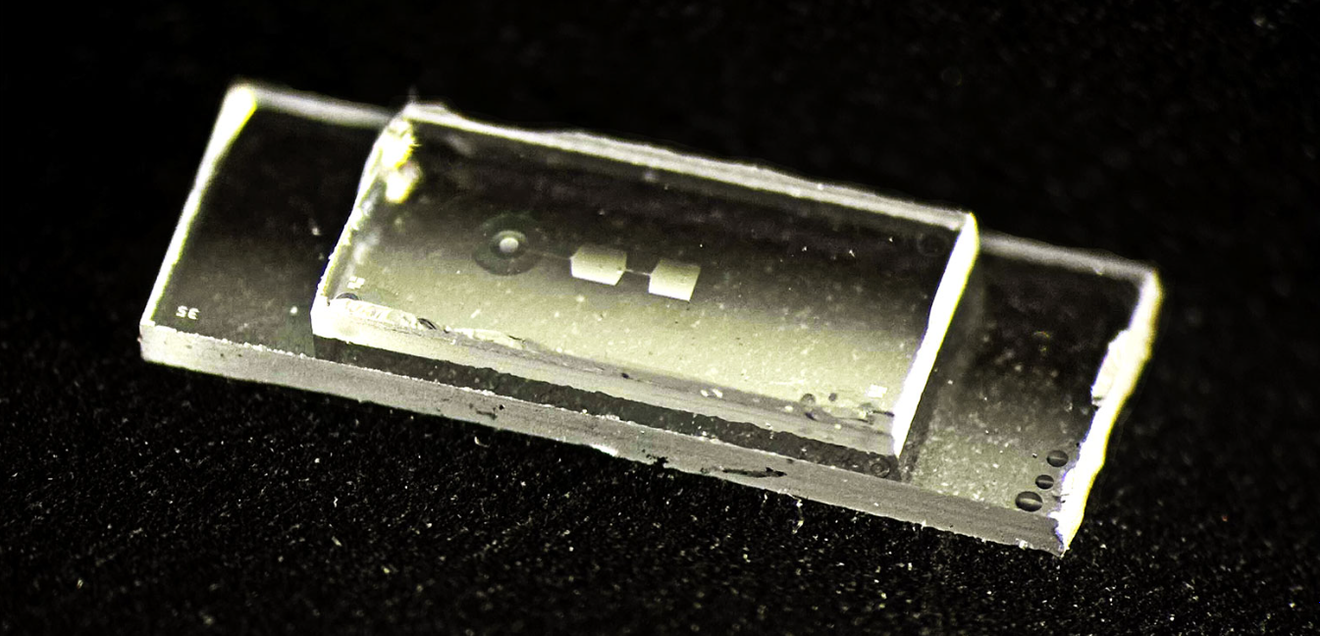
This computer works almost like a guitar. Except that no one can hear its sounds. The vibrations generated on ETH Zurich’s new quantum chip occur deep inside the component. They are not used for music, but for storing quantum information.
ETH physicist Yiwen Chu and her team have developed a new architecture for quantum computers in which information is stored in mechanical oscillations. To achieve this, the researchers connect so-called mechanical resonators to superconducting qubits, the central processing units of a quantum computer.
The new quantum chip is small
The new quantum chip is about 7.5 millimeters long, 2.5 millimeters wide, and 1 millimeter high—roughly as wide as a small fingernail. Inside, there are tiny components that begin to oscillate when storing information.
“The way the processing unit and memory interact lays a crucial foundation for establishing quantum computers as powerful and reliable tools for calculations that are not possible with conventional computers,” says Yiwen Chu.
The physics professor conducts research on quantum information and quantum computer architectures. Together with her team, she has presented an approach that separates the actual computation from storage more clearly than many previous quantum computer models.
Memory modeled after classic computers
The idea is based on the architecture of conventional computers: In such systems, a central processing unit—the processor (CPU)—processes data that is stored separately in random access memory (RAM). This separation makes it possible to process information efficiently.
Chu's quantum computer also follows this principle. A superconducting qubit serves as the computing and control unit. The information, on the other hand, is stored in a quantum memory and remains available during the computation.
The difference from previous approaches lies in the memory itself. While many quantum computers use electromagnetic memory, Chu relies on mechanical vibrations.
“In our quantum memory, however, information is not stored electromagnetically—as is usually the case today—but in the form of mechanical vibrations,” says Chu.
The qubit accesses stored information, processes it, modifies it, and then stores it back in memory.
"Specifically, our quantum chip contains what are known as mechanical resonators. These are tiny components that begin to oscillate when data is stored," says Chu.
Many types of vibrations, more memory slots
The way it works is similar to that of a guitar string. Depending on how it vibrates, it produces a different sound. Mechanical resonators can also vibrate in different ways. Experts refer to these as vibration modes.
In computer science, these modes correspond to different memory locations. Each type of oscillation can store different information. In addition, different oscillation states can arise within these modes—that is, specific states in which information is stored and retrieved.
The key difference from the guitar lies in quantum physics. The vibrations of a string follow the rules of classical physics. In a quantum chip, however, the laws of quantum mechanics apply. There, states can superimpose and become entangled with one another.
These properties fundamentally distinguish quantum computers from classical computers. Digital computers operate with two clearly distinct states: 0 or 1. Quantum computers, on the other hand, can consider multiple possibilities simultaneously. As a result, they may one day be able to solve certain complex problems much more efficiently than conventional computers.
Mechanical storage devices are smaller and more reliable
For a quantum computer to operate reliably, researchers must be able to precisely control and manipulate quantum states. The interaction between the processing unit and the memory is crucial in this regard.
In Chu's approach, the resonators store information in specific vibrational states. When the qubit retrieves information, it alters this state and then stores it back again.
To date, many quantum computer models have been combined with electromagnetic memory. This technology has been well researched and allows for precise control of quantum states. However, such memory has one drawback: it requires a relatively large amount of space.
This could hinder the development of experimental laboratory equipment into practical quantum computers for research and industry.
Mechanical resonators, on the other hand, are smaller and more compact. They can also store more information because they have many different vibration modes. In addition, the stored quantum states remain stable for longer without the vibration diminishing and information being lost.
Proof of Concept for a New Quantum Architecture
In their paper, Chu and her team demonstrate experimentally for the first time that mechanical resonators can be coupled with superconducting qubits and used for quantum computations.
The researchers have thus demonstrated that this is feasible: an oscillating memory could be an alternative to the electromagnetic memory devices used to date.
Whether this approach will prevail in the long term depends on whether it can be scaled up to larger systems. The quantum chip must continue to function reliably even if quantum computers are expected to offer significantly more computing power in the future.
The research group has already tested its architecture on more challenging tasks. These included the quantum Fourier transform and period determination—two important methods in quantum computing.
“The quantum Fourier transform is a fundamental computational method required for many quantum algorithms. The algorithm we implemented for period determination demonstrates how this method can be applied,” explains Igor Kladaric, a doctoral student on Chu’s team and co-author of the publication.
Both methods require a quantum computer to be able to precisely store, control, and interconnect many quantum states simultaneously. It is precisely this capability that the ETH researchers' approach demonstrates.
A step toward a programmable quantum computer
Yiwen Chu's system is capable of performing the basic computational steps required to carry out, in principle, any quantum computation. The team has thus demonstrated that its architecture could, in principle, serve as a freely programmable quantum computer.
However, there is still a long way to go before we have a powerful and reliable quantum computer for research and industry. The new approach from Zurich, however, points to a possible direction: Mechanical vibrations could help make quantum computers more compact and powerful in the future.
Publication:
Yang, Y., Kladarić, I., Skrabulis, M., Eichenberger, M., Marti, S., Storz, S., Esche, J., García Bellés, R., Kern, M.-E., Omahen, A., Brooks, A., Bild, M., Fadel, M., & Chu, Y. (2026). Mechanical resonator–based quantum computing. Science, 392, 972–976.DOI:10.1126/science.aef4139
Source: ETH Zurich


You might also be interested in
Hydrogen Pipelines Put to the Test
New real-world lab tests safety and resilience
The Federal Institute for Materials Research and Testing (BAM) is opening a real-world laboratory to study pipelines and components for the safe operation of future hydrogen networks.
 read more...
Research Platform for the Energy Supply of the Future
For the first time, the Karlsruhe Institute of Technology (KIT) is bringing together key hydrogen technologies in a single research environment. The facility is intended to demonstrate how the production, storage, transport, and use of hydrogen can...
read more...When the quantum computer arrives
The Research Race to Ensure the Security of Critical Infrastructure
How can we protect our critical infrastructure from attacks by quantum computers in the future? As part of the QUEST project, Darmstadt University of Applied Sciences is researching new methods—post-quantum cryptography—designed to withstand even...
read more...VDE study on electrical engineering
More retirements than graduations
According to a VDE analysis, more than 30,000 electrical engineers will retire by 2029 without enough graduates to replace them. This is due to falling student numbers and high drop-out rates.
read more...Giving lightweight construction a profile
Pultrusion: A process that forms fibers under tension
Pultrusion is developing from a niche process into a key process for lightweight construction and sustainable fiber composite structures. The Fraunhofer IWU shows applications from energy to mobility.
read more...Green hydrogen directly from the sun and water
A start-up project at the Karlsruhe Institute of Technology (KIT) aims to fundamentally simplify the production of green hydrogen: Mass-produced photoreactor panels are to be used to produce hydrogen directly from sunlight and water - without...
read more...Fraunhofer shows industrial future between AI, data and new materials
At Hannover Messe 2026, the Fraunhofer-Gesellschaft will be presenting solutions for a resilient industry: from AI and data rooms to hydrogen technologies and material and recycling innovations.
read more...The bottleneck is in the system
Is the transformation of the industry failing due to "German Angst"?
A recent ISF study examines what is slowing down change in German industrial companies. According to the results of the study, the causes of innovation bottlenecks often lie in internal structures and a lack of strategic orientation.
read more...Why a data-secure Germany needs joint implementation
Is 2026 a key year for a data-secure and networked Germany? Michael Fritz from the Fraunhofer Cluster CCIT explains why the coming year will be crucial for secure data spaces, common technical standards and Germany's digital future.
read more...