
In-house exhibition Bielefeld 2026
How DMG Mori thinks about the factory of the future
At its in-house exhibition in Bielefeld, machine tool manufacturer DMG Mori will be demonstrating how machining, automation and additive manufacturing can be combined to create integrated production systems. The focus is on the question of how companies can remain competitive in the face of growing complexity.
Industrial manufacturing is faced with a contradiction: components are becoming more complex, tolerances tighter, delivery times shorter and at the same time the pressure to produce more economically and conserve resources is increasing. For many companies, the question is therefore not so much which individual machine they need, but how entire process chains can be organized efficiently.
DMG Mori will be demonstrating what such an approach could look like at its in-house exhibition in Bielefeld from June 23 to 26, 2026. The East Westphalian plant has been regarded as the center for turning and milling technology within the Group for decades and has also developed into a competence center for automation solutions. Around 25 machines will be on display during the event. The exhibition will be complemented by seminars, workshops and the presentation of various DMQP partners, who will present solutions from the areas of tools, tool presetting and measuring technology.
The company is concerned with more than just presenting new machines. DMG Mori aims to combine different technologies into a holistic production concept. Additive manufacturing plays just as important a role in this as traditional machining processes, automation, digital networking and service offerings over the entire life cycle of a machine.
Complete processing instead of machine change
This approach is particularly evident in the field of turn-mill machining. While complex workpieces often used to require several machines and repeated clamping, modern turn-mill centers are designed to combine as many work steps as possible in a single work area.
The CTX TC and CLX TC series machines manufactured in Bielefeld are exemplary of this development. They enable 6-sided complete machining and combine turning, milling and, if required, gear cutting and grinding within one system. For users, this means above all shorter throughput times, fewer interfaces and greater process reliability.
The CLX 450 TC is the entry-level machine in this segment. For larger workpieces, DMG Mori offers the CTX gamma 3000 TC, which can machine workpiece lengths of up to 3,000 millimetres. The machine also illustrates the direction in which machine tool construction is heading: away from isolated machining steps and towards integrated manufacturing processes.
When robots supply the machine
However, even the most efficient complete machining process reaches its limits when machines have to wait for material or operating personnel. This is why automation plays a central role at the in-house exhibition.
Automated loading and unloading processes are now considered a decisive lever for high machine utilization. While the machine is producing, employees can take on tasks that cannot be automated - such as work preparation or quality control.
DMG Mori will be presenting various concepts for this. In series production, the classic bar feeder remains an important solution for continuous material supply. For smaller and medium batch sizes, however, flexible handling systems are gaining in importance.
The third generation of the Robo2Go will be on show, for the first time also as the Robo2Go Milling variant specially designed for milling machines. The portfolio is complemented by the Robo2Go Max, which can move workpieces weighing up to 210 kilograms. With the PH Cell 300, the company is also presenting a solution for automated 5-axis simultaneous machining on a DMC 75 monoBLOCK.
Another interesting aspect is that automation is no longer limited to new machines. With retrofit concepts, DMG Mori is attempting to integrate existing systems into modern production environments. For many companies, this is likely to be an economically attractive way of continuing to use existing investments and at the same time increasing the level of automation.
The connection between two worlds
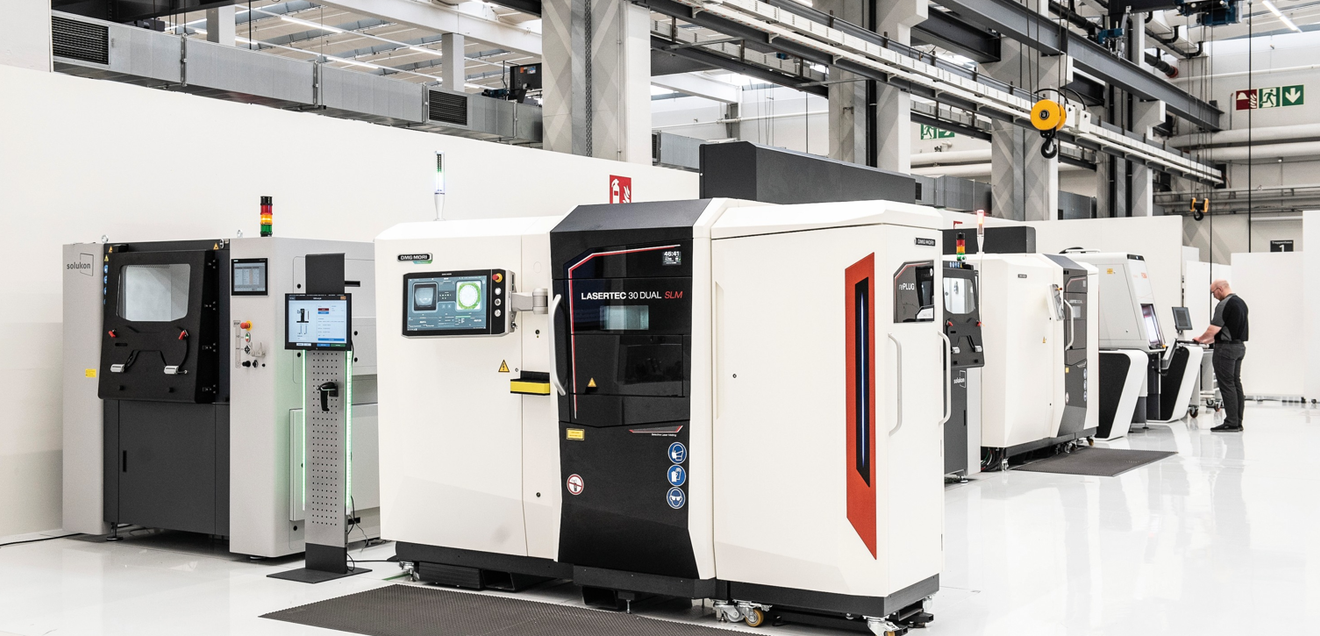
The Additive Manufacturing Precision Factory is a particular focus. DMG Mori will be demonstrating how metallic 3D printing and conventional machining can be combined.
The process begins on a LASERTEC SLM system, which builds up components using the powder bed process. This is followed by post-processing on universal machines such as the DMU 50 or the DMU 65 monoBLOCK.
This combination opens up new possibilities, particularly in industries with high demands on precision and component functionality. Additive processes enable geometries that would be difficult or impossible to produce using conventional methods. These include near-contour cooling channels in tools, for example. However, only downstream milling ensures that holes, threads and surfaces achieve the required precision.
DMG Mori therefore sees additive manufacturing not as a stand-alone technology, but as part of an end-to-end process chain. This approach is supported by the Additive Intelligence consulting unit. Here, experts analyze which components are suitable for additive processes, develop the necessary processes and test them in the Precision Factory before production starts at the customer's site.
Four pillars for the production of the future
Behind all these developments is a strategic framework that DMG Mori calls Machining Transformation (MX). The concept is based on four pillars: process integration, automation, digital transformation (DX) and green transformation (GX).
The idea behind it is simple: individual technologies only develop their greatest benefit when they are linked together. A machine alone does not make an efficient factory. Only the combination of processing, automation, data management and resource efficiency creates production systems that can react flexibly to new requirements.
In Bielefeld, the company wants to show how this idea can be implemented in practice using specific applications. Visitors will be particularly interested in the question of how productivity can be increased without increasing energy consumption and costs in equal measure.
Low entry barriers
DMG Mori is relying on its BX portfolio to make the transformation accessible to small and medium-sized companies. Machines such as the CLX 550 TC in the turning/milling area or the DMX 60 U for 5-axis machining are designed to make it comparatively easy to get started with modern manufacturing concepts.
Even in the basic configuration, the systems are designed for process-integrated and automated production sequences. Added to this are digital applications such as the CELOS X control platform or the DMG MORI technology cycles, which are designed to facilitate access to the MX ecosystem.
Ultimately, this is a development that goes far beyond individual machines. Industrial production is undergoing profound change. If you want to remain competitive in the future, you need to network processes, use automation intelligently and integrate new production technologies in a meaningful way. The in-house exhibition in Bielefeld therefore sees itself less as a product show and more as a look at the factory of tomorrow.


You might also be interested in
New Trade Show for the Turned Parts Industry
The Association of the German Turned Parts Industry has given a positive assessment of the first Make-to-Order (MTO) Days: With 184 exhibitors and approximately 1,400 trade visitors, the inaugural event proved to be a successful platform for...
 read more...
Association of the German Turned Parts...
Turned parts industry looks cautiously to the future
Rising order intake, new members, cautious optimism: the members of the Association of the German Turned Parts Industry are confident. At the spring conference in Leipzig, around 150 participants discussed current market developments, strategic...
read more...World premieres at the EMO 2025
From September 22 to 26, 2025, Grob will be presenting several innovations at EMO Hannover. The focus of the trade fair appearance will be on the latest 4- and 5-axis universal machining centers and the associated automation solutions.
read more...Efficient complete machining
Index-Werke will be bringing the Index G220 turn-mill center and the Traub TNA400 universal lathe to Intec.
read more...Digitization of process chains
CAM system Hypermill in practice
At EMO 2023, Open Mind will focus on turning, milling and the importance of CAM software and MES in networked production environments.
read more...High-speed spindle in handbag format
Modules for milling and turning
At Weiss, the focus is on the new 1.5 kilogram micro-mill spindle, which rotates at up to 60,000 revolutions per minute.
read more...Handling and workpiece clamping
Networked production starts with the component
Schunk is coming to Hanover with a 360-degree portfolio covering all aspects of machine tools. The focus will be on more sustainable production, connectivity and e-mobility.
read more...Stroll through the city
DMG Mori is inviting visitors to take a stroll through the city at EMO: In a specially constructed DMG Mori City, the machine tool manufacturer is concentrating on its focus topic of Machining Transformation (MX).
read more...Efficiency with digital twins
Digitalization and automation are the way to increase efficiency and flexibility in machining. The Tebis team will be presenting suitable solutions for mechanical engineering at EMO.
read more...