
Pipelines
Stauff expands locations with tube bending centers
Stauff, manufacturer of components for hydraulic lines, is investing in its own tube bending centers worldwide.
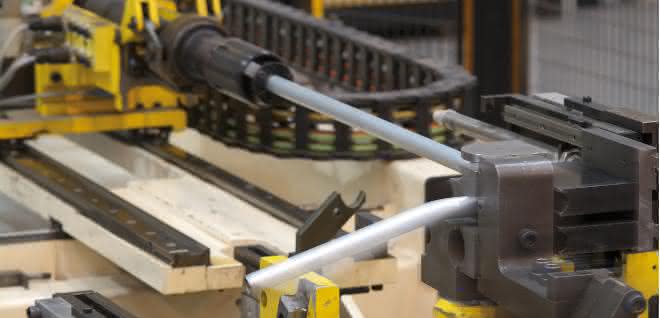
At Stauff UK in Sheffield, England, the design of complex piping systems and the processing of pipes has been part of day-to-day business for 30 years. In recent years, the subsidiaries in Russia, India and Brazil have also been equipped with high-tech pipe bending machines. The center in the United States followed in early 2019. The companies in Italy, China, Korea and Australia have also been offering the processing of pipes for years in some cases. Capacities in Russia are currently being expanded. Further production sites in Europe and Asia are being planned.
Stauff is thus further developing its concept of scalable services for hydraulic lines, Stauff Line: "By integrating ready-to-connect pipes into prefabricated assemblies in more and more countries, we are relieving OEMs of further complex steps in their manufacturing processes," says Jörg Deutz, CEO of the Stauff Group, explaining the strategy.
The tube for the Stauff-Line
The tube bending machines can bend tubes in all common materials and designs, with diameters of six to 50.8 millimetres and wall thicknesses of one to 4.5 millimetres, into highly complex shapes. Components such as nuts and cutting rings can be fitted by machine and pipe ends can be prepared for pipe connections by flanging or forming.
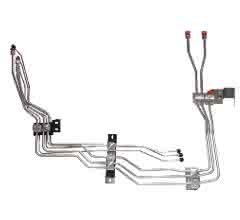
Other work steps include, for example, the welding and soldering of connecting parts with subsequent coating or surface finishing. The pre-assembly of other system components such as clamps, flanges, ball valves or manifolds - all developed and manufactured in-house - is also carried out directly at Stauff. The ready-to-assemble pipelines are combined into assemblies and modules and delivered to the machine and plant manufacturer's assembly line mounted on shadowboards or A-frames.
This reduces procurement costs and stock levels for individual components, increases efficiency and safety thanks to shorter assembly times and avoids assembly errors. as


You might also be interested in
Soldering with special gripper
In order to make the mini wave soldering of large panels stable and reproducible, Eutect developed a special gripper that prevents the panel from bending, among other things.
 read more...
Process control with traceability through soldering tips with microchips
RS has added a new 300 W manual soldering platform to its range with the WXsmart from Weller. The station combines all soldering applications in a single device and comes with a new range of intelligent soldering tips. In this way, the WXsmart...
read more...Modular system in a digital guise
Solutions for selective soldering processes
For more than 15 years, the modular system from soldering specialist Eutect has presented the entire range of modules from which the Swabian machine manufacturer develops solutions for selective soldering processes.
read more...Cobot-supported automation for everyone
TQ has been offering industry-proven robotics solutions for years. Together with the collaborative robots from Franka Emika, powerful robot-supported automation tools are created for industry, trade and much more.
read more...New thermode systems
ATN Automatisierungstechnik Niemeier has been representing Avio thermode systems in Germany since the beginning of the year and will be presenting them at Motek.
read more...The intelligent node
SMEs make a significant contribution to economic output and secure Germany as a business location. To ensure that this remains the case, it is necessary to invest in clever and sustainable automation approaches, especially in the manufacturing...
read more...Mobile filter system for flexible use
ULT has introduced the new LRA 160.1 device variant, a mobile and flexible solution for removing small to medium quantities of soldering fumes.
read more...Air extraction at the workplace
The air is clean
During the repair of faulty automotive electronics, pollutants are released during the processing and soldering of the assemblies. With an air extraction system, a repair store protects its employees from the escaping air pollutants in the long term.
read more...Stauff expands international locations
Stauff invests in its own pipe bending centers worldwide. In Sheffield, England, the design of complex piping systems and the processing of pipes has been part of day-to-day business for 30 years.
read more...