
Embedded PCs
The intelligent node
Small and medium-sized enterprises make a significant contribution to our economic performance and secure Germany as a business location. To ensure that this remains the case, it is necessary to invest in clever and sustainable automation approaches, especially in the manufacturing industry. The combination of collaborative robots, peripherals and embedded PCs often forms the basis for this.
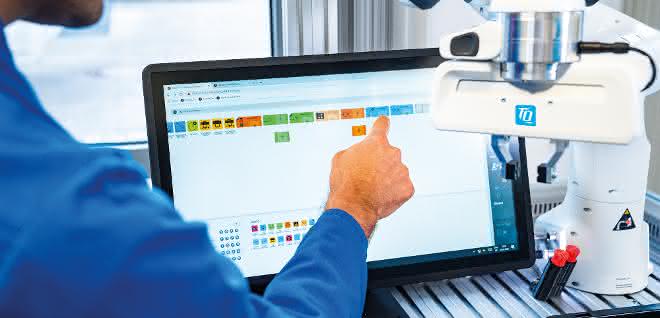
Assembly and testing of assemblies and systems are very labor-intensive and therefore have a major impact on costs and throughput times. Fully automated, PLC-controlled workflows, such as those familiar from the automotive or food industries, cannot be implemented in many cases due to the small quantities and product diversity.
The technology company TQ uses examples to show how automation and smart manufacturing in the areas of production, assembly and testing can still be implemented in a targeted and efficient manner with the expertise of its own specialists and the right equipment. The aim here is to automate time-consuming processes and repetitive tasks and make them more efficient despite the extremely large product mix and wide range of batch sizes.
Data acquisition, quality assurance and traceability
To keep investment costs as low as possible, it is important to combine different functions in one device. For example, the display of production documents, the recording of production data and functions for quality inspection and logging can be combined in one PC unit. TQ uses its own embedded PCs for this purpose, which are highly fail-safe thanks to their robust design in fanless 24/7 operation, thus minimizing downtimes. Due to the long-term availability of the models, uniform hardware is always available, which minimizes the effort involved in managing the devices and creates reproducible solutions.
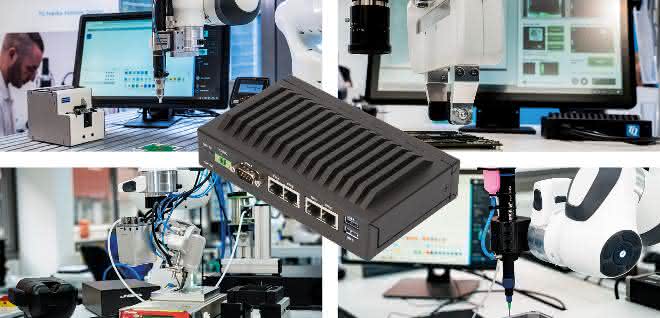
Hand-held scanners are often used to record serial numbers and product data, which offer particular handling flexibility. Alternatively, permanently installed barcode scanners can be used. If these reach their limits because they are used for very different assemblies and systems with different product labels and tags, flexible industrial cameras can be used. In this case, the camera system can also take on additional tasks such as optical inspection and object recognition for pick-and-place functions in robotics applications. All these configurations have one thing in common: they require an intelligent hub where the data converges and is processed further. Embedded PCs are ideally suited for this purpose.
Link in robotics applications
However, an embedded PC as a node can cover much more. Versions such as the TQ MBox-ADV, which is equipped with four independent Gigabit Ethernet interfaces, several USB ports, RS-232 and a high-resolution monitor interface, are also suitable for coordinating different functional units of a partially or fully automated cobot application, for example, while keeping an eye on and forwarding all data for quality assurance, material scheduling, service, process optimization and additional IoT functions such as predictive maintenance. This principle of workload consolidation, i.e. consolidating several individual tasks in one device, saves costs and also offers the option of flexibly expanding and adapting the range of functions.
Practical applications can be seen, for example, in the areas of screwing, gluing and dispensing, soldering and material handling. Robotics solutions that TQ uses itself and also offers to other companies as ready-made solution packages show which essential tasks can be usefully performed by the embedded PC. For pick-and-place and optical inspection, the embedded PC uses a camera to determine the coordinates of workpieces and at the same time to record serial numbers and perform quality control and documentation.
If necessary, the cobot can sort out faulty assemblies. Another example is the intelligent monitoring of soldering processes with the help of an embedded PC. It is easy to implement and verifies contact time, soldering tip temperature and solder wire feed. The data obtained can also be used to carry out AI-supported process optimizations.
Torque monitoring and quality recording are elementary requirements for screwdriving. Here, the embedded PC plays an important role in automated quality assurance and can warn of deviations and request immediate countermeasures. The embedded PC also ensures precise control of all process-relevant dispensing parameters during gluing and dispensing. It also monitors fill levels and can minimize downtimes by providing early feedback.
In all applications, the embedded PC can also be used simultaneously to teach the cobot and to connect to the ERP system. Service and IoT services are also provided. To ensure that all of the above solutions can also be used in combination at a workstation, the TQ MBox-ADV in the "Robotic" version already has numerous pre-installed software functions that can be used flexibly.
Harald Maier, Business Development Manager x86 / IoT, TQ-Systems / am


You might also be interested in
ebm-papst is growing again thanks to AI and data centers
ebm-papst returned to a growth trajectory in fiscal year 2025/26. Air Technology, data center applications, and artificial intelligence are driving revenue and investment.
 read more...
SPE on the Verge of a Market Breakthrough
Single Pair Ethernet (SPE) has moved beyond the conceptual phase and is increasingly being implemented in industrial settings. The focus here is not only on higher data rates and simplified cabling, but above all on the issue of system integration...
read more...More than 900 exhibitors already registered
Around six months before the start of the trade fair, more than 900 companies have registered for SPS 2026 in Nuremberg. The trade fair focuses on industrial AI, cyber security and digital transformation.
read more...Virtual PLCs in practice: How vPLCs make production systems more flexible and scalable
The increasing networking of IT and OT is fundamentally changing industrial automation. The IT/OT Integration Summit shows how modern technologies can make production environments more efficient, flexible and future-proof. The event will focus on...
read more...Sales growth in a turbulent market environment
Thanks to innovations and a focus on strategic industrial markets, Sick was able to moderately increase its sales in the 2025 financial year. In a turbulent market environment, the company was able to maintain its position and gain market share with...
read more...Siemens presents new AI agent
Siemens is launching 'Eigen Engineering Agent', an AI for automation technology. The solution is integrated into the TIA Portal, has been tested with over 100 companies and is designed to significantly accelerate engineering processes.
read more...Schaeffler keeps sales almost stable
Schaeffler generated revenue of EUR 23.5 billion in 2025 and increased EBIT before special items to EUR 936 million. At 266 million euros, free cash flow was significantly above the prior year and forecast. Net income remained negative due to high...
read more...Advancing artificial intelligence together
Helukabel is stepping up its activities in the field of artificial intelligence and is now a member of the IPAI. The innovation and collaboration platform for companies, research facilities, institutions and administration has set itself the goal of...
read more...New impetus for ifm sales
Two new positions were filled at ifm at the start of 2026: Markus Wolf becomes Managing Director Sales Germany, Sven Quant takes over the position of Central Managing Director in the Process Sensors division within the ifm Group.
read more...