
Training and further education at Rittal
Digitalization: it all comes down to people
What does digitalization mean for the employees of a company that is converting, networking and digitalizing? For Rittal, one thing is clear: when it comes to machines, it's the people that count, and the company is investing in training and further education measures.
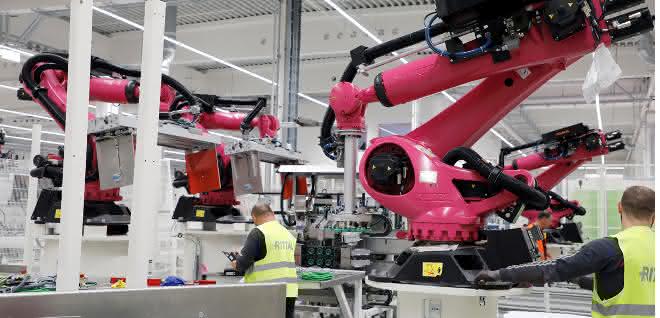
What will the working world of tomorrow look like? Full of robots and machines that produce, think and even learn independently? Almost. The Rittal plant in Haiger now has over 100 high-tech machines for manufacturing enclosures. And it is precisely here that people are important now. Why? Because every machine in the process has to be managed and continuously improved. Every production process must be monitored and punctual dispatch must be ensured. Disruptions should not occur in the first place. And if they do occur, they must be rectified quickly.
The employees at the company's own Loh Academy are also aware that networked processes, digital workflows and software tools have not necessarily been part of every Rittal employee's day-to-day work until now - and have therefore developed seminars, workshops and training courses focusing on digitalization: "Employees learn how people, machines and digital processes interact in modern production - and that they themselves are an indispensable part of this interaction," says Gero Düweke, Project Manager Qualification at the Haiger plant: "The willingness to change and the joy of learning are the best prerequisites. Many digital applications have long been familiar and taken for granted in the private sphere. You can build on this experience in a professional environment."
Specific training modules are planned for each employee, from short learning units to courses lasting several days. And afterwards? Then Rittal employees no longer work on every side of the enclosure. Instead, they control and manage not only the machines, but the entire digital production process. as


You might also be interested in
Next generation of robotics experts
Students deepen their automation expertise at Igus
Students from Nuremberg Institute of Technology Georg Simon Ohm visited the Igus plant in Cologne to deepen their knowledge of automation technology. Last July, they had already traveled to Bordeaux as Team Autonohm to take part in the 26th RoboCup...
 read more...
Competitive advantages with large machines
Whether 3D-printed components for machines and systems, prototypes or aids for design: additive manufacturing is almost indispensable for modern companies in mechanical and plant engineering and automation if they want to play in the premier league.
read more...Procentec devices now under the Anybus label
Anybus can now also perform network diagnostics
HMS Networks has assigned its network diagnostics product series, which previously bore the logo of the acquired company Procentec, to its main brand Anybus.
read more...Formnext goes full throttle at the start of the year
Formnext has made a successful start to 2023 with the best registration figures to date: by the end of February, more than 550 companies had already registered for the trade fair for AM technologies - 62 percent of them from abroad, announced...
read more...WomenPower at the Hannover Messe
With more than 1,000 participants, the WomenPower career congress kicks off on April 21 at the Convention Center on the exhibition grounds in Hanover. Deutsche Messe is organizing this important career congress for the twentieth time as part of the...
read more...Almost at pre-corona level
With over 730 exhibitors and a gross area of more than 50,000 m² booked, Formnext has already significantly exceeded last year's figures in September.
read more...Trade fair for additive manufacturing
Formnext continues to grow with more exhibitors
Formnext continues its successful development in 2022: The trade fair for additive manufacturing and modern industrial production has already reported 690 exhibitors and has thus already exceeded the final number of exhibitors from 2021.
read more...State-of-the-art workstations at the training center
The new AZTe training center for technology in Pforzheim relies on networked systems for tool and equipment allocation right from the start. And on a modern and optimal learning environment for the prospective metalworkers.
read more...Safe and ergonomic accesses from KRAUSE
There are many locations that cannot be reached with standard access solutions and where a specially adapted solution is required. Such customized accesses must be safe, standard-compliant, stable and convenient.
read more...