
Cross loops
Micrometer-precise bore machining
In the cross-grinding laboratory in Cologne, the employees of Hommel Präzision tackle the demanding challenges of µm-precise bore machining on a daily basis.
There are machining technologies that are either indispensable in terms of quality or unbeatably efficient. Sometimes both are true. Cross grinding (also known as honing) undoubtedly falls into both categories. This is because it is well known that cross grinding with typical grinding removal rates is ideal for µm-precise bore machining. In addition, Sunnen's cross-grinding machines, tools and automation solutions are the most cost-effective solution for many ultra-fine machining tasks. For example, a Sunnen cross-grinding solution is many times faster than internal cylindrical grinding, especially in unfavorable diameter/length ratios.
Another advantage of bore machining using Sunnen cross-grinding machines is the flexibility of use. This is because shrinking batch sizes and the increasing variety of parts are forcing companies to use more and more flexible machining technologies. Cross grinding is already being used in many companies where conventional turning, hard turning, drilling or internal cylindrical grinding have reached their limits.
Best options for precise results
Hommel Präzision opens up new possibilities in bore machining with Sunnen cross grinding systems. For the analysis and optimization of machining challenges and the design of manufacturing solutions, Hommel Präzision has a well-equipped cross-grinding laboratory in which all standard Sunnen horizontal and vertical machines with machining diameters from 1.5 mm to 203 mm are available. The application and sales technicians use these on a daily basis for machining tests, training and machine demonstrations.
Due to ever increasing customer requirements for components, production tolerances are becoming ever tighter and the demands on the surface structures of components ever greater.
Whereas in the past onlyRa or Rz values were in demand, today more and more applications with plateau surfaces are required, for example.
Presenting customers with machining solutions for high-precision components requires the expertise of specialists. These machining tests and demonstrations are always carried out in the cross-grinding laboratory using the customer's own components, thus providing direct proof that the Sunnen machines achieve the best results for the respective application.
Those who manufacture precisely must also control precisely
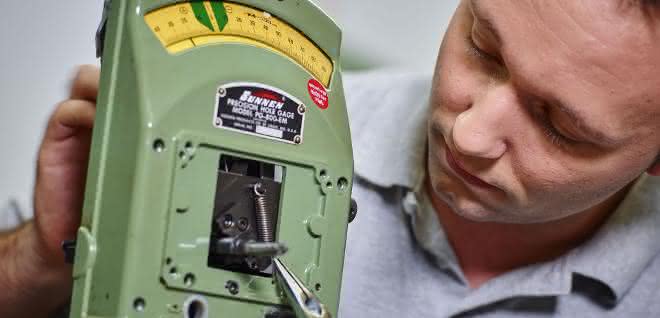
In addition to the cross-grinding machines, the employees have high-precision Sunnen bore gauges at their disposal, with which the test components can be measured directly on the machine in the diameter range from 1.7 mm to 304 mm.
Depending on the requirements, the test components are measured in the measuring room on the in-house form tester. This allows, for example, cylindrical shape, parallelism, squareness and roundness to be determined with µm accuracy. In addition, all common roughness parameters can be determined on the modern surface measuring device.
Professional maintenance and repair of measuring devices
Accurate production requires precise measurement of components. To ensure this, Hommel Präzision GmbH offers its customers
offers an all-round service. The measuring devices are repaired with Sunnen-specific expertise, resulting in numerous benefits for customers. In addition to cost savings due to fewer rejects in production, higher process reliability and a lower risk of failure are generated.
In addition to repairing measuring devices, Sunnen tools are also repaired to ensure that customers can always achieve maximum cutting performance with their tools.
After a thorough damage assessment and documentation of the actual condition of the measuring devices/tools on a service control card, they are completely dismantled, cleaned in an ultrasonic bath, defective components are replaced, reassembled and then thoroughly checked.
The inspection results are presented in measuring equipment control cards. Only when the measuring devices/tools fully meet the requirements are they released for dispatch together with the service and measuring equipment control cards.


You might also be interested in
Customized machining solutions
Custom-fit solutions for hydraulic valve housings from Mapal
The production of valve housings is the supreme discipline in the world of fluid technology. As a technology partner, Mapal provides support and designs the optimum machining strategy in dialog with the customer.
 read more...
Producing profiles to the highest perfection
In times of an abundance of difficult framework conditions, companies in the machining industry need innovative partners and technology suppliers more than ever to help them master the special challenges they face.
read more...Hard finishing for various applications
At the first GrindingHub in Stuttgart, Gleason will be presenting hard fine machining of various applications, from gears of typical e-gears to large wind power gears, including generating grinding, profile grinding, gear honing and power skiving of...
read more...Combined deburring and handling solution
Kadia's portfolio includes a wide variety of deburring machines, most of which are designed for fully automatic operation, for example with the aid of a robot.
read more...Induction hardening for heavy-duty applications
Linear guides in industrial automation and heavy-duty applications are often exposed to high mechanical loads and must meet high requirements in terms of robustness, durability, dynamics and performance.
read more...Gripper for battery terminal smoothing machine
Everything runs smoothly here
Gripper unit for battery terminal smoothing machine. Four parallel grippers from the Zimmer Group automate a machine system for surface hardening of battery terminals.
read more...Machining gray cast iron
Gray cast iron is still very popular in automotive engineering. The reason for this is certainly its adaptability to a wide range of requirements. However, this also requires special tools for machining.
read more...Cobot on the lathe
With the UR10e CB5 6-axis cobot from Universal Robots, Hommel Maschinentechnik offers an automation solution. The UR10e CB5 was designed as a universally applicable handling support for the automation of machine tools.
read more...Automated flexible handling
For flexible workpiece handling, Hommel Unverzagt has the UX 500 5-axis machining center from Quaser in its portfolio. It has two operating sides and can be used for applications with handling robots.
read more...