
Gripper for battery terminal smoothing machine
Everything runs smoothly here
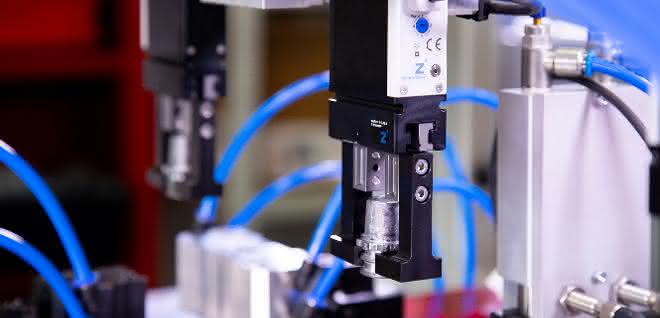
Gripper unit for battery terminal smoothing machine. Four parallel grippers from the Zimmer Group automate a machine system for surface hardening of battery terminals.
The call from faraway Russia came around lunchtime - from a small town called Novoaltaisk near the Mongolian border. The man on the other end of the line was interested in a gas-tight solution for the surface of his specially developed battery terminals, which had previously been sourced from China for the Russian market and manufactured by hand in a laborious process, recalls Ralf Löschner, founder of Wenaroll Tools and Systems. Löschner recommended the development of a roller burnishing system, as cost-intensive processes such as grinding, reaming, lapping, honing and polishing can in most cases be replaced by roller burnishing technology. The resulting surface is characterized by a high contact ratio and improved tribological properties. Following this initial discussion, a firm German-Russian partnership has now developed.
The central component of the system is four parallel grippers on an aluminum frame construction.
Wenaroll from Solingen has been a leading supplier in the field of roller burnishing technology for metallic surfaces for more than 35 years. Its core technological competence is the development and manufacture of tools and machines. Wenaroll also offers the realization of application-specific system solutions. The company's long-standing international market and customer base includes renowned companies from the fields of commercial vehicles, construction machinery, aerospace technology, mechanical engineering and the automotive industry, among others.
The extensive development project, which resulted from the German-Russian cooperation, is an automated machine system for hardening the surface of Poland. The system consists of a frame with drive unit and substructure with various roller units, a gripper unit with four grippers, a control cabinet, a feeding and sorting unit and a control panel. This so-called battery pole smoothing machine makes it possible to compact the surface of battery poles made of lead alloys by smooth rolling.
Briefly explained, the process in the system then runs as follows: The battery poles enter the machine through the feed unit. The gripper unit transports the poles to the rolling units, where the actual processing takes place. For smooth rolling, the poles are clamped and rotated. The rolling units move together and the intended surfaces are consolidated with a defined force using the roller burnishing rollers. The roller burnishing process takes place at a maximum force of 255 Newtons and at a maximum speed of 400 revolutions per minute. The result is impressive: the poles are gas-tight and have a surface with a roughness depth Rz < 1 micrometer. In addition to the gas density, the Russian customer paid particular attention to the production speed of the machine: it had to be very high, so the processing time is a maximum of eight seconds per battery pole.
One of the central components of the system are the four parallel grippers, which are mounted on an aluminum frame construction. The customer had precise ideas regarding the grippers. Electric grippers with a single-cable solution were preferred. These should have the lowest possible gripping force so as not to damage the sensitive surface of the lead battery pole. The gripping process was not allowed to cause any defects in the gripped material. Another requirement was the possible use of long gripper jaws or gripper fingers. Depending on the item to be gripped, these should also be able to plunge deep into the device if necessary. High torques occurring in the gripper are optimally absorbed by the long jaw guides. This is made possible by a parallel offset arrangement of the gripper jaws, which also allows long guide lengths in a compact installation space. Furthermore, the grippers should be able to accurately grip different material thicknesses or sizes.
The grippers have a mechanical self-locking mechanism that prevents loss of the battery poles in the event of a power failure.
The development team headed by Ralf Löschner opted for the gripper specialist Zimmer Group. According to the company founder, the company from Rheinau in Baden not only had the required high quality and availability, but also "the best reputation in the region". Four models from the GEP2000 series (GEP2010IO-05-A) were selected specifically for this application: electrically driven small parts grippers that are easy to control and designed for assembly tasks and, above all, the handling of small parts. For these tasks, the series offers adjustable gripping forces between 40 and 500 newtons and jaw strokes between six and 16 millimetres.
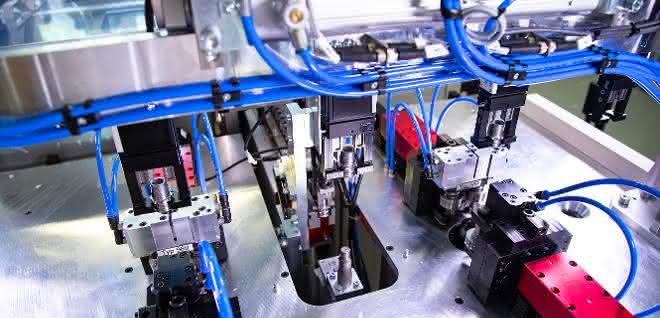
In addition, the grippers are equipped with a mechanical self-locking mechanism that prevents the loss of battery poles in the event of a power failure. Another reason why the Zimmer grippers were selected by Wenaroll is their maximum robustness and reliability. The housings are made of hard-anodized aluminium, and the developers used a flat guide that has been tried and tested for decades for the guides. This means that ten million cycles can be managed without maintenance. However, the Zimmer Group not only supplied Wenaroll with the four individual grippers, but also developed and manufactured the complete gripper unit, including the frame structure and cabling, through its own systems department.
Future considerations were also taken into account when designing the system and the grippers: The Zimmer Group's GEP2000 grippers are equipped with an integrated controller and, in the selected variant, have two digital inputs in combination with an analog output for querying the jaw positions. An integrated analog sensor outputs a voltage of between zero and ten volts depending on the jaw position. This voltage can now be evaluated via an analog card in the higher-level controller, making it possible to determine the position of the gripper jaws.
A particular challenge in the construction of the system was the development of the rolling unit. This had to perform many functions simultaneously in order to precisely smooth and compact the surface of the parts, which have a large tolerance. The finished system, which is currently under construction at Wenaroll in Solingen, has already been accepted and is now about to be shipped to Russia. G. Neumann/as


You might also be interested in
Helu makes its first trade fair appearance under a new brand name
Helu Kabel will be presenting itself as Helu for the first time at Hannover Messe 2026, showcasing system solutions, Heluchain cables and new industrial luminaires.
 read more...
Strategic realignment with brand relaunch
In future, Helukabel will trade as Helu
The Helukabel Group is parting with part of its name: in future, the company will only operate under the Helu brand. With this step, the specialist for electrical connection technology is underlining its strategic development from a classic cable...
read more...Modular plant construction for corrugated board
Insight into the production of corrugators at BHS Corrugated: Automated, modular and equipped with Helukabel components.
read more...Best quality for the steel
Conditions in the steel industry are harsh and inhospitable. The machines used must be able to withstand the demanding environmental conditions in order to deliver the best quality at all times.
read more...If the standard cable is not sufficient
Lapp offers cables for countless applications - but not for all of them. From time to time, the developers have to modify a standard cable or develop a special cable.
read more...Slight decline in sales, strong investments
The Lapp Group has not been spared from the weakening global economy. However, the company only recorded a slight loss in the past 2024 financial year.
read more...Electrical connection technology
Cables and wires for industrial automation
Heukabel offers system solutions for cable routing from a single source. The subsidiary EKD Systems specializes in tailor-made cable drag chains made of steel, stainless steel and plastic, which are used in moving machines and systems as well as in...
read more...Lapp relies on Ultramid from BASF
Mobile charging of electric vehicles
The automotive industry is currently undergoing the biggest transformation in its history. The boom in battery electric vehicles in particular is presenting the industry with major challenges. Lapp, as a supplier of cables and connection...
read more...Cable handling application
At this year's Motek, ArtiMinds Robotics is showcasing a robot-based automation solution for the sensor-assisted assembly of flexible cables in connector housings.
read more...