

Deburring
Combined deburring and handling solution
Alongside honing, mechanical deburring is the second business area of Kadia in Nürtingen. The company's portfolio includes a wide variety of deburring machines, most of which are designed for fully automatic operation, for example with the help of a robot.
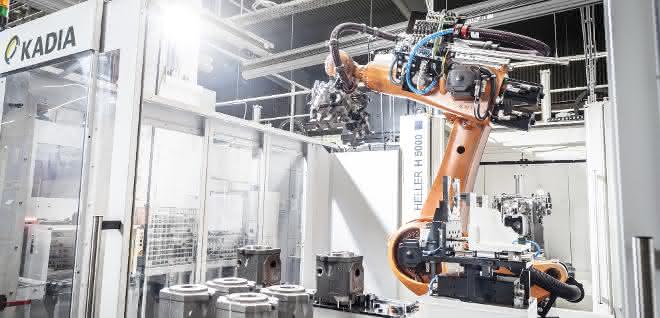
The experts from Nürtingen implemented three deburring automation cells (EAZ) at ZSO Zerspanungs- und Systemtechnik in Oberstaufen. The tasks of these systems not only include deburring the workpieces, but the robots also take over the complete handling for mechanical processing.
The market for machining technology is highly competitive. For machining service providers such as ZSO, it is therefore clear that quality, process reliability and productivity must be raised to a maximum level, and this is only possible with consistent automation of processes. ZSO has therefore invested heavily in handling systems and the networking of its machinery in recent years. Of the 35 or so processing machines currently in use, a third are already fully automated.
One of the most recent projects was particularly important for ZSO Managing Director Dr. Carsten Binder: the handling and deburring of grey cast iron casing housings for hydraulic pumps weighing up to 26 kilograms. These are, for example, pumps for hydraulic systems in construction machinery. The housings are sent directly from the foundry to ZSO, where they are manufactured ready for mechanical assembly.
In the Oberstaufen-based company's previous automation projects, much lighter workpieces had to be moved and deburred, so lightweight collaborative robots were the ideal solution. However, the pump housings are too large and too heavy for this approach. As a result, the employees moved and deburred the housings by hand - no easy task.
Manual deburring also has some disadvantages: Each hand works differently, holds the tool at a different angle and presses on the housing edges with individual force. It is particularly tedious when working on internal contours that are difficult to access. There is also a risk of slipping with the hand tool and damaging the workpiece. To get a better handle on this work, a new solution had to be found: "Our plan was to have a robot carry out all rigid, recurring processes," explains Binder. "Deburring would also be possible on the machine tool, but a robot is a far more cost-effective solution."
Machine tool and robot - a perfect team
In Kadia, ZSO finally found a partner with the appropriate expertise in the fully automatic deburring of heavy workpieces. After a short time, the design engineers in Nürtingen presented a concept that convinced the ZSO managers. It is based on a 6-axis robot with a load capacity of 120 kg and a reach of 2.5 m. Kadia's customers receive such solutions from a single source. The scope of supply includes process development, robot, cell, gripper, deburring stations and tools, including special solutions. Not forgetting, of course, the sequence programming with all safety-relevant versions. Kadia delivered its first automation cell in April 2019, a second in September and a third in January 2020.
The aim of the project was to connect the automation cells to three identical H5000 machining centers from Heller. ZSO had gradually purchased several of these 4-axis machines specifically for the pump housings, already equipped with a robot interface. The robots were to carry out the loading and unloading of the machine tools as well as deburring within the machining center cycle time, i.e. within a time window of around 20 minutes.
As two clamping operations are required, the workpiece is fed via a rotary table. The housings are clamped on fixtures specially developed by the machining specialists in Oberstaufen. All these steps also involved a lot of programming and adjustment work for the project managers at Kadia. Coordination was required with ZSO regarding the housing variants and the fixture technology, as well as with the machine and robot supplier regarding the connection of the robots to the machining center. An effort that is now paying off for the user, as machine tools and robot cells work together as perfect production units. This close cooperation between all those involved will continue in the future, for example when new workpiece variants need to be programmed.
But what do the deburring automation cells do? The most important work steps are as follows: The robot picks up two blanks one after the other and places them in the fixture for the first clamping. During machining, the gripper places two more blanks in the free fixture positions so that there are always four workpieces in the cycle at the same time. A second robot gripper is used for the second clamping operation. Before the workpieces are set down, the chips are blown off the contact surfaces with compressed air to ensure precise clamping. The machine continuously alternates between the first and second clamping.
Once the NC program for two clamping operations has been completed, the robot guides the workpieces to the deburring station. For this purpose, Kadia has equipped the cell with three or four brush deburring stations with automatic wear compensation, depending on the housing variant. Cup brushes with steel wire filaments are used for outer edges and outer surfaces, while specially manufactured square brushes with high-strength filaments are used for bores and inner contours. This means that all contours can be reached and deburred reliably.
As the cleanliness of the workpieces is an important aspect for the customer, the robot arm places the finished deburred housings in a washing basket, which it then transports out of the cell. The handling of this container had to be integrated into the automation concept as a further sequence. And that's not all: every fifth workpiece also receives a mark for quality assurance.
Complex processes, simple operation
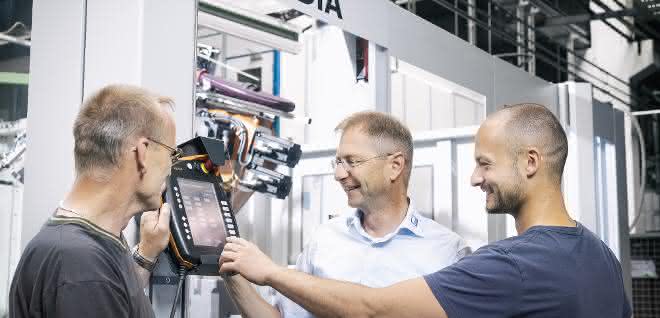
Dr. Carsten Binder lists the advantages of the concept: First and foremost is the elimination of tedious handling for employees. As a result, fewer staff are now required than before automation. Manual operation required one employee per processing machine. A three-shift operation with three machines would therefore require a total of nine operators. However, thanks to automation, one operator now looks after all three production systems (BAZ and EAZ) in parallel. Importantly, no one had to undergo extra training to become a certified robot specialist, as Kadia and ZSO had agreed to make operating the systems as simple as possible. "We included the 'home position retraction strategy' option in the concept," explains Udo Frieß, robotics and deburring expert at Kadia. "This allows the operator to return the system to the starting position at any time in the event of an interruption and restart it from there. He does not need a robot panel for this."
The ZSO Managing Director continues: "What is important for our customers is that we have been able to increase process reliability and therefore also product quality when deburring. All edges are now deburred absolutely evenly and according to customer requirements; there are no fluctuations in the finish. In addition, the robot does not miss any edges or threads. This also makes reworking a thing of the past." This also applies to process interruptions, which can never be avoided in manual operation. "Automation eliminates many scheduled and unscheduled interruptions, so our output has become more continuous and we produce more parts per unit of time," confirms Binder. Dominik Landhäußer, Sales Engineer at Kadia, adds: "We see that the output of machine tools can be increased by 30 to 50 percent with the help of deburring automation cells, depending on the workpiece and the processes to be integrated." For ZSO Managing Director Binder, it is clear that this is the way forward: "In future, we will introduce every new customer project on the basis of an automation solution."


You might also be interested in
Customized machining solutions
Custom-fit solutions for hydraulic valve housings from Mapal
The production of valve housings is the supreme discipline in the world of fluid technology. As a technology partner, Mapal provides support and designs the optimum machining strategy in dialog with the customer.
 read more...
Producing profiles to the highest perfection
In times of an abundance of difficult framework conditions, companies in the machining industry need innovative partners and technology suppliers more than ever to help them master the special challenges they face.
read more...Hard finishing for various applications
At the first GrindingHub in Stuttgart, Gleason will be presenting hard fine machining of various applications, from gears of typical e-gears to large wind power gears, including generating grinding, profile grinding, gear honing and power skiving of...
read more...Micrometer-precise bore machining
In the cross-grinding laboratory in Cologne, the employees of Hommel Präzision tackle the demanding challenges of µm-precise bore machining on a daily basis.
read more...Induction hardening for heavy-duty applications
Linear guides in industrial automation and heavy-duty applications are often exposed to high mechanical loads and must meet high requirements in terms of robustness, durability, dynamics and performance.
read more...Gripper for battery terminal smoothing machine
Everything runs smoothly here
Gripper unit for battery terminal smoothing machine. Four parallel grippers from the Zimmer Group automate a machine system for surface hardening of battery terminals.
read more...Machining gray cast iron
Gray cast iron is still very popular in automotive engineering. The reason for this is certainly its adaptability to a wide range of requirements. However, this also requires special tools for machining.
read more...Machining with the robot
Based on its experience in the construction of deburring robot cells, Kadia developed advanced solutions for general machining processes such as milling, drilling and thread cutting.
read more...Case Study: Networked Manufacturing Platform for Toolmaking
Using a networked manufacturing platform, Escha GmbH & Co. KG, a manufacturer of industrial fastening technology, has comprehensively modernized its toolmaking operations.
read more...