
Industrial robots
Machining with the robot
Based on its experience in the construction of deburring robot cells, Kadia developed advanced solutions for general machining processes such as milling, drilling and thread cutting.
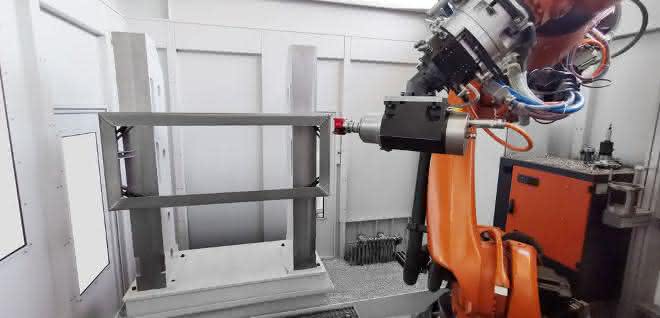
The Nürtingen-based company pursues two concepts with its "deburring robot cells": either the robot grips the workpiece and moves it to stationary tools, often brushes, or it guides the tools itself, such as milling tools. The latter case is the more demanding. One example is the deburring of large gear wheels. The term deburring is no longer entirely appropriate for this application; it is more about shaping the edges. The gear wheels are given chamfers of up to 5 mm. The tool used for this is a solid carbide end mill. The programming is complex, as the milling cutters follow the involute contour of the tooth flanks.
Deburring automation cells
A further development in recent years is "deburring automation cells", in which the robot takes on comprehensive handling tasks in addition to deburring. In this constellation, it works together with machining centers, for example. It places the components on the machine, removes them again and, if required, also acts as an interface for neighboring system parts such as quality or washing stations.
This is why the company has now added a third category of robot systems: "processing robot cells". "More and more customers are asking whether the robot can also be used to apply a thread or a flat surface, for example," explains Jannik Weiss, Sales Deburring Machines at Kadia. The customers' plan: They want to avoid reclamping processes. If the deburring robot, which often continues the process chain after mechanical processing, can relieve the other processing machines of work, a lot of time can be saved under certain circumstances.
More degrees of freedom with less effort
In principle, a 6-axis industrial robot is suitable for various machining technologies: Drilling, milling, thread cutting and a few more, and dry or wet or using minimum quantity lubrication, everything is possible. The main advantage: The robot is a comparatively cost-effective machining solution. It can easily reach all exposed sides of a cubic workpiece.
If you want to achieve the same number of degrees of freedom with a machining center, much more complex 5-axis machine concepts are required, which comes at a high cost. A robot can also alternately pick up grippers and tools, making it suitable for multifunctional scenarios.
Lower rigidity
The limitation of a robot for mechanical processing is its comparatively low rigidity. It cannot offer the repeat accuracy of precision guides that are available on a machining center. The further the arm extends, the less accurate the result. Its use is therefore limited to applications with correspondingly large tolerances and small depths of cut.
There are, however, adjusting screws that can be used to influence the results: The programming can compensate for deviations from the ideal path at the reversal points within certain limits. "Process development at Kadia determines which parameters need to be optimized and how. We take the necessary time to do this so that we can give the customer a process guarantee at the end," emphasizes Jannik Weiss.
Optimal use case
One application for which a robot is ideally suited is the machining of the parting surfaces on aluminum housing trays for vehicle batteries. These housings made from extruded profiles with crash protection structures are the successors to fuel tanks, so to speak. The quantities required are increasing rapidly. Due to the surface requirements and tolerances needed, a machining center would be oversized. A robot, on the other hand, meets the requirements for dimensional accuracy and makes full use of its cost benefits and flexibility.
The company recently developed a corresponding machining concept for a car manufacturer. The task in detail: milling the parting surfaces with subsequent brush deburring so that the frames can later be bolted and sealed with a steel cover. An important detail of the customer's requirement was flat milled surfaces with low waviness. The customer specified the quality of the surfaces with an average roughness depth Rz < 20 µm and a center roughness value Ra < 4 µm.
Three robots for the processing cell
The solution: a cell with three robots. To meet the cycle time, two robots are required on one side of the workpiece - where the machining scope is larger - and one is sufficient on the other side. The setup requires less than 80 seconds for complete machining with milling including brush deburring. In the event that a future workpiece variant with further details needs to be processed, the cell still has space for a fourth robot.
Tests carried out in advance with milling tools showed that the minimization of vibrations is the major issue when determining almost all machining parameters in robot machining. The cutting edge geometry, macro and micro geometry, for example, are important adjusting screws, as they have a decisive influence on the cutting forces.
Reduce vibrations
Among other things, the cutting depth is a key criterion, which the application engineers limited to 2 mm in order to reduce vibrations. They also optimized the cutting speeds and tooth feeds to avoid chatter marks. The cutting edges are cooled during machining by means of minimum quantity lubrication. Programmable spindle units mounted on the robot arm are responsible for realizing the cutting data. They form a 7th axis. The solution described in this way achieves Rz = 10 µm and Ra = 2 µm for the surfaces. The values required by the user are therefore undercut by a factor of 2.
At first glance, a cell with three robots is a complex system. However, operating it is easier than you might think. Weiss continues: "Any skilled metal worker who understands a technical drawing is able to operate our robot cells. Only one master point is defined for each machining detail. This is easy to correct. The approach paths and transition movements to the next feature are predefined. Every process-relevant dimension on the workpiece can be read from the drawing in plain text." This means that If a workpiece is out of tolerance, the operator can quickly and easily correct the corresponding workpiece and tool coordinates independently.


You might also be interested in
In-house exhibition Bielefeld 2026
How DMG Mori thinks about the factory of the future
DMG Mori will be showcasing turning and milling expertise, automation solutions and additive manufacturing along the Machining Transformation (MX) at the Bielefeld 2026 in-house exhibition.
 read more...
Up to 50 percent higher cutting speeds
The current market situation is putting pressure on companies that rely on carbide tools: Rising raw material costs, volatile supply chains and limited predictability are putting pressure on the industry. Fette Werkzeugtechnik, a member of the LMT...
read more...A robot for all occasions
Industrial robots take on many tasks. Even milling with accuracies in the sub-millimeter range is now possible.
read more...High metal removal rate for high maneuverability
Large module gears for ship drives place high demands on machining. Switching from skiving to 5-axis simultaneous milling with high-feed tools considerably shortens the roughing process. Process parameters and a well thought-out tool selection are...
read more...Schunk shows flexible systems for electronics production
Schunk Electronic Solutions will be exhibiting modular, flexible systems for electronics production at Productronica 2025 - from stand-alone depaneling systems to fully integrated inline solutions.
read more...Hydraulic 4-jaw chuck for automated workpiece clamping
HWR Spanntechnik presents a hydraulically actuated 4-jaw chuck for automated workpiece changing. The clamping device is designed to enable short set-up times, precise clamping and high productivity in automation.
read more...Corner, face and plunge milling
Paul Horn is expanding the DA milling system for corner, face and plunge milling. With the DA65 variant, the system offers a larger cutting insert compared to the existing DA62.
read more...World premieres at the EMO 2025
From September 22 to 26, 2025, Grob will be presenting several innovations at EMO Hannover. The focus of the trade fair appearance will be on the latest 4- and 5-axis universal machining centers and the associated automation solutions.
read more...Flexible and efficient processing
New high-performance CNC series
Fanuc's presentation at EMO will focus on the new FS500i-A CNC series. The new CNC generation offers high user-friendliness, process optimization as well as digital and network technologies.
read more...