
Locking system up to wheel drive
What drive technology is in the bike?
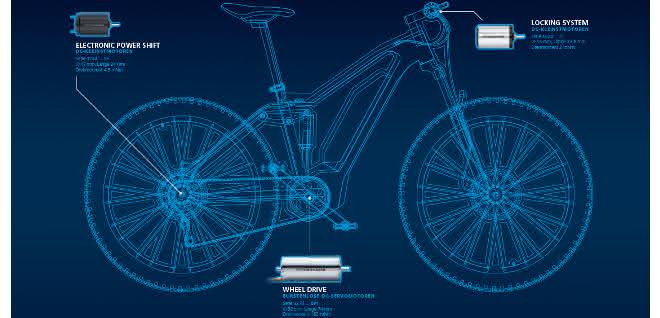
Drive technology in bicycles: Compact motors are not only the driving force in modern e-bikes, but also work in wheel locking systems, for example, or support gear shifting.

The history of the bicycle began in 1817, when Karl von Drais, a forestry official from Baden, presented his running machine. This was the first time that a steered two-wheeler was realized. Today, cycling is a natural part of the transportation culture in Germany, almost everyone can ride a bicycle and, especially in large cities, more and more people see it as aCO2-saving, sustainable and congestion-free alternative to the car.
If you want to ride a bike, you don't necessarily have to own one these days. In cities in particular, it is easy to rent a bike quickly and easily. This saves you the cost of purchase and maintenance, minimizes the risk of theft, while at the same time doing something for your health and contributing to environmental protection. Bike sharing models are also sustainable in themselves: the utilization of the bikes is significantly higher than with an individually used bike. Rental bikes travel around 10,000 kilometers a year.
Locking systems for bike sharing
Thanks to digital locking systems, bike sharing is now very convenient. Depending on the usage system, bike sharers can now rent a bike at fixed rental stations or without a station using a smartphone app. The locking systems have an electromotive locking mechanism. This is a typical area of application for Faulhaber miniature motors from the 1624 series. With a diameter of only 16 millimetres and a length of just under 24 millimetres, they deliver a torque of 2 millinewton meters. The precious metal commutated DC motors operate without cogging torque, have very low power consumption and are also lightweight. The miniature motors installed in the front fork move the bolt of the locking mechanism via a precision gearbox as soon as the bike is unlocked.
Bike sharing is now offered not only for normal bicycles, but also for pedelecs (pedal electric cycles). Pedelecs (insurance-free and license-free up to 250 watts) are bicycles that are assisted by an electric motor up to 25 kilometers per hour when the rider pedals. At speeds above 25 kilometers per hour, the motor reduces. The level of assistance can be set individually and depends on the rider's pedal force or cadence. The pedelec market in Europe is currently growing significantly, with Germany at the forefront of this development.
Compact servo motors as wheel drive
The basic function of a pedelec is easy to understand: A sensor registers that the rider is pedaling and forwards this information to the motor controller. As a control unit, the controller converts the direct current from the battery into three-phase current for the brushless motor as required. The frequency and rotating field are automatically adapted to the speed and the required motor torque. This control ensures minimum power consumption through maximum efficiency, allows smooth starting and protects both the drive mechanism and the battery.
Faulhaber motors provide the right drive for pedelecs. Because the motors from Schönaich are very small despite their performance, they can be installed so cleverly that the pedelec is not even recognizable as such from the outside. The 3274 BP 4 brushless DC servo motor in combination with a planetary gearbox is integrated into the frame, while the associated battery is "disguised" as a water bottle.
With a diameter of 32 millimetres and a length of 74 millimetres, the compact wheel drive has a continuous torque of 165 millinewton meters. At its peak, the bike could therefore support the rider with an impressive 330 watts for up to five minutes. At just under 320 grams, the motor weighs less than half as much as conventional models with comparable performance. The four-pole brushless DC servo motor is particularly suitable for applications that require high performance and dynamic start/stop operation with the lowest possible total weight, such as pedelecs.
Precise and fast shifting
Electronic shifting systems are on the rise and are increasingly being used not only in pedelecs, but also in sports bikes such as racing bikes. Integrated electronic shifting systems increase riding comfort and safety, they reduce wear and tear on shifting components and, ultimately, electronic shifting makes riding more efficient and the battery lasts longer. With these systems, the gears are no longer changed via Bowden cables, but via small servomotors. DC micromotors from the 1524 SR or 1724 SR series are typically used here. The precious metal commutated, 24 millimeter long DC motors have a diameter of just 15 or 17 millimeters and deliver torques of 2.8 or 4.5 millinewton meters.
The future of the bicycle also remains exciting, as further electronic components will change cycling. The SmartFaraday Pedal project, for example, developed by a team of students from the Faculty of Engineering at the University of Freiburg, demonstrates the direction this could take. The intelligent bicycle pedal offers a variety of functions that help cyclists track their rides, from performance and route tracking to theft notification and an interface for the internet and smartphone. The students won the Cosima Competition 2017 (Competition of Students in Microsystems Applications) with this project and also achieved an excellent second place in the international microsystems technology competition iCan. One of their main sponsors is Faulhaber. as


You might also be interested in
Source of raw materials instead of hazardous waste
With the increasing use of lithium-ion batteries in industry, for example in driverless transport systems or as an emergency power supply for control systems, the volume of used batteries is also growing - and with it the challenge of recovering...
 read more...
Intelligent clutches
In many cases, a torque transducer is oversized for measuring torque and speed. A new intelligent clutch from R+W could be an alternative: it enables measurement data to be recorded directly in the drivetrain, measurements to be taken with high...
read more...Music of the future
The Blechexpo and Schweisstec trade fair duo took place in Stuttgart at the beginning of November. Like other industries, sheet metal workers and welding technicians have mixed feelings about the future.
read more...Early warning through interactive warning vest
The interactive warning vest from Linde Material Handling protects pedestrians in storage and production areas from approaching industrial trucks at an early stage with a tactile, audible and visible warning function.
read more...When is maintenance due?
The Brady inspection timer can save lives by clearly indicating when machines, equipment and tools need to be serviced. The LED indicators are clearly visible to operators and maintenance technicians, even from a distance.
read more...For one-hand installation
Desoutter is launching a one-handed angle screwdriver for the assembly of critical screw connections. With a length of around 30 centimetres and a weight of one kilogram, the transducer-supported EABS facilitates assembly processes.
read more...Process-accurate screw connections in series production
The power tool manufacturer Fein has launched three versions of the ASM 18 mid-handle screwdriver. They are identical in shape, but differ in terms of their torque output.
read more...Getting to the clamping point
Hermos Schaltanlagen in Mistelgau works with Desoutter screwdriving tools in production. Using the ergonomic cordless screwdrivers from the Elit series, the employees tighten the sensitive connections to the exact torque specified by the customer.
read more...1,400 variants, one line
I4.0 assembly line. With an assembly line from Bosch Rexroth, SFB manufactures hydraulic valves 20 percent more productively. A digital assistance system guides the workers through the entire assembly process, reduces errors and increases...
read more...