
Cordless screwdriver
Getting to the clamping point
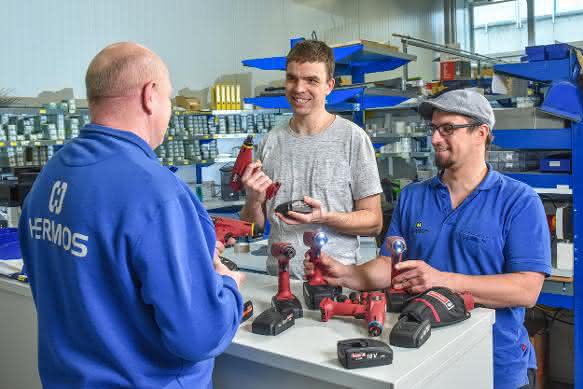
Hermos Schaltanlagen in Mistelgau works with Desoutter screwdriving tools in production. Using the ergonomic cordless screwdrivers from the Elit series, the employees tighten the sensitive connections to the exact torque specified by the customer.
"In our company, we assemble components that you can't tell how sensitive they are," explains Armin Birner as he gives a tour of the production facilities at Hermos Schaltanlagenbau in Mistelgau. Here, the company manufactures installation distributors, power distributors up to 6,300 amps, UL-certified switchgear and even complex control cabinets. Some of the switchgear is manufactured for the company's own projects, which include developing solutions for building automation and building management systems as well as IT solutions for the manufacturing and process industries.
External customers order the switchgear for mechanical and plant engineering, assembly lines in the automotive industry or robot applications. "The orders range from batch sizes of one to small series to several thousand units," says Birner. Planning brings together all the areas required for switch cabinet construction: mechanical processing including assembly, wire and cable assembly and labeling. Many work steps are automated; the assembly of the components, on the other hand, is manual work, without which the high level of flexibility would not be possible. "When it comes to tools, however, we rely on high-quality screwdriving technology from Desoutter," says Birner.
Electrical instead of mechanical connections
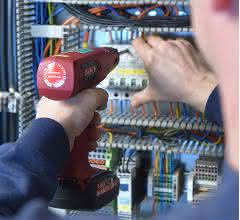
Armin Birner is responsible for process optimization in switchgear construction at Hermos. Together with his colleagues Volker Breit and Ronny Messinger, he is responsible for assembly, which employs around 180 people. "The big difference to other industries is that we don't create a purely mechanical connection between components, but an electrical connection between component and conductor," he explains. This connection has a completely different characteristic. "It's not just about whether the screw holds or doesn't hold. Soft clamping points and soft surfaces are predominant. The contact pressure must be sufficient in the long term and the contact resistance must not be too high."
There are components that are very large but require almost no torque. "If terminals are tightened too tightly, for example, the clamping point is weakened in the long term. The terminal or conductor will be damaged." If the electrical connection is too loose because it has not been tightened enough, it will either not work or, in the worst case, pose a fire hazard if the contact resistance becomes too high.
You don't have torque in your wrist
For every system that is assembled at Hermos, it is therefore precisely specified which connection must be tightened with which torque. "In terms of clamping points, we supply our customers with exactly what the component manufacturer requires." A torque of 0.5 Newton meters is "not in the wrist", as Birner emphasizes. Manual assembly with a simple screwdriver would tend to exceed the manufacturer's specifications. "That's why we prefer to rely on modern screwdriving technology."
The team quickly came to a consensus when it came to selecting them. "We tested various models from different manufacturers and then settled on the screwdriving tools from Desoutter in Maintal." The first tools purchased in 1995 were pneumatic bar screwdrivers, which Hermos still uses on the shop floor today. "If the workpieces are positioned horizontally, they are easy to assemble with the bar screwdrivers," says Volker Breit. "Finishing in the cabinet is more difficult. Because when the control cabinet goes through the final wiring phase, it is upright."
It is no easy task to operate the screw contacts cleanly with the bar screwdrivers. Hermos tried it out with compressed air angle screwdrivers from Desoutter, but these also have the handicap of air. "The operation is relatively strenuous, and I have to apply more force to put the bit on and hold it in the right position," Birner cites as disadvantages. The speed may be too high, the bit grip may not be optimal and, in the worst case, you may slip and damage components. And there is always a hose in the way.
Cordless screwdriving tools enable ergonomic working
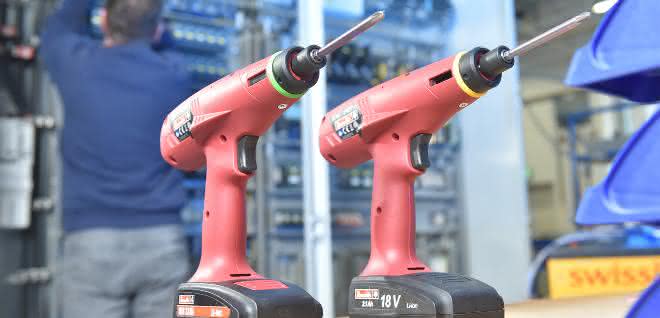
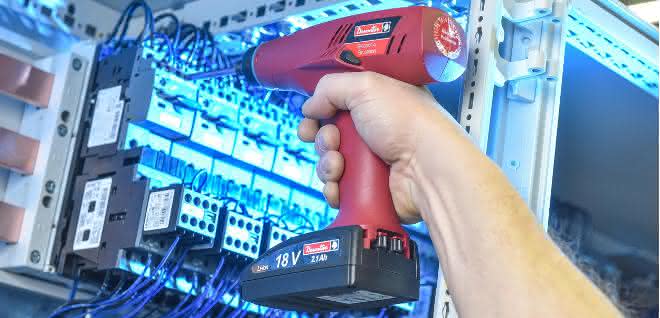
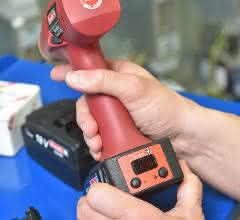
A few years ago, Hermos used the cordless screwdriving tools from Desoutter's Elit series for the first time. Since then, they have become an integral part of assembly work. The ergonomic and quiet cordless screwdrivers with pistol grip impressed the team from the very first use: "I don't have an annoying hose, the basic machine is more ergonomic, the trigger button is easier to operate, I can lock the torque setting and have the option of reducing the speed - it's a completely different way of working," Ronny Messinger and Volker Breit also assure us. For the lithium-ion batteries, two positions are also possible for optimum access to the screw connection.
Today, every switchgear assembly station is usually equipped with at least three Elit screwdriving tools. These have different torque settings to cover as many clamping points as possible. "This allows us to achieve around 80 to 90 percent of the required specified values," says Volker Breit, who adjusts the screwdrivers in the workshop. The manufacturers normally specify a tolerance range. Some components have to be screwed together with torques between one and 1.5 Newton meters, others with 0.8 to 1.2 Newton meters. "In such cases, we set a screwdriver to one Newton meter, for example, in order to meet both manufacturers' specifications," explains Breit. For special cases, appropriately adjusted screwdrivers are added. "The tools are marked accordingly with colored rings in the output - and the torque is also written on them," says Breit. "This means that mix-ups are virtually impossible."
Two thirds screwed together with Elit tools
60 Elit cordless screwdrivers are now in use at Hermos. And the trend is rising. "When we invest in tools, we only use Elit screwdrivers," the team agrees. 190 pneumatic bar nutrunners are also still regularly used to assemble horizontal components. Occasionally, they are also used for connections that require higher torques, such as switch-disconnectors, or for larger cross-sections. Over six Newton meters are also still assembled by hand with a torque wrench - this applies to around ten percent of screw connections. "From 0.4 to 6 Newton meters, we generally use the ELB and ELS pistol-grip screwdrivers from Desoutter," says Volker Breit. "That's around two thirds of all connections." With a daily output of 10,000 to 15,000 clamping points, in principle almost all cordless screwdrivers are always in production with their work groups. To ensure error-free processes, the entire production is structured in such a way that switch cabinets and systems are divided into work groups. "The same teams always serve the same customer or the same style and are therefore trained in certain work processes," explains Birner.
The tools are regularly readjusted for the upcoming tasks and handed over to the teams together with the project. "The Elit screwdrivers can be adapted as flexibly as the respective project requires," says Birner. Whether it is a matter of implementing special solutions or setting up complete project lines. Twelve of the screwdrivers are ELB models and have a fixed speed. The speed of the ELS models can also be flexibly adjusted using a corresponding module. "We process torques over 2.2 Newton meters at 900 revolutions per minute, over three Newton meters at 650 revolutions. For all lower torques, the speed usually remains at 1,150 or 1,500 revolutions per minute," says Volker Breit. The screwdriver offers the possibility of a solution approach for each individual screwdriving case. "When a project goes into series production, there are tests and evaluations to find the optimum tool parameters."
Error rate and deviations close to zero
Since Hermos has been working with the Elit screwdrivers, the quality of the screw connections has improved noticeably. There are hardly any more complaints and even positive feedback. "When working with pneumatic screwdrivers, it can happen that the bit does not grip one hundred percent due to the immediate start-up. This almost never happens with the cordless screwdriver," says Birner. The ELS screwdrivers also provide a visual signal (green = OK) when the torque has been reached.
All screwdrivers are checked annually as standard. "In the beginning, we tested the screwdrivers every six months," reports Ronny Messinger. But as the error rate and deviations were always close to zero, this interval was extended. "Of course, that's not ideal for Desoutter," smiles Armin Birner. "If the tools always work perfectly, we don't buy new ones." Maintenance and repairs are also kept to a minimum, as the screwdrivers are extremely robust thanks to the brushless motor and wear-free start button.

Depending on the customer's requirements, the joints are either spot-checked or 100% checked using a torque gauge at the time of goods issue. The serial number of the screwdriver used to tighten the joints is also recorded. "With the annual inspection of the screwdrivers, we have proof that the tools were in order at the time of use," says Ronny Messinger.
A higher degree of automation in production and documentation would be feasible for the innovative company and is also being discussed as part of the increasing requirements of some customer groups, but "we don't want to make production more complicated than we need it to be," emphasize the three Hermos employees. As it is now, they can intervene very flexibly in the continuous improvement process. "But if projects come our way in the future that make the implementation of Industry 4.0 solutions in our production seem sensible, we are always ready to do so. And we will be happy to take this step with Desoutter." as


You might also be interested in
Helu makes its first trade fair appearance under a new brand name
Helu Kabel will be presenting itself as Helu for the first time at Hannover Messe 2026, showcasing system solutions, Heluchain cables and new industrial luminaires.
 read more...
Strategic realignment with brand relaunch
In future, Helukabel will trade as Helu
The Helukabel Group is parting with part of its name: in future, the company will only operate under the Helu brand. With this step, the specialist for electrical connection technology is underlining its strategic development from a classic cable...
read more...Modular plant construction for corrugated board
Insight into the production of corrugators at BHS Corrugated: Automated, modular and equipped with Helukabel components.
read more...Best quality for the steel
Conditions in the steel industry are harsh and inhospitable. The machines used must be able to withstand the demanding environmental conditions in order to deliver the best quality at all times.
read more...If the standard cable is not sufficient
Lapp offers cables for countless applications - but not for all of them. From time to time, the developers have to modify a standard cable or develop a special cable.
read more...Slight decline in sales, strong investments
The Lapp Group has not been spared from the weakening global economy. However, the company only recorded a slight loss in the past 2024 financial year.
read more...Electrical connection technology
Cables and wires for industrial automation
Heukabel offers system solutions for cable routing from a single source. The subsidiary EKD Systems specializes in tailor-made cable drag chains made of steel, stainless steel and plastic, which are used in moving machines and systems as well as in...
read more...Lapp relies on Ultramid from BASF
Mobile charging of electric vehicles
The automotive industry is currently undergoing the biggest transformation in its history. The boom in battery electric vehicles in particular is presenting the industry with major challenges. Lapp, as a supplier of cables and connection...
read more...Cable handling application
At this year's Motek, ArtiMinds Robotics is showcasing a robot-based automation solution for the sensor-assisted assembly of flexible cables in connector housings.
read more...