
Assembly lines
1,400 variants, one line
I4.0 assembly line. With an assembly line from Bosch Rexroth, SFB manufactures hydraulic valves 20 percent more productively. A digital assistance system guides the workers through the entire assembly process, reduces errors and increases productivity. The result: greater job satisfaction, complete transparency and precise deliveries in every batch size.
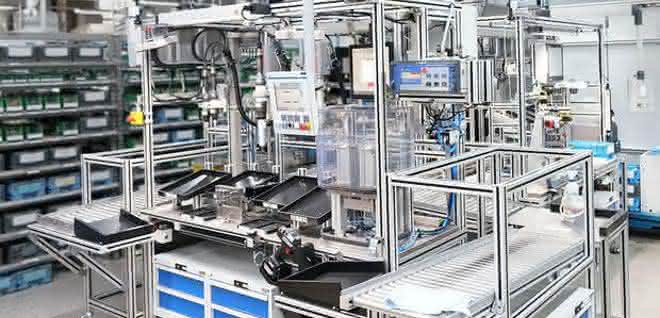
SFB from the Swabian town of Babenhausen consists of a network of technology companies that supplies complex precision parts, hydraulic valves and sophisticated mechanical assemblies worldwide. More than 1,400 variants are currently manufactured in the flush and feed valve product area. In purely mathematical terms, 65,000 different combinations can be created from the 300 individual components. Mastering this wealth of variants with the typical SFB batch sizes of 5,000 to five is a logistical challenge that the company has been facing since mid-2018 with a fully networked and highly flexible multi-product line. The main objectives of the solution developed in collaboration with Bosch Rexroth: zero errors and 20 percent more productivity with lower costs and seamless traceability. New technical solutions are designed to support the workers in the multi-variant production and complex work processes.
As there were no specifications yet, Bosch Rexroth worked out the key requirements together with SFB in an interdisciplinary project team. "We recorded the processes, mapped the variance in a material matrix and developed a customer-specific lean line design and an IT concept," says Stefan Hetzer, project manager for the concept phase at Bosch Rexroth, explaining the key milestones. Bosch Rexroth integrated a fully digital worker assistance system that guides employees stringently through the individual process steps based on timed work content and checks them. A supermarket solution optimizes the material supply. Because the assembly line is not only horizontally networked with the individual workstations, but also vertically with SFB's ERP system, the line management system (LLS) created by Rexroth can specify the exact processes for each type variant. The collected quality and life cycle data is fed back into a database for documentation and data analysis. If parts are installed incorrectly, the assistance system blocks the next work step.
Only three instead of five workstations
The automatic grouping of individual orders and process flexibility have eliminated two of the previous five workstations. Depending on the workload and product complexity, one to three workers work at the three stations of the scalable line, initially logging in using an RFID batch. At the first station, a touchscreen visualizes the order list from the ERP system. After selecting an item, a graphically illustrated parts list appears. The worker prepares the individual components and scans them. After positive matching by the LLS, the line activates the first work step: laser marking of the valve housing with a unique data matrix code.
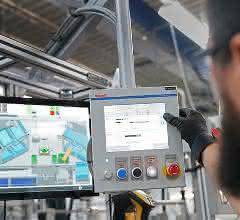
At the assembly station of workstation 1, the employee scans the DMC code of the product ID and the assistance system uses a photo or video to find out which material needs to be inserted in which position. Each assembly step is checked via two ultrasonic receivers and the process is stopped in the event of an error. In the final work step, the worker fixes the housing with the wired Rexroth Ergospin or the Nexo wireless cordless screwdriver, depending on the required torque. To document the parameters, the LLS records the torque and angle and transfers the values to a database. This stores all product and process data generated in the line for traceability purposes and provides further analysis results. The digital transfer, such as the seamless product life cycle, opens up new possibilities for SFB for efficient and reliable processes in the next stage of the value chain, right through to the customer.
Depending on the variant, the valve continues to the second or third station via a material transfer system. At station 2, the optional throttle pins are assembled using the same system as at station 1: The component scan initiates the matching, the assistance system guides the worker through the assembly process and checks the individual work steps, including the screwing of the pins. A pneumatic function test completes the optional assembly step. All valve variants are completed at station 3 - all sealing rings are inserted step by step and final assembly is controlled in a pressing station. In the next step, two vision systems check the inserted O-rings for damage and correct fit as well as the completeness of the fastening screws in the valve housing.
As the fully networked assembly line records all process parameters and clearly assigns them to the respective product, all aspects of production are fully traceable. In addition to the 20 percent increase in productivity and high process reliability, the flexibility is remarkable: "We are now able to take our customers' value chains into account even more precisely and deliver on time, regardless of the batch size," says SFB Managing Director Bruno Hanselka, summing up the importance of the i4.0 project. "We have not only significantly improved our logistics processes, but also our competitive position." pb


You might also be interested in
Source of raw materials instead of hazardous waste
With the increasing use of lithium-ion batteries in industry, for example in driverless transport systems or as an emergency power supply for control systems, the volume of used batteries is also growing - and with it the challenge of recovering...
 read more...
Intelligent clutches
In many cases, a torque transducer is oversized for measuring torque and speed. A new intelligent clutch from R+W could be an alternative: it enables measurement data to be recorded directly in the drivetrain, measurements to be taken with high...
read more...Music of the future
The Blechexpo and Schweisstec trade fair duo took place in Stuttgart at the beginning of November. Like other industries, sheet metal workers and welding technicians have mixed feelings about the future.
read more...Early warning through interactive warning vest
The interactive warning vest from Linde Material Handling protects pedestrians in storage and production areas from approaching industrial trucks at an early stage with a tactile, audible and visible warning function.
read more...When is maintenance due?
The Brady inspection timer can save lives by clearly indicating when machines, equipment and tools need to be serviced. The LED indicators are clearly visible to operators and maintenance technicians, even from a distance.
read more...For one-hand installation
Desoutter is launching a one-handed angle screwdriver for the assembly of critical screw connections. With a length of around 30 centimetres and a weight of one kilogram, the transducer-supported EABS facilitates assembly processes.
read more...Process-accurate screw connections in series production
The power tool manufacturer Fein has launched three versions of the ASM 18 mid-handle screwdriver. They are identical in shape, but differ in terms of their torque output.
read more...Getting to the clamping point
Hermos Schaltanlagen in Mistelgau works with Desoutter screwdriving tools in production. Using the ergonomic cordless screwdrivers from the Elit series, the employees tighten the sensitive connections to the exact torque specified by the customer.
read more...Inloader improves apple crate transportation
To make the material flow in its apple warehouse in Val Venosta more efficient, the Mivor fruit cooperative relies on an inloader from Hubtex. By switching from tractors to the KTR 120 box transporter, Mivor is relieving its employees and increasing...
read more...