
Research at the Intersection of Fiber Optics and Quantum Photonics
New Fiber-Optic Technology Reduces Energy Consumption in Photonic Computers
Sometimes a new technology isn’t created by a completely new material, but by a surprising application of a familiar one. Optical fibers, for example, have been the invisible lifelines of digital communication for decades. They carry light signals across continents and enable the global exchange of data. Now, scientists have developed an optical fiber whose unique property is, of all things, that part of it freezes.
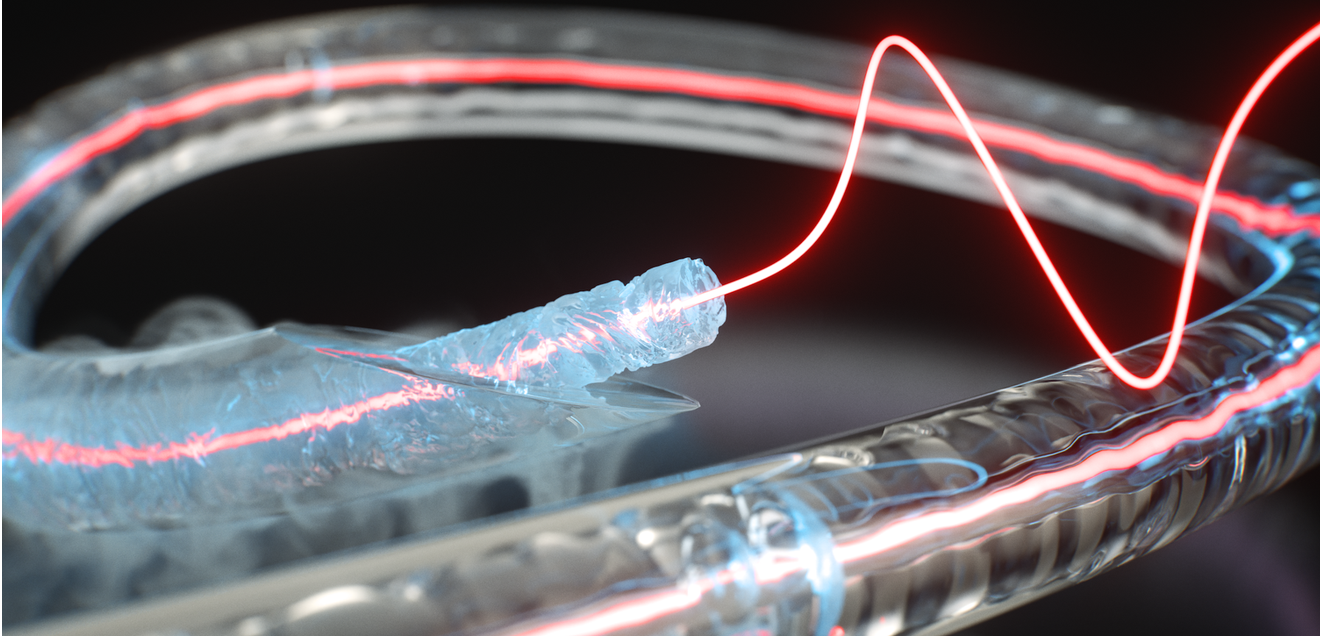
Researchers at the Max Planck Institute for the Physics of Light (MPL) in Erlangen, Leibniz University Hannover (LUH), and the Leibniz Institute for Photonic Technologies (IPHT) in Jena have created a new type of optical fiber capable of simultaneously transmitting light and sound waves. The key step: A glass capillary filled with liquid was cooled to -196 °C in liquid nitrogen. As a result, the liquid core of the fiber changed its state from liquid to solid.
The result is an unusually strong interaction between light and sound—a property that could help significantly reduce the energy consumption of photonic computing systems and quantum signal processing applications in the future.
An age-old principle with new possibilities
Phase transitions have always been a part of nature. When a volcano erupts, liquid lava cools and solidifies into rock. When a lake freezes in winter, the water molecules rearrange themselves into a new structure. In both cases, the material changes, and with it, its physical properties.
Density and refractive index, for example, determine how sound and light propagate through a material. Scientists have long been taking advantage of precisely these properties in the manufacture of optical fibers. Glass preforms are heated, their structure is altered, and they are then drawn into thin fibers. This allows light to be guided precisely through the fiber core—a cornerstone of modern telecommunications.
But fiber optics have long since ceased to be merely a medium for data transmission. Numerous variants have been developed for specialized applications. Hollow-core fibers filled with gases or liquids, for example, can measure temperature distributions or serve as tiny chemical reaction chambers. Fiber lasers, fiber-optic endoscopes, and high-precision sensors also benefit from such customized fiber designs.
The frozen core remains a light guide
The newly developed liquid-core fiber—LiCOF (Liquid Core Optical Fiber) for short—takes this a step further. The researchers selectively froze the liquid core and investigated whether the fiber retains its unique properties despite its new state of matter.
She did it and, on top of that, demonstrated an unexpected ability.
“The key point is that the frozen section of the LiCOF retains its ability to guide light. Not only that: both the liquid and frozen sections of the fiber guide hypersonic waves,” says Simon Seiderer, one of the three lead authors of the article and a researcher in Prof. Dr. Birgit Stiller’s “Quantum Optoacoustics” research group, which is leading the project at the MPL and LUH.
This led to the creation of a new platform for what is known as optoacoustics—that is, the combination of light and sound waves.
A connection between light and sound that is a thousand times stronger
The researchers are taking advantage of an effect known as Brillouin-Mandelstam scattering, in which light and sound can interact with each other within a material. This effect already occurs in conventional optical fibers, though only to a limited extent.
The frozen LiCOF core fundamentally changes the conditions. The phase transition creates an extremely confined and dense environment in which the interaction between light and sound becomes particularly strong. As a result, optoacoustic coupling is more than 1,000 times stronger than in conventional optical fibers.
This enhancement opens up new technical possibilities. The scientists have already demonstrated an optoacoustic memory—a technology considered a key component of photonic neuromorphic computing systems.
The principle is similar to a conversion process between two different speeds: Information is first transmitted as a fast light wave and then converted to much slower sound waves. After a certain amount of time, it can be converted back into light.
It is precisely this combination of high speed and low energy consumption that makes photonic computing architectures so interesting. The efficient coupling in the frozen liquid-core fiber could help reduce the energy consumption of such systems by several orders of magnitude.
A New Physical Platform for Photonics
This development was made possible through collaboration with Prof. Markus Schmidt and Prof. Mario Chemnitz of the IPHT in Jena. Both have done significant pioneering work in the field of optical liquid-core fibers. Freezing the fiber core adds a crucial aspect to this work: it creates a platform with particularly strong nonlinearities.
"By freezing the liquid core, we have created an entirely new physical platform that offers extreme nonlinearities while remaining easy to handle," says Stiller.
For the researchers, the optoacoustic memory is just the beginning. The unusually strong connection between light and sound could prove relevant not only for neuromorphic computing but also for other emerging fields of photonics.
"While the demonstration of a highly efficient optoacoustic memory is a fantastic first step, but this level of light-sound coupling opens up exciting new possibilities not only for neuromorphic computing, but also for quantum information processing, microwave photonics, and high-precision sensor technology.”
Original publication:
Simon Seiderer, Andreas Geilen, Luan N. Sliwa, Linqiao Gan, Xue Qi, Mario Chemnitz, Markus A. Schmidt, and Birgit Stiller, "Giant Brillouin gain in frozen CS2 capillaries," Optica 13, 1415–1422 (2026)DOI:10.1364/OPTICA.600056
Source: Max Planck Institute for the Physics of Light


You might also be interested in
A quantum computer that performs calculations using oscillations
When it comes to storing information, quantum computers have so far run up against technical limitations. Instead of electromagnetic storage, researchers are now using mechanical vibrations. Their vibrating memory can store significantly more...
 read more...
Hydrogen Pipelines Put to the Test
New real-world lab tests safety and resilience
The Federal Institute for Materials Research and Testing (BAM) is opening a real-world laboratory to study pipelines and components for the safe operation of future hydrogen networks.
read more...Research Platform for the Energy Supply of the Future
For the first time, the Karlsruhe Institute of Technology (KIT) is bringing together key hydrogen technologies in a single research environment. The facility is intended to demonstrate how the production, storage, transport, and use of hydrogen can...
read more...When the quantum computer arrives
The Research Race to Ensure the Security of Critical Infrastructure
How can we protect our critical infrastructure from attacks by quantum computers in the future? As part of the QUEST project, Darmstadt University of Applied Sciences is researching new methods—post-quantum cryptography—designed to withstand even...
read more...VDE study on electrical engineering
More retirements than graduations
According to a VDE analysis, more than 30,000 electrical engineers will retire by 2029 without enough graduates to replace them. This is due to falling student numbers and high drop-out rates.
read more...Giving lightweight construction a profile
Pultrusion: A process that forms fibers under tension
Pultrusion is developing from a niche process into a key process for lightweight construction and sustainable fiber composite structures. The Fraunhofer IWU shows applications from energy to mobility.
read more...Green hydrogen directly from the sun and water
A start-up project at the Karlsruhe Institute of Technology (KIT) aims to fundamentally simplify the production of green hydrogen: Mass-produced photoreactor panels are to be used to produce hydrogen directly from sunlight and water - without...
read more...Fraunhofer shows industrial future between AI, data and new materials
At Hannover Messe 2026, the Fraunhofer-Gesellschaft will be presenting solutions for a resilient industry: from AI and data rooms to hydrogen technologies and material and recycling innovations.
read more...The bottleneck is in the system
Is the transformation of the industry failing due to "German Angst"?
A recent ISF study examines what is slowing down change in German industrial companies. According to the results of the study, the causes of innovation bottlenecks often lie in internal structures and a lack of strategic orientation.
read more...