
E-mobility
Vehicles with hybrid or electric drive
The car industry accepts the reasons for the technology change. In the medium term, the combustion engine will gradually be replaced by a combination with the electric motor in order to transition to a completely emission-free, transmission-free electric drive in the long term (current status Berlin 1.1.16: 0.12% purely electric, 0.22% hybrid). Hurdles such as range/battery technology, price and charging infrastructure must be overcome in order to undercut the price per km of petrol or diesel.
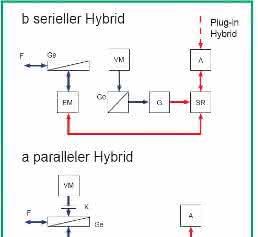
Overview
The hybrid electric vehicle (HEV) consists of a combination of at least two drives, the combustion engine VM and the electric motor EM with separate energy storage units (tank or battery can be filled when stationary or while driving). The far more energy-efficient EM (ηEM ≥ 0.9, ηVM ≥ 0.4) can change its direction of rotation by means of electrical control and therefore does not require a gearbox. Their cooperation is managed electronically.
Self-sufficient hybrids are available:
- Mild hybrid
Electric motor 10...15 kW (battery approx. 1 kWh) as starter and generator to support the combustion engine during acceleration (boosting), works as a generator during regenerative braking (recuperation), with automatic start-stop system. Energy/fuel savings of 15-20 % - Full hybrid
E-motor > 15 kW (battery approx. 2 kWh) supports the VM in addition to all operating modes of the mild hybrid so that it can also move the vehicle on its own, for example in city traffic or when maneuvering. Fuel saving approx. 40 % - Plug-in hybrid
(plug-in hybrid) The full hybrid variant is mainly electric (engine output 50 kW, battery approx. 15 kWh). When stationary, it is charged/recharged at the socket (plug-in). If the energy content of the battery is no longer sufficient after a longer period of driving, the VM is automatically activated (range extender).
If an energy management system optimizes the work of the generator, starter and battery and the vehicle has an automatic start-stop system, this equipment is referred to as a micro-hybrid (fuel savings of 5-10%, not a true hybrid due to the lack of a second drive).
In addition to the electric drive and the control electronics with bus system, all genuine hybrids have a high-voltage on-board electrical system with new safety requirements.
The emission-free e-vehicle is moved exclusively by the battery-powered electric motor (>< 30 kW), which is operated both by the motor and the generator. The battery (approx. 30 kWh) allows long-distance travel. All systems are capable of recuperation. Electric braking relieves the mechanical brakes and protects the environment with less tire wear.
System structure
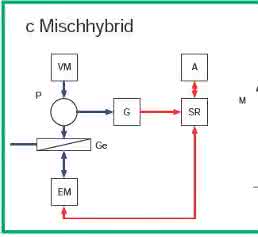
In the parallel hybrid, both motors move the vehicle axle (autonomous operation is possible). It can even be designed as an all-wheel drive system with more than two motors. The addition of the torques allows their cost- and weight-saving dimensioning. Design for purely electric operation is possible. In the case of the serial hybrid, which corresponds to the diesel-electric drive, the EM supplies the entire torque. The combustion engine, which has no mechanical connection to the driven vehicle axle, moves the electric generator, which produces the drive energy for the engine supply or fills the drive battery, which can also be charged from the mains. It can also briefly supply additional power for higher power requirements. Plug-in, full hybrids use this structure.
Mixed hybrids automatically and variably combine both structures using a special gearbox depending on the driving conditions. Either the VM only charges the battery via the generator, which feeds the EM (serial hybrid), and/or it is mechanically coupled to the drive shaft (parallel hybrid). The core of the e-vehicle corresponds to an autonomous drive, the Power Drive System PDS according to EN 61800 with the working machine vehicle, as the motion cell of a mechatronic system.
Components
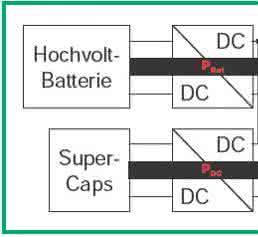
In addition to the bus-coupled IE, the most important vehicle components include motors and storage units. Together with the charging infrastructure, they determine efficiency and range. The asynchronous, synchronous and reluctance motors used have the advantageous torque curve in common. Lithium-ion systems (Li-ion, lithium-polymer), but also nickel-cadmium, nickel-metal hydride or nickel-zinc, lead-acid batteries and high-temperature sodium-nickel chloride collectors (for serial concepts) are used as long-life batteries with high power density and high energy content (range 300 - approx. 500 km, 33-60 kWh). Power electronic components (inverters, rectifiers, frequency converters, DC/DC converters) play a decisive role in enabling the bidirectional flow of energy and linking the classic low-voltage (12 V) and high-voltage (150 - ≤ 600 V) networks. Such components lead to completely different accident risks (battery fire, contact with the high-current cable).
Environmental balance
Hybrid and electric vehicles are sustainably emission-free if green electricity is used for production and operation.
Outlook
The triumph of e-mobility seems certain, provided that the inadequate charging infrastructure is replaced by practicable, harmonized, securely communicating systems. For the time being, this path is focused on passenger cars and public transport. It is supported by hydrogen and fuel cell technology as well as SuperCaps(http://www.cleanenergypartnership.de). In addition to private transport (including two-wheelers), the move away from VM is also reaching commercial vehicles and ships. Trucks with energy supply from overhead lines are just as much a case in point as long-distance/local bus systems. They are recharged from conductive high-current charging stations installed along the route as well as inductive fast charging stations at stops. The resulting smaller battery dimensions (weight, space) allow a greater range. The scarce raw material Li must be replaced in the long term. Alternatives such as Na, S, Si, Mn, Al, Zn are therefore being tested.
The future will also be determined by assistance systems through to automated or autonomous driving with clarification of liability/data protection. Fully electric car-sharing and robot vehicles will limit individual traffic. Permissible grid feedback must be ensured.
Dr.-Ing. habil. Joachim Krause
Recuperation
Conversion of mechanical kinetic energy into electrical energy during braking, downhill driving, etc. The electric motor works as a generator that feeds this energy into the battery.


You might also be interested in
Source of raw materials instead of hazardous waste
With the increasing use of lithium-ion batteries in industry, for example in driverless transport systems or as an emergency power supply for control systems, the volume of used batteries is also growing - and with it the challenge of recovering...
 read more...
Intelligent clutches
In many cases, a torque transducer is oversized for measuring torque and speed. A new intelligent clutch from R+W could be an alternative: it enables measurement data to be recorded directly in the drivetrain, measurements to be taken with high...
read more...Music of the future
The Blechexpo and Schweisstec trade fair duo took place in Stuttgart at the beginning of November. Like other industries, sheet metal workers and welding technicians have mixed feelings about the future.
read more...Early warning through interactive warning vest
The interactive warning vest from Linde Material Handling protects pedestrians in storage and production areas from approaching industrial trucks at an early stage with a tactile, audible and visible warning function.
read more...When is maintenance due?
The Brady inspection timer can save lives by clearly indicating when machines, equipment and tools need to be serviced. The LED indicators are clearly visible to operators and maintenance technicians, even from a distance.
read more...For one-hand installation
Desoutter is launching a one-handed angle screwdriver for the assembly of critical screw connections. With a length of around 30 centimetres and a weight of one kilogram, the transducer-supported EABS facilitates assembly processes.
read more...Process-accurate screw connections in series production
The power tool manufacturer Fein has launched three versions of the ASM 18 mid-handle screwdriver. They are identical in shape, but differ in terms of their torque output.
read more...Getting to the clamping point
Hermos Schaltanlagen in Mistelgau works with Desoutter screwdriving tools in production. Using the ergonomic cordless screwdrivers from the Elit series, the employees tighten the sensitive connections to the exact torque specified by the customer.
read more...1,400 variants, one line
I4.0 assembly line. With an assembly line from Bosch Rexroth, SFB manufactures hydraulic valves 20 percent more productively. A digital assistance system guides the workers through the entire assembly process, reduces errors and increases...
read more...