
Workpiece carrier transport systems
Networked and transparent installation
Workpiece carrier transport systems. As a manufacturer of workpiece carrier transport systems, Stein Automation offers standardized and networked modules. Users can assemble their systems as required and react quickly to changing production conditions.
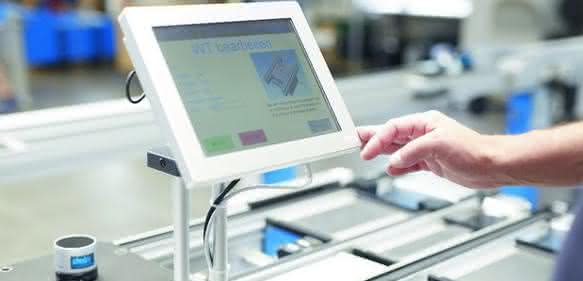
Efficient networked assembly requires interactive communication between the system, people and the control system. The aim is to record and statistically evaluate relevant data, integrate the assembly line into the ERP system and create standard interfaces to the stations and workstations. Stein, the automation specialist, offers solutions for this purpose that provide users with a quick overview of the operating status, capacity utilization or errors. The Control operating system, for example, enables efficient workflow management and facilitates diagnostics. Clearly designed color touch screens can be flexibly integrated into systems. Among other things, they display parts lists or provide the worker with work instructions. The terminals are integrated into the company network and can be configured individually and easily. The Stein HMI (Human-Machine Interface) enables visualization of the assembly down to the individual work step and ensures effective order management. A special statistics module facilitates traceability. It provides relevant information, for example on the number of belt stops, part errors at stations or enables a comparison of quantities. This ensures optimum line balancing. Stein's tried-and-tested app delivers relevant production data and fault messages to mobile devices such as cell phones or tablets, allowing operators to react quickly if necessary.
In recent years, the company has implemented more than 20,000 interfaces for pick-to-light systems or material picking at automated stations and manual workstations. In the next generation of Control, topics such as hot plug, i.e. the replacement of components during operation, or open databases will be increasingly incorporated.
Which system? The operator has the choice!
Which workpiece carrier transport system should I choose? The answer to this question for the customer lies in the analysis of the product range to be manufactured. The degree of automation can also vary. Product life cycles that are difficult to predict, combined with smaller quantities, tend to favor manual or hybrid systems. In contrast, highly automated solutions are a good choice when a product needs to be manufactured in large quantities over a long life cycle. Stein has developed a standard modular system from which many layout variants can be configured to customer specifications. For example, a U-shaped system enables fast processes; the material is fed in from the outside and the workers are located at different stations in the system as required. Additional workstations can be added in parallel. When it comes to avoiding the risk of workpieces backing up, a linear transfer with underfloor return of other goods scores highly: this variant is compact and the operators have access to the assembly stations from both sides. In systems based on the "boomerang principle", several cycles are necessary because additional work steps such as riveting or labeling are required before completion. Info terminals provide the operator with important information on the current status of the goods. Such systems can be expanded in various stages. pb


You might also be interested in
Assembly processes seamlessly monitored
Tox Pressotechnik is expanding its range of standard presses.
 read more...
Automated production
From self-learning robots for the field and factory to state-of-the-art cleanroom technologies, methods for the explainability of machine learning and software tools for optimized production, Fraunhofer IPA will be showcasing applications and...
read more...Many components lead to the desired product
Safe and healthy working is Hymer's central theme at the A+A occupational health and safety trade fair in Düsseldorf in October. The company will be presenting step and platform ladders there.
read more...With water cooling system for multiple rivet joints
A Slovakian automotive supplier uses a stable C-frame press with electromechanical servo drive from Tox Pressotechnik for the precise riveting of clutch components in large-scale production.
read more...Clean connection
Clinching has proven itself in the assembly of household appliances thanks to its efficiency and reliability. On a new clinching system, a Swiss manufacturer joins the guide plates for crockery and cutlery drawers to the side panel of the high-end...
read more...Intelligent drives improve riveting technology
Together with automation specialist Sigmatek, Swiss company BalTec has developed an innovative drive module for efficient and precise riveting and cold forming.
read more...Gun with integrated cooling line
Maschinenbau Technologie Herrde (MTH) presents the further developed USH 40E and USH 30E manual welding machines.
read more...Pneumatic riveting tools from Chicago...
Repairing metal structures in aircraft construction
Chicago Pneumatic has launched a new range of riveting tools for the repair and maintenance of metal structures in the aerospace industry.
read more...Conveyor chain for overhead conveyors
Conveys twice as long
Conveyor chain for overhead conveyor. A British car manufacturer was looking for a maintenance solution for the overhead conveyor driven by a conveyor chain for transporting car parts.
read more...