
Conveyor chain for overhead conveyors
Conveys twice as long
Conveyor chain for overhead conveyor. A British car manufacturer was looking for a maintenance solution for the overhead conveyor driven by a conveyor chain for transporting car parts.
The chain had to be replaced too often in order to reliably prevent production downtime. A Tsubaki conveyor chain provided a remedy.
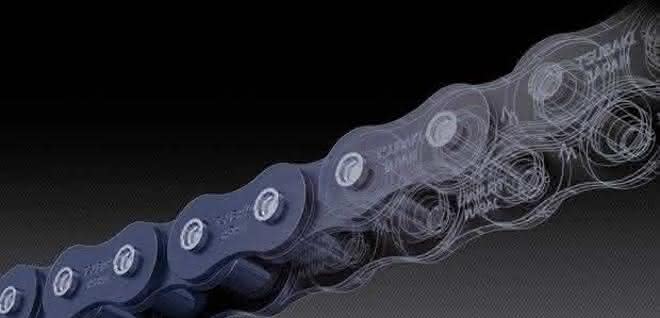
In automotive production, the machines and systems used are expected to run without interruption all year round. Downtimes are taboo because they cost thousands of euros per minute. It is therefore surprising that some machine elements are still regarded as commodity products. Purchasing decisions are made on the basis of price, without taking their performance or quality into account.
In automotive assembly, overhead conveyors usually transport the body parts from one work station to the next. The conveyor systems driven by conveyor chains are therefore an important part of the material flow. If the conveyor chain fails here, not only does a large part of the production line come to a standstill. Rather, this can quickly spread to the other production processes from the subassembly to the interior, painting, quality assurance and other downstream processes. This makes it all the more incomprehensible that the performance of the chain is no longer a priority. Special chains often offer a much longer service life than standard chains - especially in high-performance applications.
A good example of these differences in quality is provided by one of the largest British car assembly plants: the conveyor chain installed in the overhead conveyor had to be replaced at least every twelve months and serviced quarterly. The requirements for maintenance and replacement increased because the chain could only be lubricated every three months. It became stiff and sluggish and dust particles in the air caused the chain to become contaminated, which led to wear. The chain usually broke before the twelve months were up. So those responsible decided to replace it every three months as a precaution.
The plant manager wanted to change this and turned to Tsubaki: they quickly realized that the OE chain originally installed by the system manufacturer was not at all suitable for high-performance operation and suggested replacing it. They also wanted the chain to have a lower total cost of ownership (TCO). The Tsubaki engineers then recommended a maintenance-free, self-lubricating chain from the Lambda series. This eliminated the need for manual lubrication, which reduced maintenance costs. The costs for downtime and replacement chain are also a thing of the past.
In terms of durability, the engineers went one better: they developed a special cover plate that was attached to every second chain link to reduce contamination and protect against wear. The rivets used to attach the cover plates have been replaced by special, high-strength screws that are held in place with threadlocking adhesive. as


You might also be interested in
Assembly processes seamlessly monitored
Tox Pressotechnik is expanding its range of standard presses.
 read more...
Automated production
From self-learning robots for the field and factory to state-of-the-art cleanroom technologies, methods for the explainability of machine learning and software tools for optimized production, Fraunhofer IPA will be showcasing applications and...
read more...Many components lead to the desired product
Safe and healthy working is Hymer's central theme at the A+A occupational health and safety trade fair in Düsseldorf in October. The company will be presenting step and platform ladders there.
read more...With water cooling system for multiple rivet joints
A Slovakian automotive supplier uses a stable C-frame press with electromechanical servo drive from Tox Pressotechnik for the precise riveting of clutch components in large-scale production.
read more...Clean connection
Clinching has proven itself in the assembly of household appliances thanks to its efficiency and reliability. On a new clinching system, a Swiss manufacturer joins the guide plates for crockery and cutlery drawers to the side panel of the high-end...
read more...Intelligent drives improve riveting technology
Together with automation specialist Sigmatek, Swiss company BalTec has developed an innovative drive module for efficient and precise riveting and cold forming.
read more...Gun with integrated cooling line
Maschinenbau Technologie Herrde (MTH) presents the further developed USH 40E and USH 30E manual welding machines.
read more...Pneumatic riveting tools from Chicago...
Repairing metal structures in aircraft construction
Chicago Pneumatic has launched a new range of riveting tools for the repair and maintenance of metal structures in the aerospace industry.
read more...Force-fit connection of components
Press-fit devices. Press-fit devices are the method of choice when several components need to be joined together by longitudinal pressing or riveting during assembly processes.
read more...