
Software-supported worker guidance
Tamper precisely bolted
Mint has installed two assembly stations with software-supported worker guidance at a construction machinery manufacturer.
Vibratory plates, also known as vibratory plates, are used in road and path construction. Depending on their design, these motor-driven construction machines for soil compaction are driven by a motor with one, two or three shafts with integrated imbalances. The centrifugal forces are significantly higher than the weight of the machine and briefly lift the machine a few millimetres off the ground with each rotation of the imbalances. This moves the plate forwards or backwards.
Shortly afterwards, the plate falls back to the ground. Due to the built-up kinetic energy and centrifugal force, it briefly reaches a surface pressure and compacts the material beneath it. The strong vibrations can affect the screw connections on the construction machine. This is why perfect assembly is essential. Every screw connection must be precisely coordinated and carried out with the correct torque and in the correct sequence.
In times of traceability, there is also an obligation to provide precise documentation. A manufacturer of such construction machinery has set up a new assembly line for the production of guided vibrators. The rammers are fully assembled at two stations. Mint supplied the complete bolting and handling technology as well as the worker guidance system (software).
The assembly of a vibrator was divided between two stations in order to save space in the production hall and allow employees to work more flexibly and avoid monotony. A worker is now employed at each station to carry out all the assembly steps. At the first station, around 40 screwing processes have to be completed and at the next station 60. At the start of the assembly process, each vibrator is provided with a barcode to which the respective screwing result is stored for documentation.
Worker guidance ensures perfect quality
At the first station, the motor is placed on the base plate and fastened with other additional components. During assembly, various screwdriving tools are used to fit the different components - cordless screwdrivers (electrically driven, controlled tools) and cable-bound, controlled tools if higher torques are required. All tools are connected to the worker guidance system. This shows the assembly sequence and which assembly step is to be carried out with which tool on a display. The display can be in the form of photos or graphics.
The user also has the option of entering their own images and drawings into the worker guidance system and marking where the bolting points are. Once the worker has completed the screw connection, he receives visual feedback; the completed screw connection switches from yellow to green. Red would be the signal for an error. This makes it possible to define a reworking plan and track where faulty assembly has taken place and needs to be reworked.
If all points are green, a new graphic with new assembly tasks is displayed. At the same time, the corresponding tools are released as the screw connections are to be carried out with different tools.
Tool releases precisely specified
The software for worker guidance is connected to the Mint screwdriver controls so that only the appropriate tool is released for execution depending on the work step. Some of the tools are equipped with a nut selector box; the software uses the control system to tell the worker which socket is to be used, which is indicated by a display in the nut selector box. This procedure ensures that only the right screw with the right torque can be screwed in the specified sequence. For documentation purposes, this is reported back to the control system and saved. This results in clear documentation for each work step.
Once the 40 or so tightening processes have been completed at the first station, the jogger is moved to the next station and the barcode is scanned again. Scanning the barcode loads the next assembly process in the worker guidance system and displays it to the worker at this station. At the second station, various covers for the engine and additional components such as the starter motor are screwed on. Here, too, the operator is only ever given access to the tools he needs.
Cordless tools in combination with handling system
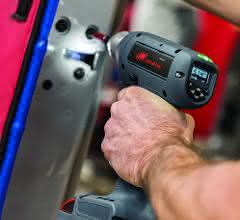
The main tools used are controlled cordless tools in pistol and angle form from Ingersoll Rand's QX series. It includes precision EC cordless screwdrivers with transducers for torque and angle measurement. The QX series can be used as a stand-alone solution at a single workstation or fully integrated into a high-tech workstation with process control and wireless communication. If screwdriving processes with more than 100 Newton meters of torque are planned, the cable-connected tools are integrated into a handling system, as such screwdriving processes can no longer be kept free.
In fact, the handling system absorbs the entire screwdriving reaction. At this station, the worker switches from a cordless tool to a corded tool because a higher output is required. For these integrated tools, Mint worked together with the handling provider Jäger Handling from Sulzbach-Laufen, who built the corresponding rail system. The screwdriving tools are suspended from this, which simplifies handling. The installation of the assembly stations, including the programming of the worker guidance system, took two weeks in each case.
The software-controlled release and locking of the tools ensures a predetermined assembly sequence, and the specified screw sequences and torques are consistently adhered to. The time sequence is also precisely defined, allowing for detailed planning of the production process. New employees can be trained quickly. pb


You might also be interested in
Source of raw materials instead of hazardous waste
With the increasing use of lithium-ion batteries in industry, for example in driverless transport systems or as an emergency power supply for control systems, the volume of used batteries is also growing - and with it the challenge of recovering...
 read more...
Intelligent clutches
In many cases, a torque transducer is oversized for measuring torque and speed. A new intelligent clutch from R+W could be an alternative: it enables measurement data to be recorded directly in the drivetrain, measurements to be taken with high...
read more...Music of the future
The Blechexpo and Schweisstec trade fair duo took place in Stuttgart at the beginning of November. Like other industries, sheet metal workers and welding technicians have mixed feelings about the future.
read more...Early warning through interactive warning vest
The interactive warning vest from Linde Material Handling protects pedestrians in storage and production areas from approaching industrial trucks at an early stage with a tactile, audible and visible warning function.
read more...When is maintenance due?
The Brady inspection timer can save lives by clearly indicating when machines, equipment and tools need to be serviced. The LED indicators are clearly visible to operators and maintenance technicians, even from a distance.
read more...For one-hand installation
Desoutter is launching a one-handed angle screwdriver for the assembly of critical screw connections. With a length of around 30 centimetres and a weight of one kilogram, the transducer-supported EABS facilitates assembly processes.
read more...Process-accurate screw connections in series production
The power tool manufacturer Fein has launched three versions of the ASM 18 mid-handle screwdriver. They are identical in shape, but differ in terms of their torque output.
read more...Getting to the clamping point
Hermos Schaltanlagen in Mistelgau works with Desoutter screwdriving tools in production. Using the ergonomic cordless screwdrivers from the Elit series, the employees tighten the sensitive connections to the exact torque specified by the customer.
read more...1,400 variants, one line
I4.0 assembly line. With an assembly line from Bosch Rexroth, SFB manufactures hydraulic valves 20 percent more productively. A digital assistance system guides the workers through the entire assembly process, reduces errors and increases...
read more...