
Mobile assembly stations
On the road with the workplace
Mobile applications in assembly and handling technology are booming: they are able to make work processes more flexible, efficient and reliable as well as safer and more ergonomic.
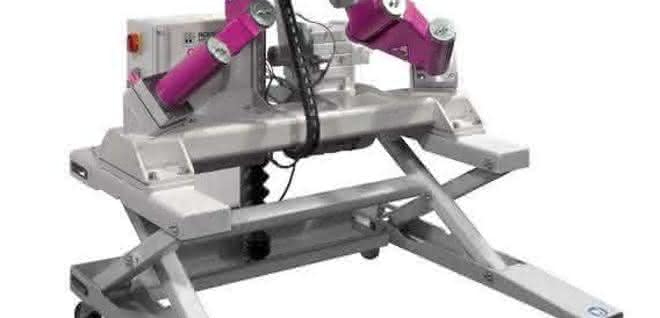
"A typical area of application is the assembly of vehicle components such as gearboxes, power units, compressors and body parts for cars and commercial vehicles," explains Alexander Schul, Product Manager Assembly and Drive Technology at Roemheld. The benefits include stable processes, improved quality and therefore lower costs. Work steps can be simplified and standardized. As a result, they can be reproduced at any time and can be clocked productively. In addition to the advantages for production, there are also major benefits for employees. This is because the individually adaptable assembly workstations reduce the physical strain on fitters.
With its coordinated Modulog modular range, Roemheld offers a wide selection of lifting, turning, tilting, trolley and floor modules, which can be driven manually or electrically depending on requirements. "The selection enables a wide variety of station setups that can be quickly adapted to changing requirements," summarizes Schul. "If assembly stations are also set up to be mobile, the design freedom increases even further."
It is often sufficient to replace the base frame of a Modulog assembly system with a trolley module to make the workstation mobile. Powerful and fast-charging batteries provide the necessary energy. "Work safety and flexibility increase, while process times are reduced: Investments in mobile assembly systems usually pay off quickly," says Schul. An example of a mobile assembly workstation could look like this: The basis is an assembly trolley with height adjustment, which the worker adapts to their needs using a hydraulic lift drive or electrically with a battery-powered control module. He turns or tilts the workpiece directly by hand or at the assembly device. Even when tilting, the operator only has to exert a small amount of force because a pneumatic balancer effectively compensates for any torques that occur. A hand or foot lever is used to release or fix the current axis position. For workpieces weighing up to 150 kilograms, Schul recommends self-locking, battery-powered axes and actuators.
Components weighing up to 2,000 kilograms can be moved, tilted, rotated and lifted with the all-electric turn/tilt manipulators in the Centrick series from Roemheld. Patented kinematics ensure that the workpiece remains securely guided even with off-center centers of gravity and always remains in the optimum assembly position. Mobile Centrick models with castors can be moved easily even in confined spaces. as


You might also be interested in
Source of raw materials instead of hazardous waste
With the increasing use of lithium-ion batteries in industry, for example in driverless transport systems or as an emergency power supply for control systems, the volume of used batteries is also growing - and with it the challenge of recovering...
 read more...
Intelligent clutches
In many cases, a torque transducer is oversized for measuring torque and speed. A new intelligent clutch from R+W could be an alternative: it enables measurement data to be recorded directly in the drivetrain, measurements to be taken with high...
read more...Music of the future
The Blechexpo and Schweisstec trade fair duo took place in Stuttgart at the beginning of November. Like other industries, sheet metal workers and welding technicians have mixed feelings about the future.
read more...Early warning through interactive warning vest
The interactive warning vest from Linde Material Handling protects pedestrians in storage and production areas from approaching industrial trucks at an early stage with a tactile, audible and visible warning function.
read more...When is maintenance due?
The Brady inspection timer can save lives by clearly indicating when machines, equipment and tools need to be serviced. The LED indicators are clearly visible to operators and maintenance technicians, even from a distance.
read more...For one-hand installation
Desoutter is launching a one-handed angle screwdriver for the assembly of critical screw connections. With a length of around 30 centimetres and a weight of one kilogram, the transducer-supported EABS facilitates assembly processes.
read more...Process-accurate screw connections in series production
The power tool manufacturer Fein has launched three versions of the ASM 18 mid-handle screwdriver. They are identical in shape, but differ in terms of their torque output.
read more...Getting to the clamping point
Hermos Schaltanlagen in Mistelgau works with Desoutter screwdriving tools in production. Using the ergonomic cordless screwdrivers from the Elit series, the employees tighten the sensitive connections to the exact torque specified by the customer.
read more...1,400 variants, one line
I4.0 assembly line. With an assembly line from Bosch Rexroth, SFB manufactures hydraulic valves 20 percent more productively. A digital assistance system guides the workers through the entire assembly process, reduces errors and increases...
read more...