
Zero point stresses
AMF zero point clamping: A well-rounded solution
Very long set-up times are sometimes required before processing components, during which the processing machine is not productive. If this time can be reduced, the company's productivity and flexibility increase at the same time. Zero-point clamping modules from AMF make a significant contribution to achieving these goals.

Kocks, a supplier of tube, wire and rod rolling mills, has optimized its production - with impressive results. The long-established company uses AMF zero-point clamping systems on a new machining center to manufacture components. This allows production times to be reduced by more than 80 percent in some cases. The flexibility gained is particularly beneficial for the production of spare parts and for setting up a third, unmanned shift.
"With the AMF zero-point clamping modules, we have greatly increased our flexibility in production," emphasizes Carsten Aeilts, Operations Manager at Kocks Manufacturing in Bremen. Thanks to the use of a new production center in conjunction with the AMF system, the production times for manufacturing parts for the scaffolding have been reduced to just under a fifth. "The AMF zero-point clamping modules have played a large part in this," confirms Kai Staschen, Team Leader Machining at Kocks. "Some parts no longer have to be clamped nine times, as they used to be, but only three times. And that is also much quicker now," says Staschen. The set-up time saved fully benefits productivity on the new Mazak machining center, but also on other machines.
Three rollers for the technological edge
The stands, which have three adjustable rolls, are the core of the rolling mills. The 3-roll technology developed by Kocks for the production of wire rod and bar steel as well as tubes enables the twist-free rolling of quality steels, special grades, superalloys, sintered materials as well as non-ferrous metals and their alloys. The stands incorporate the company's experience and know-how. Their reliability and durability are crucial for the productivity of production and the quality of the end products. For example, the company rolls round material from 160 mm diameter to 40 mm. Kocks also builds three-roll stretch-reducing mills for the production of seamless and welded tubes. The stands also play a decisive role here.
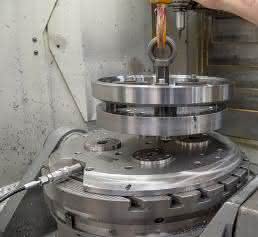
The new Mazak Integrex machining center has a machine table on which workpieces with a large diameter can be turned. As the K20 module from AMF is also approved for milling/turning operations up to 2,200 rpm , the zero-point clamping module became the preferred solution here too. This consists of a 48 mm high base plate with four K20 zero-point clamping modules. These realize pull-in and closing forces of 20 kN each and holding forces of 55 kN each. The repeat accuracy during clamping is less than 0.005 mm. With a diameter of 112 mm each and additional ground support pieces on the station, a large support surface is created. Nevertheless, with an installation depth of 34 mm, the modules are very compact and only require a small part of the total installation height on the machine table. "This is why the base plate can also be kept relatively flat," explains Michael Gödecke, Sales Engineer Clamping Technology at AMF.
A traffic light for more safety
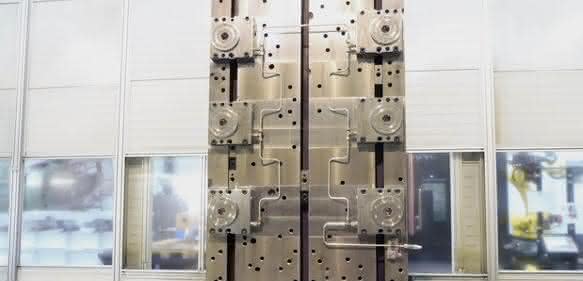
Eccentrics, shafts, covers and other parts for the rolling mills are machined by milling, turning or drilling. For example, Kocks also inserts complex lubrication grooves or carries out sophisticated spindle machining. Some workpieces, which are clamped directly with AMF clamping pins, take around three hours to machine. "We are happy to support our customers in determining the optimum positions of the holes for the clamping pins," says Gödecke. 15 to 20 tools are used. The machine retrieves them directly from the tool store and changes them automatically. Further core elements are waiting to be processed in various production states on a total of twelve pallet stations. These are pre-set at a set-up station during machining.
A normal hydraulic unit is used to open the clamping modules. For the milling/turning application, this is additionally equipped with controls and an easy-to-read traffic light. This signals the clamped state of the clamping station and releases the workpiece for machining. A total of three clamping operations are now required to complete the core elements. In addition to the set-up time saved as a result, the sources of error that are inevitably present during each clamping process are also reduced.
For even more power
Because the AMF zero-point clamping modules show such convincing results in reducing set-up times, Kocks uses the technology on two other machines, including a huge Union boring mill with a machine table measuring 2,000 x 2,000 mm and a clamping angle measuring 1,000 x 1,000 x 2,000 mm. Here, the extra-strong AMF K40-H modules are used for heavy-duty machining in a superstructure station for direct workpiece clamping and in a single station for holding base plates or fixtures. These achieve 40 kN pull-in and locking forces as well as 105 kN holding force with a diameter of 148 mm. The modules are opened hydraulically and locked mechanically by spring force. The module is clamped without pressure and the pressure line can be removed at any time.
The K40 modules for direct workpiece clamping are characterized by a special feature: At 300 mm, they are high enough to be able to machine the workpiece clamped directly via the clamping pins from five sides without the table being an interfering contour. In addition, two of the four modules are height-adjustable. The modules can be adjusted in steps of 0.05 mm using a thread with a pitch of 0.75 mm for diameters greater than 150 mm. This allows a total height adjustment of 5 mm (±2.5 mm) to be achieved.
Third shift: higher productivity
Kocks mainly manufactures bevel gears and levers on another DMG machining center. "The flexibility gained by the K20 zero-point clamping system is particularly noticeable here," reports Staschen. Because it is so easy to reclamp, unplanned spare parts that need to be produced in a hurry can be inserted into the process without any problems. The part whose machining was interrupted is then simply re-clamped and machined again without the need for long set-up times. The machining team leader also mentions another aspect. At the end of the second shift, the workpieces can now be unclamped in any machining state and make way for another part with a longer machining time. "This means we are planning a third shift with less manpower in the near future." am


You might also be interested in
In-house exhibition Bielefeld 2026
How DMG Mori thinks about the factory of the future
DMG Mori will be showcasing turning and milling expertise, automation solutions and additive manufacturing along the Machining Transformation (MX) at the Bielefeld 2026 in-house exhibition.
 read more...
Up to 50 percent higher cutting speeds
The current market situation is putting pressure on companies that rely on carbide tools: Rising raw material costs, volatile supply chains and limited predictability are putting pressure on the industry. Fette Werkzeugtechnik, a member of the LMT...
read more...A robot for all occasions
Industrial robots take on many tasks. Even milling with accuracies in the sub-millimeter range is now possible.
read more...High metal removal rate for high maneuverability
Large module gears for ship drives place high demands on machining. Switching from skiving to 5-axis simultaneous milling with high-feed tools considerably shortens the roughing process. Process parameters and a well thought-out tool selection are...
read more...Schunk shows flexible systems for electronics production
Schunk Electronic Solutions will be exhibiting modular, flexible systems for electronics production at Productronica 2025 - from stand-alone depaneling systems to fully integrated inline solutions.
read more...Hydraulic 4-jaw chuck for automated workpiece clamping
HWR Spanntechnik presents a hydraulically actuated 4-jaw chuck for automated workpiece changing. The clamping device is designed to enable short set-up times, precise clamping and high productivity in automation.
read more...Corner, face and plunge milling
Paul Horn is expanding the DA milling system for corner, face and plunge milling. With the DA65 variant, the system offers a larger cutting insert compared to the existing DA62.
read more...World premieres at the EMO 2025
From September 22 to 26, 2025, Grob will be presenting several innovations at EMO Hannover. The focus of the trade fair appearance will be on the latest 4- and 5-axis universal machining centers and the associated automation solutions.
read more...Flexible and efficient processing
New high-performance CNC series
Fanuc's presentation at EMO will focus on the new FS500i-A CNC series. The new CNC generation offers high user-friendliness, process optimization as well as digital and network technologies.
read more...