
Condensate treatment for compressed air systems
Oil-water separator reduces disposal costs
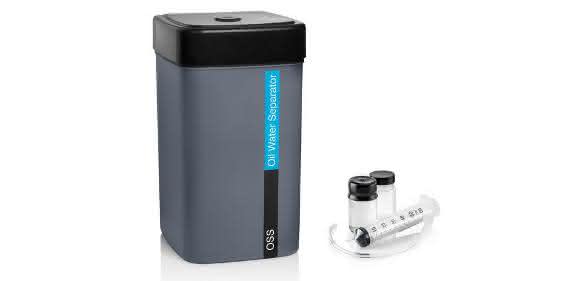
Atlas Copco is launching a new oil/water separator for smaller compressed air installations: the OSS. It is similar to its big brother, the OSC, but has been designed for smaller air volumes (up to 25 liters of compressed air per second). The OSS is compact, clean and particularly cost-efficient. It reliably separates the oil from the compressor condensate. This allows users to reduce their disposal costs, as the cleaned condensate can easily be fed into the waste water system.
The condensate that forms in an oil-injected or lubricated piston or screw compressor contains traces of oil and dust. It must not be discharged untreated into the waste water system, as oil poses an environmental risk. Although it would be possible to dispose of all the condensate properly, this would be expensive and unsustainable due to the much larger quantity that would be produced.
It makes more sense and, above all, is cheaper to treat the condensate with an oil-water separator. The OSS works with two filter stages. The result is a clean condensate with almost no residual oil: After separation, the residual oil concentration in the water is less than 15 ppm, so that it can be discharged into the waste water.
The new separator is very compact and optimized for small compressors. A bracket for wall or panel mounting is supplied by Atlas Copco. All materials used in the separator can be 100 percent recycled. sw


You might also be interested in
Neue Baureihe von Adsorptionstrocknern
Druckluft noch effizienter trocknen
Atlas Copco präsentiert seine neue Baureihe CD 25-260+. Sie trocknet einen Volumenstrom von 25 bis 260 Litern Druckluft pro Sekunde (l/s).
 read more...
Vakuumpumpen und Gebläse von Atlas Copco
Auf der Powtech in Nürnberg zeigte Atlas Copco energieeffiziente Lösungen für die pneumatische Förderung mit ölfreier Druckluft und Vakuum.
read more...Filtration and sound attenuation in circuits
In liquid or air circuits, filter housings and silencers protect measuring devices, ensure particle-free vacuum and pneumatic systems, keep cooling circuits clean and reduce noise.
read more...KSS ultrafine filtration for grinding oils
Modular concept for pure oil
In order to grind economically, reliably and with the highest quality, extremely clean grinding oils are required. Filter manufacturer Vomat offers the metalworking industry high-performance and customized concepts for the filtration of cooling...
read more...Up to 95 percent less flue gas thanks to direct extraction
The requirements for occupational safety measures and safety technology are also constantly increasing in welding technology. The Technical Rules for Hazardous Substances (TRGS) stipulate that welding fumes and harmful substances must be extracted...
read more...Everything accurate in switch cabinet construction
To ensure smooth work processes, tools for processing enclosures and housings must function flawlessly and reliably. Häwa rounds off its punching range with the Multi-Press 500.
read more...Cooling and temperature control units
Hygienic packaging sells safely
In few industries are the requirements for hygiene in the production process as strict as in the food sector - the health of consumers has top priority. This results in enormous challenges for all machines and components involved, especially in...
read more...Efficient and sustainable
Rotary screw compressors are the reliable backbone of industrial compressed air generation. The innovative CSD/CSDX series from Kaeser Kompressoren with its numerous features produces them efficiently and saves energy costs. This also reduces theCO2...
read more...Healthy air during welding
Welding produces fumes and gases that are hazardous to health. Extraction is necessary to comply with the occupational exposure limits and is even mandatory when welding high-alloy steels.
read more...