

Tool development
Development of a short-hole drill
It is difficult to develop an indexable insert drill that can drill holes with depths of up to 7×D in a single operation without deflection or chip jams. This is mainly because the extension of a drill results in the drill being bent or deflected disproportionately. A fundamental rethink was necessary with regard to the design and production of drill bodies and indexable inserts.
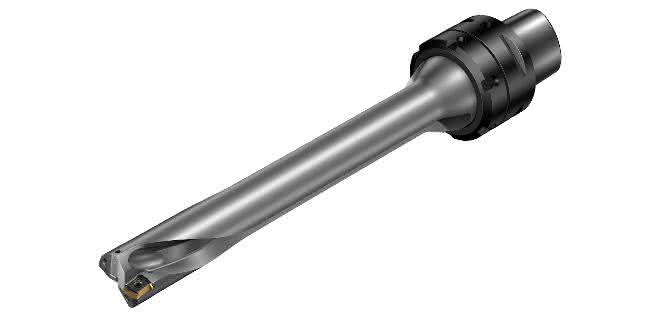
With the new CoroDrill DS20, Sandvik Coromant has introduced a 7×D indexable insert drill that makes drilling from both sides of a component obsolete in the area of short-hole drilling. This is made possible by a new design for both the basic body and the indexable inserts. The differences to its predecessor, the CoroDrill 880, are therefore immediately apparent: instead of a conventional, constant, helical helix, the new 7×D indexable insert drill has an initially strongly curved chip channel, followed by a straight chip channel. This design not only enables high performance, but also stability and a balance of forces. The latter in particular is necessary for a long, asymmetrical drill.
Key aspects of development
Controlled cutting forces, reliable chip evacuation with predictable chip deflection and high centering capability are among the most important requirements for drills for depths greater than 5×D. As the bending tendency of a 7×D drill is three times higher than that of a 5×D drill, the requirements for stability and optimum force distribution increase with the length of the drill. Consequently, one of the first challenges during development was to find the ideal design and the best possible position of the indexable insert - especially with regard to determining the optimum resulting force, as both indexable inserts are arranged asymmetrically. A solid basic geometry and a hard-wearing indexable insert design with four full cutting edges on both the inner and peripheral inserts also ensure robustness.
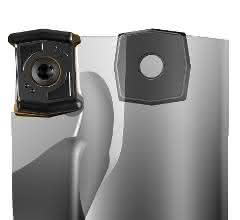
Another important aspect in the development of the CoroDrill DS20 was to find the optimum combination of material and design for the drill body and tool cooling. This required extensive research, analysis and testing, as the drill body needed to be durable and more rigid than before. In addition, the chip channel shapes had to be individually designed for each drill size and indexable insert in order to achieve less vibration, predictable wear patterns and a longer tool life. The team needed around two years just to develop the optimum chip channel design while maintaining the required internal cooling.
The challenge was to achieve the greatest possible rigidity of the drill body on the one hand and to design the chip removal in such a way that high process reliability, repeat accuracy and consistent quality are guaranteed at all times on the other. The design of the chip flute plays a decisive role in this conflict between high drill rigidity and optimum chip evacuation. The "straighter" the chip channel, the less material is removed - this increases rigidity. On the other hand, a steeper helix angle increases the speed of chip removal, which increases process reliability. Both capabilities are required in every drill, but must be optimized for bores larger than 5xD - a challenge that the team successfully solved with meticulous work and intensive testing.
A total of 50 different parameters had to be adjusted during the development of the drill. Each time a parameter was changed, the 49 others also had to be adjusted accordingly. In order to manage this effort efficiently and without errors, experts from Sandvik Coromant developed special software that enabled all parameters to be controlled, modulated and analyzed in a virtual environment. Only on this basis was the team able to develop the next generation of two-stage technology, which reduces cutting forces on entry by up to 75 percent compared to CoroDrill 880 and improves centering capability.
From the development to the field test
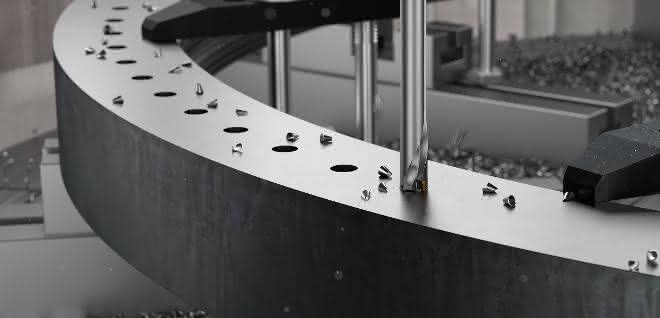
In order to test the new indexable insert drill under real conditions, initial trials were carried out at a user that manufactures slewing rings for the wind turbine industry. With success: By switching from a 6×D competition drill to the CoroDrill DS20, a complete component could be machined safely and faster, as there were no unpredictable stops or insert changes. The company was also able to double its productivity.
Further tests allowed conclusions to be drawn about the potential advantages of the 7×D indexable insert drill. For example, the CoroDrill DS20 can increase tool life by 25 percent when drilling steel, cast iron or hardened workpieces and by 10 percent when drilling stainless steel and non-ferrous materials. Productivity increases are also achieved: typically 10 percent when machining steel, stainless steel and cast iron and 5 percent for hardened materials, non-ferrous materials, super alloys and titanium.
This performance is due in particular to the chip control and feed speeds in all 4×D to 7×D applications. Process reliability is ensured by lower forces and easier cutting, especially during entry. Users of the CoroDrill DS20 benefit from lower costs per hole, the ability to drill deeper and lower noise levels. In addition, no pilot holes are required.
For manufacturing companies, this means that they can drill through large components, which would often have to be drilled from two sides, directly from one side using the new indexable insert drill. A 100 kg wind turbine slewing ring, for example, can be machined in this way in a single pass - without the component having to be rotated and readjusted. In this way, enormous time and cost savings can be achieved and errors avoided. This is particularly important for large components, as a high level of added value has already been achieved through previous forging and machining processes.
MDI interface for high quality
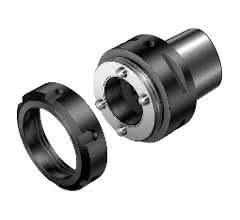
However, reliable and repeatable machining with drilling depths of up to 7×D is not just a question of the drill. That is why Sandvik Coromant has developed a new Modular Drilling Interface (MDI) in parallel with the CoroDrill DS20, which serves as an interface between the drill and the adapter. The MDI adapter is available with the Coromant Capto and HSK shank types on the spindle side and offers good concentricity and optimum repeatability thanks to double centering with high fitting accuracy.
Thanks to the new MDI design, users can utilize more tool length and at the same time benefit from a reduced collar length or interfering contour - especially when used on lathes. Here, the tool can be mounted rotated by 180° in stationary use, which means that the outer cutting edge is always visible to the user. Another advantage of the tool design with the MDI is the simple adaptation to various machine tool interfaces. The modular coupling between drill and adapter enables the use of one interface size for several drill diameters or one drill in different machine spindles; this reduces tool inventory and costs. In addition, only the drill bit needs to be replaced in the event of wear due to chip abrasion.
Dr. Niklas Kramer, Director Product and Industry Segment Management, Sales Area Central Europe, Sandvik Coromant / ag


You might also be interested in
Cutting solutions in 2D and 3D
Microstep showed 2D and 3D cutting solutions in action on sheet metal, tubes, profiles and container bases, including bevel cutting with plasma or waterjet and dynamic fiber laser cutting, as well as drilling, milling and marking demonstrations.
 read more...
Precision machining of bores
Paul Horn is presenting an innovative extension for the Supermini system in the field of ultra-fine machining at EMO 2023. The system has been supplemented by a variant with an ultra-fine ground cutting surface.
read more...Deep drill holes optimized with PCD
When the Schlote Group built a new plant in Harzgerode in 2017, production was geared towards series production of a single component right from the start.
read more...Production goes digital
EMO, the world's leading trade fair for production technology, invites the industry to Hanover from September 18 to 23.
read more...Vibration-free groove turning process
Adjustable damped boring bar
Paul Horn is exhibiting innovations and product enhancements at the EMO in Hanover. Among other things, the company is exhibiting a boring bar that can be adjusted to the vibration amplitudes that occur.
read more...Efficiency with digital twins
Digitalization and automation are the way to increase efficiency and flexibility in machining. The Tebis team will be presenting suitable solutions for mechanical engineering at EMO.
read more...Many highlights in Leipzig
Ceratizit will be presenting the highlights from its portfolio at Intec. In addition to the latest tools for milling, turning and drilling, automation solutions will also be a top topic at the tool manufacturer's stand.
read more...How smart robot simulation works
More intelligent, more efficient, easier to operate - robots are developing rapidly. Among other things, great care is required when setting them up and operating them in order to avoid cost-intensive downtimes. Robot simulation tools are...
read more...Milling, turning and grinding center
Milling, turning, grinding and gear cutting on one and the same machine - in a single clamping operation: Soraluce's multitasking machines are the answer to technically complex workpieces with tight tolerances that require various machining...
read more...