
Requirements in machining
Continuous process chain in carbide machining
The machining of hard metals can be complex and cost-intensive. For this reason, a continuous process chain is essential. During a seminar at a machine tool manufacturer, experts from the fields of production technology, machine tools, tools and CAD/CAM software presented their relevant experience and practical solutions.
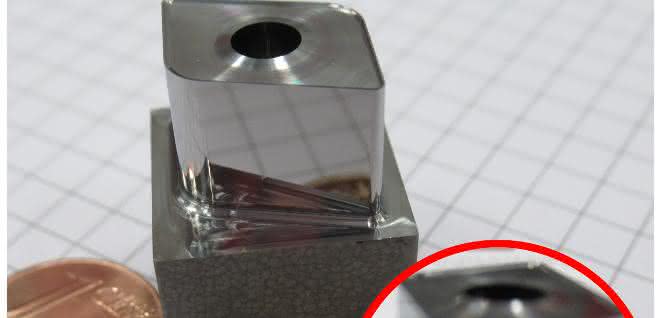
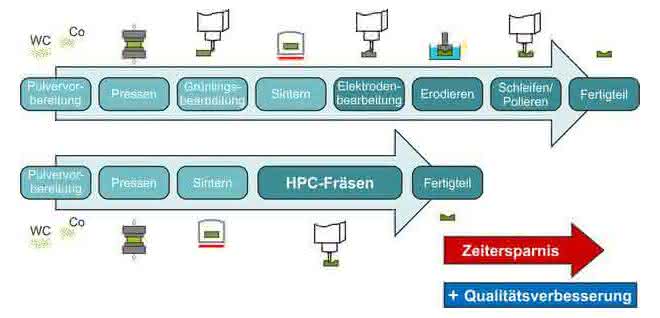
In the mass production of stamped or formed parts, the wear of the tools used has a significant impact on quality and costs. This is why carbides are increasingly being used for this purpose, as they have a superior service life. However, machining these super-hard materials is challenging. Carbides consist of fine hard material grains - usually tungsten carbide - with a metallic bond such as cobalt. They are shaped using powder metallurgy and achieve high strength and hardness values after sintering. As the machining of carbides used to be difficult due to their high hardness, a complex process chain was used that relied primarily on spark erosion and grinding or polishing. Significant advances in the areas of machine tools, tools and software have now made it possible to use standard machining processes such as milling, drilling, turning or jig grinding instead of spark erosion. This enables a considerably shortened process chain with significant time and cost benefits. In addition, there are also benefits in terms of quality, surface finish, accuracy and tool life.
Coordinated process chain is crucial
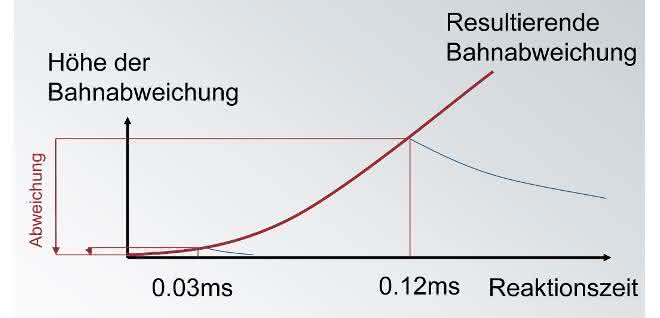
The machining of carbides remains a technical challenge despite all the progress made. Due to their high hardness, machines and machining tools are exposed to extremely high loads, which means that even minor inadequacies can have a significant negative impact on the service life of the tools and the machining quality or prevent successful machining. Even small path deviations of the tools, for example due to insufficient rigidity or zero-point stability of the machine, are particularly critical, as this can quickly drive the load on the cutting edges into the red zone. In the same context, the smooth running, rigidity and damping of the machine tool are also crucial. Careful attention should be paid to the tools themselves to ensure that they are suitable for the intended processing and the corresponding material. An indiscriminate glance at the catalog or the selection of an alleged "universal solution" can lead to drastically reduced tool life or defects in the product if the material and tool are unsuitably paired.
Another aspect is the milling strategies and NC programming, which should be optimized specifically for the respective task. This involves aspects such as avoiding suboptimal trajectories, which can cause excessive wrap, or optimizing the wear of ball nose end mills by evenly distributing the contact points over the entire length of the cutting edge.
Basics of machining hard metals
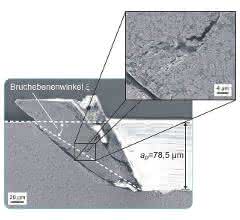
"Hard metals have hardnesses in the range of around 1,500 to 2,000 HV and flexural strengths of up to 4,500 MPa," explained Prof. Wolfgang Hintze from the Institute of Production Management and Technology at TU Hamburg. In order to be able to machine them, the penetrating cutting edge must have a higher hardness. This applies to materials such as polycrystalline cubic boron nitride (PCBN), polycrystalline diamond (PCD) and chemically vapor deposited diamond (CVD). Developers are also focusing in particular on tools made of carbide with a CVD diamond coating. Under suitable conditions, quasi-continuous ductile chips can be removed. The cutting force level is high and increases significantly due to wear of the cutting edges, whereby CVD diamond behaves better than PCBN. During machining, residual compressive stresses occur in the surface of the workpiece, which have a positive effect on its behavior in use and can lead to significantly longer tool life. The main wear mechanism for PCD tools is chip and flank wear due to abrasion, while the service life of diamond-coated carbide tools is limited by failure of the coating.
Coordinate grinding with electroplated or ceramic-bonded diamond grit is an alternative to machining with special milling tools. These tools are relatively inexpensive to purchase, achieve good tool life and enable high surface qualities. However, due to the grinding process, their use is limited to flat surfaces.
Requirements for machine tools
"Milling and grinding machines for carbide machining must have very specific features," revealed Jürgen Röders, Managing Director of Röders. First and foremost, particularly high precision, rigidity and damping must be mentioned. This requires a very rigid design. The control frequency of the drives is also particularly important. The higher it is, the faster path deviations - for example due to cutting forces - are detected and corrected. Based on this knowledge, Röders has developed 32 kHz controllers, which have further improved the achievable surface qualities. Linear direct drives, which unlike ball screws have no spring-loaded intermediate links between the drive and the axis position, also contribute to precision.
Zero point stability is also very important, i.e. the zero point must not drift away even during longer machining times. The latter is a prerequisite for consistently low chip thicknesses as well as high dimensional accuracy and machining quality. Low chip thicknesses in combination with minimal vibrations are decisive for the service life of the tools. High zero-point stability requires particularly sophisticated temperature management of the machine tool. In the same context, control of the change in length of the spindle with changing loads or speeds should also be mentioned. Temperature management also includes the cooling lubricant. Aqueous coolant emulsions influence the temperature of the work area and the workpiece in a way that is difficult to control due to evaporative cooling, which is why oil cooling is more suitable. As the machines from Röders therefore meet all the requirements for efficient milling of carbides, but are also suitable for jig grinding, the user can choose the right machining strategy for every task.
Tools for carbide machining
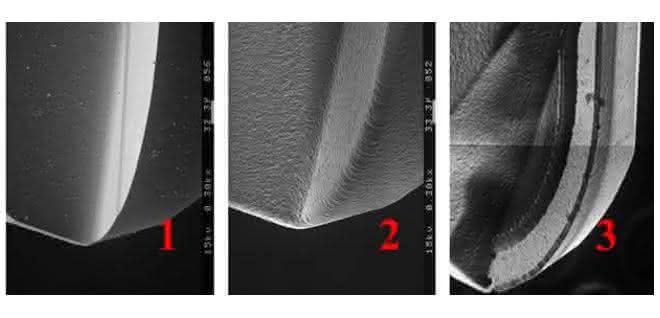
"Union Tool has developed solid carbide tools with a special diamond coating that are particularly suitable for machining carbide," said Robert Schönfelder, Managing Director of Six Sigma Tools. In his experience, dies and punches made of carbide that have been produced by milling often have a tool life that is several times longer than those that have been machined by eroding. The reasons for this are the absence of corrosion and the low heat input, as the heat is removed with the chips during machining. Other advantages include greater precision, better dimensional accuracy and a better surface finish. The latter is also achieved immediately during machining, without the need for an additional polishing operation. The solid carbide tools in the UDC series have a special, 20 µm thick high-performance diamond coating, which is applied using the CVD process. The cutting edges rounded by the coating are then sharpened using a special preparation. This considerably reduces cutting forces and significantly increases tool life. In addition to milling cutters, drills and thread whirling tools have also been developed. The results speak for themselves: a 20 mm deep hole with a diameter of 6.8 mm in a solid carbide block could be produced in just two minutes, and the production of 16 M5 or M6 threaded holes took just three hours in total, whereby the threads were true to gauge. When determining the pull-out forces, it turned out that these were many times higher than for threads that had been produced by erosion.
CAD/CAM software suitable for carbide machining
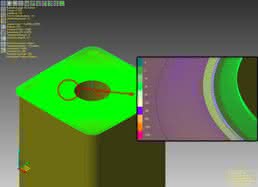
"VISI is specially designed for use in tool and mold making and is based on a Parasolid kernel that enables the machining of wire, surface and solid models," said Ferdinand Hoischen, sales representative at Mecadat. The machining functions offer extensive milling strategies for 2.5-axis, 3+2-axis and 5-axis machining with special HSC options. Thanks to numerous standard interfaces, the system is completely open. However, a prerequisite for good results is good CAD data quality: Successful machining of carbide is only possible if this is given. "VISI offers a whole range of CAD functions for carbide machining in order to process the data with the highest possible accuracy, such as improving edge accuracy," added Sebastian Krause from Mecadat Support. Other CAM functions enable reduced feed rates when moving into or out of the contour; the reduction is divided into different feed ranges in order to avoid break-outs. All important phases of machining can also be controlled from the feed rate during drilling. In 5-axis simultaneous machining, continuous tilting from 8 to 20° ensures that the cutting edge is used as evenly as possible over its entire length and is therefore utilized in the best possible way. High-speed stroke grinding can be used for grinding external contours.
The practical demonstration
The theoretical presentation of the requirements for carbide machining was rounded off by the presentation of two real applications in Röders' technical center on the RXP500 and RXP501DSC machines. The seminar participants were given an insight into the VISI programs as well as detailed explanations of the machining strategy directly on the machines. For optimum efficiency, milling with tools from Six Sigma with diameters of 5 mm for roughing and up to 0.7 mm for finishing were combined with jig grinding when machining the punches. Surface finishes of up to Ra 0.015 µm were achieved. In the concluding discussion, J. Röders summarized the results of the day as follows: "The machining of hard metals is economically feasible, provided that good solutions are implemented in all subsystems. However, if something is done incorrectly at just one point, the machining process will no longer work."
Klaus Vollrath, freelance journalist in Aarwangen, Switzerland / ag


You might also be interested in
In-house exhibition Bielefeld 2026
How DMG Mori thinks about the factory of the future
DMG Mori will be showcasing turning and milling expertise, automation solutions and additive manufacturing along the Machining Transformation (MX) at the Bielefeld 2026 in-house exhibition.
 read more...
Up to 50 percent higher cutting speeds
The current market situation is putting pressure on companies that rely on carbide tools: Rising raw material costs, volatile supply chains and limited predictability are putting pressure on the industry. Fette Werkzeugtechnik, a member of the LMT...
read more...A robot for all occasions
Industrial robots take on many tasks. Even milling with accuracies in the sub-millimeter range is now possible.
read more...High metal removal rate for high maneuverability
Large module gears for ship drives place high demands on machining. Switching from skiving to 5-axis simultaneous milling with high-feed tools considerably shortens the roughing process. Process parameters and a well thought-out tool selection are...
read more...Schunk shows flexible systems for electronics production
Schunk Electronic Solutions will be exhibiting modular, flexible systems for electronics production at Productronica 2025 - from stand-alone depaneling systems to fully integrated inline solutions.
read more...Hydraulic 4-jaw chuck for automated workpiece clamping
HWR Spanntechnik presents a hydraulically actuated 4-jaw chuck for automated workpiece changing. The clamping device is designed to enable short set-up times, precise clamping and high productivity in automation.
read more...Corner, face and plunge milling
Paul Horn is expanding the DA milling system for corner, face and plunge milling. With the DA65 variant, the system offers a larger cutting insert compared to the existing DA62.
read more...World premieres at the EMO 2025
From September 22 to 26, 2025, Grob will be presenting several innovations at EMO Hannover. The focus of the trade fair appearance will be on the latest 4- and 5-axis universal machining centers and the associated automation solutions.
read more...Flexible and efficient processing
New high-performance CNC series
Fanuc's presentation at EMO will focus on the new FS500i-A CNC series. The new CNC generation offers high user-friendliness, process optimization as well as digital and network technologies.
read more...