
Laser Blanking
Improving the forming process
Laser blanking is an alternative to conventional cutting. This allows lines to be operated more flexibly, cost-effectively and with less material. At the same time, capacity utilization and throughput increase.
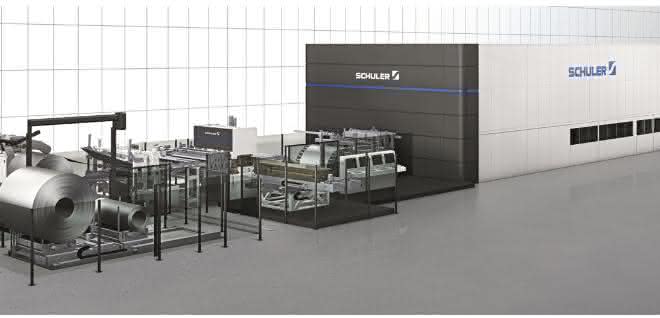
Schuler 's laser blank cutting systems supply press lines of many automotive OEMs and suppliers. As a result, complete sets of cutting tools can be saved on new models - with around a dozen tools per vehicle body, this results in a cost reduction in the millions of euros. OEMs and TIERs also benefit from laser-cut blanks in the downstream forming process.
The proportion of aluminum in vehicles is increasing, but the surface-sensitive material presents processors with the challenge of gentle handling. Aluminum tends to form burrs on the lower cutting edge. If this burr becomes detached and remains in the forming tool, it leads to marks on the material surface and thus to rejected components. To avoid burrs, additional system components such as flake extractors or blank cleaning systems are required as well as system stops to clean the forming tools. Aluminum blanks produced on a Schuler Laser Blanking Line hardly form any burrs. By eliminating the need for regular cleaning, laser-cut blanks increase the productivity of the press lines.
Depending on requirements, blank geometries can be adapted in the laser cutting program and produced in small batches without tools. In contrast to the flatbed lasers usually used for this purpose, the blanks are not cut out of a rectangle in a laser blanking line, but directly from the continuously passing strip material of the coil.
In addition, there are technical material savings and corresponding cost savings.
Higher output
In addition to the aspect of material savings, the much higher output rates speak in favor of cutting in "Dynamic Flow". While flatbed lasers can usually produce between two and three such blanks per minute, the output rates for hoods on a laser blanking line, for example, can reach up to 35 parts per minute with a system efficiency of over 80 percent.
Depending on the purchasing strategy, either small tryout batches can be flexibly run on the laser blanking line at the touch of a button between series production or purchased from a supplier with a laser blanking line. Laser blanking combines the possibility of flexible geometry adjustment and tool-free cutting of flatbed lasers with short response times, as it not only allows faster production but also eliminates the upstream cut-to-length process.
Changes can also be made during series production. While adjustments to the forming or cutting tool involve pre-production and tool work, the contour of laser-cut blanks can be easily changed. The previous status can also be restored at any time. This also offers the opportunity to test optimizations.
According to documents from Schuler / am


You might also be interested in
New loyalty program at Conrad
With its platform economy, Conrad Electronic enables simple and fast procurement from a single source and acts as a solution provider to make it as smooth as possible for business customers to cover their technical needs.
 read more...
Supply chains for injection molded parts
How to move tools successfully
Supply chains are coming under pressure, manufacturers are disappearing from the market, successors remain open - for purchasers in the plastics industry, this has long been no exception, but a daily reality. Companies that buy in injection molded...
read more...Integrated pneumatic lifting pin
A pneumatically operated, self-locking ball support pin enables seamless integration into robot and handling systems.
read more...Flexible lever solution for electromobility
With electromobility, the number of lithium-ion batteries that need to be moved, dismantled or tested during vehicle servicing, take-back campaigns or recycling is growing. However, weighing around 700 kg, these power storage units place high...
read more...Innovation for a strong SME sector
Small and medium-sized suppliers face tough national and international competition. These companies can achieve the required flexibility in production with digitalized manufacturing and automation solutions. Financing models and after-sales service...
read more...Small helpers with a big impact
Spring-loaded thrust pieces and ball lock pins
Whether cup holders, light housings or clamping devices, Halder develops and manufactures standard parts for almost every application and offers a range of around 13,000 standard parts, including spring-loaded thrust pieces, which are used in...
read more...VDMA takes over sponsorship of Intec
With a great response and more than 17,800 trade visitors from 42 countries, Intec was able to draw a very successful balance in mid-March. Together with the supplier trade fair Z, the trade fair duo made a strong contribution to ensuring that...
read more...Small and medium-sized enterprises
Innovation and partnership for a strong SME sector
Mobility, Data & Semiconductor, Aviation & Space - manufacturers in these and other key sectors are dependent on a functioning network of suppliers in many areas.
read more...Safely transported in one easy step
The new threaded lifting pins with handle from Erwin Halder are ideal for transporting or positioning light and medium loads quickly and easily. They are quick and easy to assemble and disassemble and offer a high level of safety and a robust design.
read more...