
Bending and punching basics
Metal forming
Whether in the automotive or electrical industry, power generation or distribution - all of these sectors require control cabinets, busbars and other components that need CNC, bending and punching machines to manufacture them. But there are a few things to bear in mind during the bending and punching process.
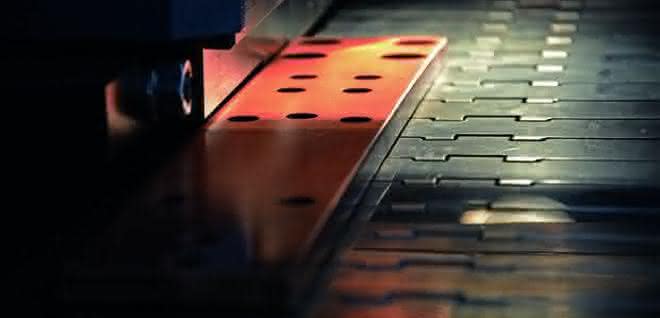
The formability of metallic workpieces is based on their crystalline structure. Forming occurs when external forces act on the material. There are elastic and plastic changes in shape. In the case of elastic forming, the material deforms back to its original shape after the external forces have been applied. A permanent change in shape can only be achieved with plastic deformation.
Forming process
There are various processes for bending or forming workpieces. From compression forming to tensile forming and bending forming to shear forming, there are many different ways to shape the workpiece. There are also fundamentally different processes for tool control. On the one hand, there is the option of a straight-line tool movement during the bending process. Furthermore, tools with a rotating movement can be used for bending. The third option is numerically spatially controlled bending movements during the bending process, for example for pipes. Ehrt Maschinenbau, for example, works with the free bending process, whereby a locally changing component is usually formed by applying a bending moment. Another option for free bending would be bending with a punch.

With copper in particular, it is important to note that, depending on the material type and batch, springback may occur during the bending process despite plastic deformation. Although the metal is bent to the desired angle, the fibers of the workpiece attempt to return to their original state. How strong these forces are varies from material to material, but even with the same type of material, this can vary between different batches and even within a batch.
The size or accuracy of fit of the bending tools is very important in order to ensure optimum conductivity of the workpiece afterwards. This is particularly important for copper to prevent microcracks. The choice of material for the workpieces plays a role that should not be underestimated. The length of the material changes depending on how it is bent. The extent to which the material length changes depends on the type of bending. Specific bending factors resulting from experience and integrated into the software are used as empirical values for calculating the workpieces. In some tables, the K-factor plays a role as a bending factor. However, this is only a theoretical value and cannot adequately replace years of practical experience and knowledge.
Tools in the forming process
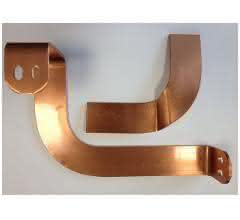
There are various tools for forming metal rails with bending machines. A distinction can be made between mechanical and electronic tools, for example. With mechanical tools, a stroke curve is created in advance to determine the springback of the material. This is then compensated for manually during the bending process so that the metal rail is overbent to such an extent that it remains at the desired angle despite springback. However, this is initially associated with a certain loss of material, as a test workpiece has to be produced to determine the angle. Electronic tools from Ehrt have what is known as springback compensation. This means that the workpiece is automatically bent to the desired angle in two short strokes. The advantage is that there is no need to create a stroke curve or test workpieces in advance and every workpiece reaches the target angle on the first bend. This advantage is particularly important for small quantities or even individual parts.
There are also options for special and customized bends. For example, the metal rails can be bent over the narrow side, shelves with different shelf heights can be bent and workpieces can be twisted. Stack bending refers to the bending of two closely spaced bends in one stroke. The torsion of workpieces also falls under special bending.
Other factors play a decisive role in punching.
Punching - definition and process
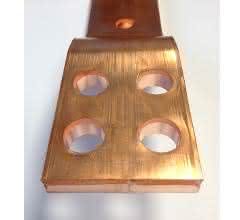
The term punching is not a fixed, standardized term. In practice, however, shear cutting has emerged as the main process under the term punching. This is a cutting process, so the tools are often referred to as cutting tools. The generic term shear cutting also includes punching in a figurative sense: A metal rail is fixed over a die, then the cutting punch (the tool) presses so hard into the workpiece that first an elastic and then a plastic deformation occurs. The edge of the die-cut is cut first, and as soon as the maximum shear stress is exceeded, the last piece tears. Once the punching process is complete, the tool is raised again and the workpiece is transported away on belts, for example. Punching processes are significantly faster in the production process than drilling or milling processes.
Note special features
The cutting clearance is of enormous importance in the design of tools. It describes the difference in size between the punch and die. The correct cutting clearance is selected depending on the material thickness, strength and properties and can be looked up in tables. The punch coatings are particularly important for copper, as copper otherwise smears during punching. The relationship between the "tearing" of the last piece during the punching process and the "cutting" is strongly influenced by the cutting clearance.
The required number of pieces and the processed material should be taken into account for the tools or machines, as these determine, among other things, which machine and which tool is suitable for this type of load.
According to documents from Ehrt Maschinenbau / ag


You might also be interested in
Integrating AI-supported robotics
Markus Hees, Managing Director of Trumpf Deutschland Werkzeugmaschinen, gives an outlook on Blechexpo, which takes place from October 21 to 24 in Stuttgart, in an interview with Andreas Mühlbauer.
 read more...
Production times for aircraft doors drastically reduced
The production of doors for passenger aircraft is largely manual work. However, the TAVieDA research project reduces the production time for the door structure from 110 to just four hours.
read more...Arnold expands the management team
Equipped for the future on the anniversary
July 1, 2024 marked the 30th anniversary of Prof. Dr. h. c. Reinhold Würth's decision to take over the screw production of the L&C Arnold Group at the Forchtenberg-Ernsbach site and integrate it into the Würth Group.
read more...Arnold Umformtechnik expands after-sales...
Faster help with VR glasses
Arnold Umformtechnik is expanding the after-sales service for its machines to include digital remote services. The focus is on data security, simple operation and clear processes.
read more...Nomination Products of the Year 2024
Arnold Umformtechnik: Conform screw
Under the motto "Every screw can be a climate protector", the Conform screw from Arnold Umformtechnik has been nominated in the metalworking category in the competition for Product of the Year 2024. Its use can save costs andCO2.
read more...Punch laser machine for networked production
At Blechexpo 2023, Trumpf will be showcasing a fully automatic punch laser machine for networked production. The TruMatic 5000 enables greater productivity and part quality with reduced energy consumption.
read more...Blechexpo and Schweisstec 2023
Focus on sustainability and automation
The 16th Blechexpo, together with the 9th Schweisstec from November 7 to 10, 2023, will be the meeting place for sheet metal processing.
read more...Digital production world
The motto of this year's leading EMO trade fair is "Innovate Manufacturing".
read more...Modular and individual
Laser systems according to customer requirements - this is what Arnold Maschinenfabrik from Ravensburg specializes in. The portfolio includes systems for laser welding, laser cutting, laser hardening and laser polishing.
read more...