
SpaceX competition
Through the vacuum at 1000 km/h
Students from ETH Zurich won the SpaceX competition organized by US entrepreneur Elon Musk with their Swissloop concept against thousands of other teams. Now, the Swiss students will be able to prove themselves again in the next round in summer 2018 with their further developed capsule. The Swissloop project is supported by Leybold, among others. The vacuum pioneer has been supporting the technology revolutionary's Hyperloop project with its vacuum expertise since 2015.
Whether Mars will be colonized by rockets in Elon Musk's lifetime may be questioned critically. The Tesla founder's utopian ideas are already being realized in the revolution of transportation and the vision of quickly overcoming great distances by land. And the enthusiasm with which his employees and supporters around the world are participating in the innovation with the illustrious name Hyperloop certainly speaks for the appeal of his ideas.
Through the vacuum at 1000 km/h
This is one of the reasons why teams from all over the world have been working on prototypes for the high-speed capsules since 2017. In the future, people will travel through vacuum tubes at around 1000 kilometers per hour. A team of students from ETH Zurich was one of the winners in the transfer of the pneumatic tube idea to passenger transportation. The designers, physicists, computer scientists and mechanical engineers led by Swissloop CEO Luca Di Tizio were able to hold their own against thousands of other teams in the "Hyperloop Pod Competition 2017".
Bronze for the Swissloop capsule
In late summer 2017, they were initially selected as one of 27 out of an original 1200 university teams and were personally invited by Elon Musk to the SpaceX test site in Hawthorne, Los Angeles. There they were able to present the pod they had developed.
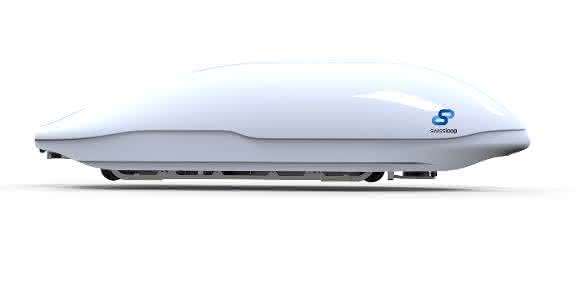
And their success reflected the quality of their concept idea: the snow-white Swissloop capsule took an excellent third place. Despite minor teething troubles, all the members were delighted with the result. Also because the Swissloop crew was the first team to attempt a test run with cold gas propulsion.
Gliding safely through the tube
The persistence and motivation with which the ETH students subsequently worked on further optimizations has now been rewarded once again: since February 2018, it has been clear that Swissloop has officially qualified for the 2018 Hyperloop Pod Competition. And this contest will also be held at SpaceX headquarters in California. From July 15-21, 2018, Swissloop will work closely with SpaceX engineers and the Boring Company to validate this year's pods and test whether the Swissloop pod glides safely through the vacuum tube. The final, where only the best teams will compete, will take place on July 22, 2018.
Great performance
"We are delighted to have taken part in the final and would like to thank ETH Zurich and our sponsors once again for their support," says Swissloop CEO and ETH student Luca Di Tizio. Sponsor and vacuum pioneer Leybold, which has been involved in the Hyperloop project with its expertise since the beginning, was also delighted with the performance of the Swissloop makers.
Strong partners required
Leybold's involvement is a matter close to the vacuum pioneer's heart. The specialist sees great potential in the technology and is convinced that its commitment will help to drive the success of the Hyperloop project. "The challenge of creating something fundamentally new that revolutionizes traditional means of transport is naturally a huge motivation for us," emphasizes Leybold CEO Johan Van der Eeken.
Companies like Leybold are predestined to lead such projects to success with their wealth of experience in the field of vacuum. And vice versa, the project managers at Hyperloop and Swissloop look for strong partners like Leybold to turn such visionary ideas into reality.
Energy self-sufficient system
The Hyperloop concept is essentially based on vacuum technology: the vacuum tunnel massively reduces air resistance and thus enables smooth travel at speeds of up to 1,000 kilometers per hour. At the same time, the tube provides sufficient space for solar panels. The energy required to maintain the vacuum can be generated via the modules located on the surface of the vacuum tubes. The result is an energy self-sufficient system that is not only visionary, but also sustainable.


You might also be interested in
Transport at up to 1,200 km/h
It feels like hardly a week goes by without news of Elon Musk's futuristic projects - such as the expansion of human cognition with Neuralink, the conquest of space with SpaceX or the revolution in mobility with Hyperloop.
 read more...
Logistics solution of the future
Continental supports Hyperloop technology
For the "HyperPodX" project, students from Emden/Leer University of Applied Sciences and the University of Oldenburg have developed a Hyperloop as part of a competition organized by the American company SpaceX. The drive is provided by a...
read more...Industrial Mandate for the Capital Region
Siemens and Stadler to Deliver 350 New Trains for Berlin
The contract award also has implications for the industry: The vehicles will be manufactured in Berlin, and maintenance is to remain in the region on a permanent basis. This will help secure jobs and generate economic value throughout the entire...
read more...New Corporate Structure Separates Feeding...
Köberlein & Seigert will operate under the name Köberlein Technologies going forward
Köberlein & Seigert GmbH, a specialist in feeding technology, has been operating under the name Köberlein Technologies GmbH since March 31, 2026. At the same time, a sister company, Köberlein Solutions GmbH & Co. KG, was founded to handle...
read more...Hummel Expands Its Plant in Denzlingen
Hummel is beginning the expansion of its plant in Denzlingen. The 35-million-euro project includes new production facilities, a nickel-plating plant, and a fuel recovery system.
read more...Wago Appoints Björn Twiehaus as New CEO
Effective September 15, 2026, Björn Twiehaus (48) will assume the position of Chief Executive Officer (CEO) of the Wago Group. Twiehaus succeeds Jürgen Koopsingraven, who is currently serving as interim CEO in addition to his role as Chief Financial...
read more...No Turnaround for the Chemical Industry
The German Chemical Industry Association Warns of Persistent Weakness in Investment
The VCI's 2026 Midyear Report shows that production and revenue in the chemical and pharmaceutical industries continue to decline. Investment has fallen for the third consecutive year.
read more...Bosch, Toyota, BMW, and Repsol Are Testing Renewable Gasoline in Real-World Conditions
Does the mobility transition have to wait for new cars? Bosch, Toyota, BMW, and Repsol are testing renewable gasoline in real-world conditions in Spain. The pilot project aims to demonstrate that more climate-friendly fuels also work with existing...
read more...Hendrik Rawe heads the Trade and Consumer Trade Shows Division
Hendrik Rawe took over as head of Deutsche Messe's Trade and Consumer Trade Shows division effective July 1, 2026. He reports directly to CEO Dr. Jochen Köckler.
read more...