
No Turnaround for the Chemical Industry
The German Chemical Industry Association Warns of Persistent Weakness in Investment
Although the German chemical and pharmaceutical industry slowed its decline in the first half of 2026, a recovery is not in sight, according to the German Chemical Industry Association (VCI). Production was down about 3.0 percent from the previous year, and revenue fell by 1.0 percent to 106 billion euros. At the same time, investments have been declining for the third consecutive year—which the industry association views as the real warning sign.
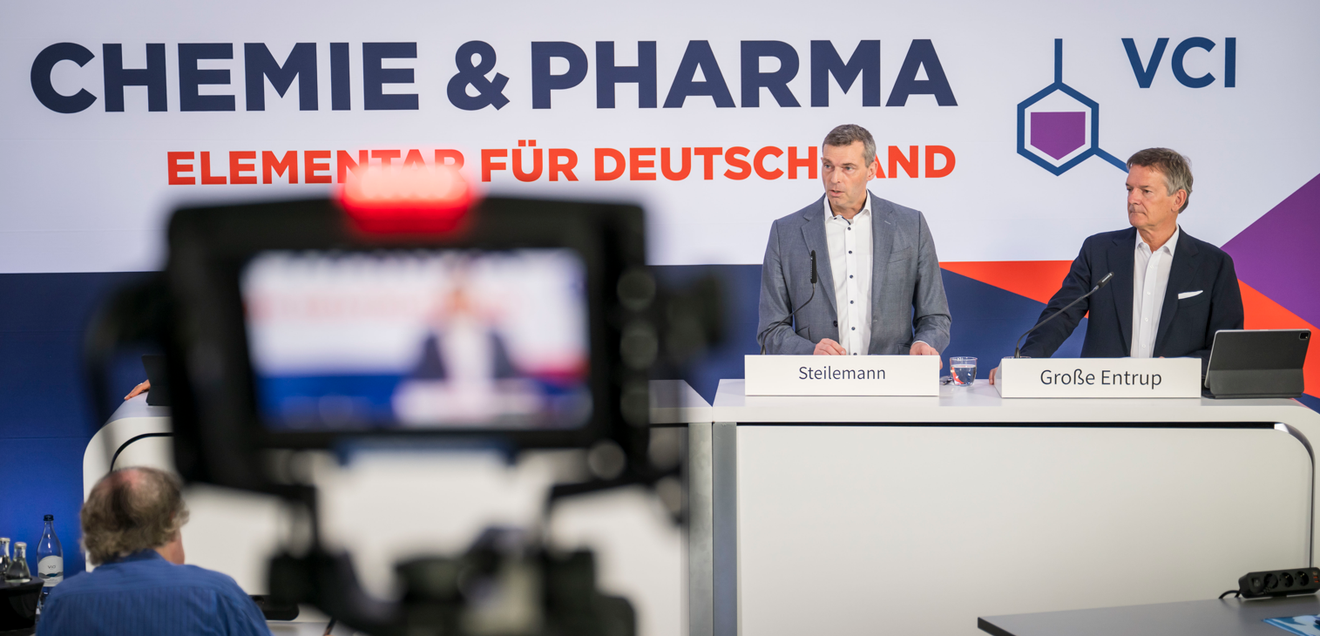
“We are merely experiencing a respite, not a turnaround,” said VCI President Markus Steilemann during the presentation of the midyear report. Although the first half of the year performed better than the second half of the previous year, this is not enough to signal a sustained recovery.
Special geopolitical factors are supporting domestic business
The VCI attributes this slight stabilization primarily to one-time geopolitical factors. As a result of the armed conflicts in the Middle East, companies reportedly increased their inventory levels to prevent potential supply disruptions. At the same time, the temporary closure of the Strait of Hormuz has temporarily eased competitive pressure from Asian suppliers.
Domestic business benefited most of all. Domestic sales rose by 2.0 percent to 40 billion euros in the first half of the year. Export business, on the other hand, continued to perform weakly. Foreign sales fell by 2.5 percent to 66 billion euros. According to the VCI, many production facilities continue to operate below capacity. Production and sales remain well below 2021 levels.
The chemical industry has been hit harder than the pharmaceutical industry
Economic performance varied within the sector. Production fell by 3.0 percent in the chemical industry and by 1.5 percent in the pharmaceutical industry. The decline in revenue was also smaller in the pharmaceutical industry (0.5 percent) than in the chemical industry. At the same time, the VCI points out that business conditions are now deteriorating for pharmaceutical companies as well.
The decline in production was particularly pronounced for petrochemicals and their derivatives, at minus 5.5 percent. Polymers were down 4.0 percent from the previous year. Declines were also recorded for laundry and personal care products as well as cosmetics (-3.5 percent), fine and specialty chemicals (-1.5 percent), and pharmaceuticals (-1.5 percent). The production of inorganic basic chemicals remained relatively stable (-0.5 percent).
The number of employees decreased by 1.0 percent in the first half of the year to approximately 471,500.
Earnings remain under pressure
The weak production figures are also reflected in companies’ expectations. According to a VCI member survey, 47 percent of companies expect their revenues to decline in 2026. Another 22 percent expect no change. Only 31 percent anticipate an improvement in their economic situation.
Rising costs, low sales volumes, and intense international competition are likely to keep pressure on margins high in the coming months as well. For the year as a whole, the association continues to expect a 1.5 percent decline in production. The VCI is refraining from making further forecasts in light of the ongoing geopolitical volatility.
Investments are becoming the real problem for the location
The association is more concerned about investment trends than about the current economic situation. According to the VCI, investment in property, plant, and equipment is now about 15 percent below the 2023 level. This marks the third consecutive year of decline.
International comparisons also paint a sobering picture. According to a McKinsey analysis cited by the VCI, net productive investment in Germany amounts to only about 0.2 percent of economic output. This places Germany at the bottom of the list of industrial locations considered in an international comparison. At the same time, production capacity is also being reduced in Europe without sufficient investment in new facilities or future technologies.
Companies’ investment plans reflect this trend. Forty-five percent of the companies surveyed plan to reduce their investments in Germany. Abroad, however, expansion plans predominate. Foreign locations are also becoming more attractive for research and development.
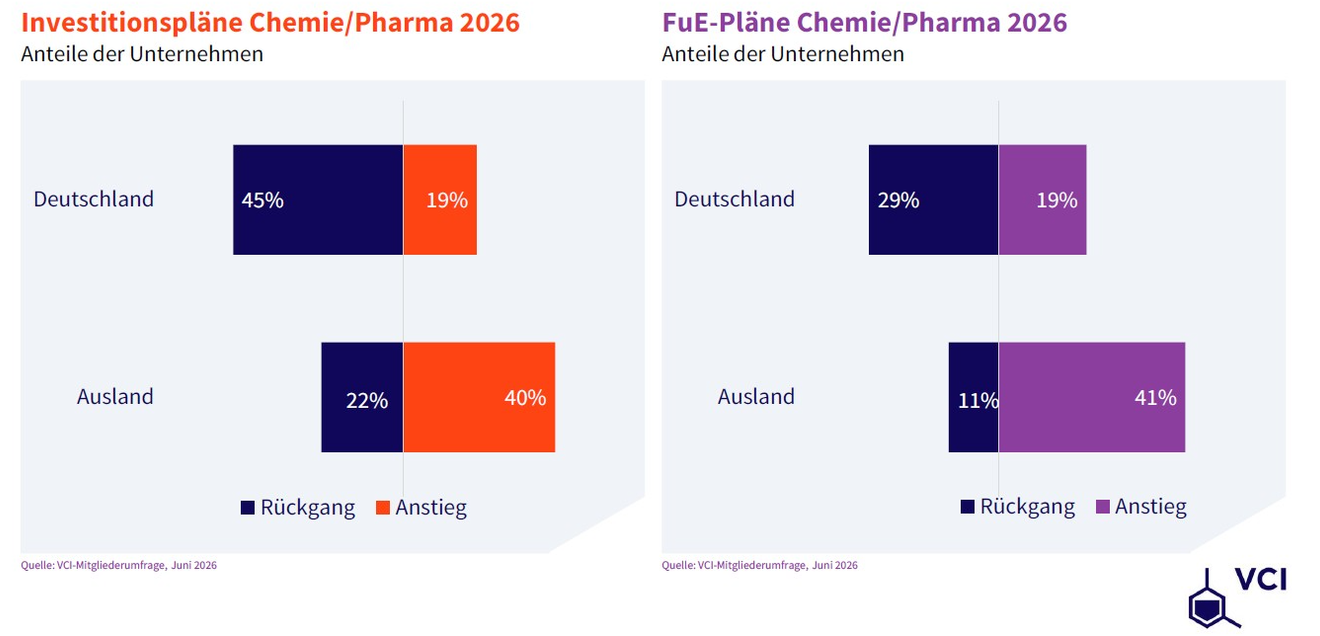
The trend is even more pronounced in research and development. While only 19 percent of companies in Germany plan to expand their R&D activities and 29 percent expect a decline, the focus is increasingly shifting abroad. There, 41 percent intend to expand their research and development activities, while only 11 percent expect a decline. The survey thus suggests that not only investments but also innovation activities are increasingly concentrated outside of Germany.
Companies See Disadvantages of Their Location
Companies cite high location costs as the biggest barriers to investment. 86 percent of respondents view them as a decisive disadvantage. This is followed by energy and climate policy (81 percent), what they perceive as a lack of reliability in industrial policy (61 percent), increasing import pressure (53 percent), and a lack of reforms (51 percent).
Consequently, the assessment of the political framework is critical. More than 80 percent of companies believe that the risks of deindustrialization are not being adequately addressed at the political level. The VCI is therefore calling for, among other things, more competitive corporate taxes, lower labor costs, faster permitting procedures, and further reductions in bureaucracy.
According to VCI President Markus Steilemann, the federal government’s reform package is “the first serious attempt in years” to strengthen Germany as an industrial hub. However, he noted that the key factor will be whether it leads to long-term structural reforms and does not impose additional burdens on industry.
What the Chemical Industry Figures Mean for the Industry
The performance of the chemical industry is traditionally regarded as a leading indicator of industrial economic conditions. So do the current signals extend beyond this sector? The ongoing reluctance to invest and high cost pressures highlight the challenges many industrial companies are currently facing. At the same time, there is a growing need to use existing production capacities more efficiently. Automation, digitalization, and data-driven process optimization are thus becoming increasingly important—not only in the chemical industry, but throughout the entire industrial value chain.


You might also be interested in
Pro-K Publishes Template for EU Declaration of Conformity
Starting August 12, 2026, the PPWR will require manufacturers of various types of packaging to provide a formal EU declaration of conformity. Pro-K has now provided a sample template for this purpose. At the same time, the association warns that...
 read more...
Pöppelmann reorganizes management
Pöppelmann is set for a change in management: Bernd Moormann will join the management board on July 1, 2026. At the same time, Matthias Lesch will leave the management board and the company by mutual agreement after 24 years with the company.
read more...Despite Higher Profits, Evonik Sticks to Its Job Cuts
Following a surprisingly strong second quarter, specialty chemicals group Evonik is more optimistic about the current fiscal year. The company is raising its profit forecast but is sticking to its comprehensive restructuring plan: The planned...
read more...Baerlocher Restructures Its European Operations
Effective July 1, 2026, Baerlocher will transfer its operational business to a newly established subsidiary: Baerlocher Germany, headquartered in Lingen. This wholly owned subsidiary of the former Baerlocher will take over the European business...
read more...International Federation of Robotics
U.S. Robotics Industry Sees Double-Digit Growth
In the U.S., sales of industrial robots rose by 11% compared to the previous year: 38,000 units were newly installed in 2025. This significant recovery is driven by robust growth in the food industry and other non-manufacturing sectors. However, the...
read more...Why the crisis continues
How deep is Germany's chemical industry really in crisis in 2026? After a weak start to the year, burdened by the conflict in the Middle East, high energy costs and global competitive pressure, the German Chemical Industry Association (VCI) paints a...
read more...Stratasys takes over MarkForged
Stratasys is acquiring MarkForged from Nano Dimension for USD 42.5 million, thereby expanding its portfolio in the field of fiber-reinforced composites. The acquisition also strengthens the company's software and materials expertise in industrial 3D...
read more...Wittmann reorganizes the management
Wittmann reorganizes the management team: From May 2026, owners Michael Wittmann and Dr. Werner Wittmann will combine the management of the entire group of companies in a dual leadership team. Rainer Weingraber is leaving the company.
read more...Electricity price subsidies decided
Industrial electricity price is coming, VCI warns of limited effect
The EU Commission has approved the German industrial electricity price: Until the end of 2028, electricity costs for energy-intensive companies can be subsidized with 3.8 billion euros and capped at five cents per kilowatt hour. The VCI criticizes...
read more...