
Green Fuel from the Gas Pump
Bosch, Toyota, BMW, and Repsol Are Testing Renewable Gasoline in Real-World Conditions
A pilot project by Bosch, Toyota, BMW, and Repsol aims to demonstrate that renewable fuels don't have to wait for the next generation of vehicles.
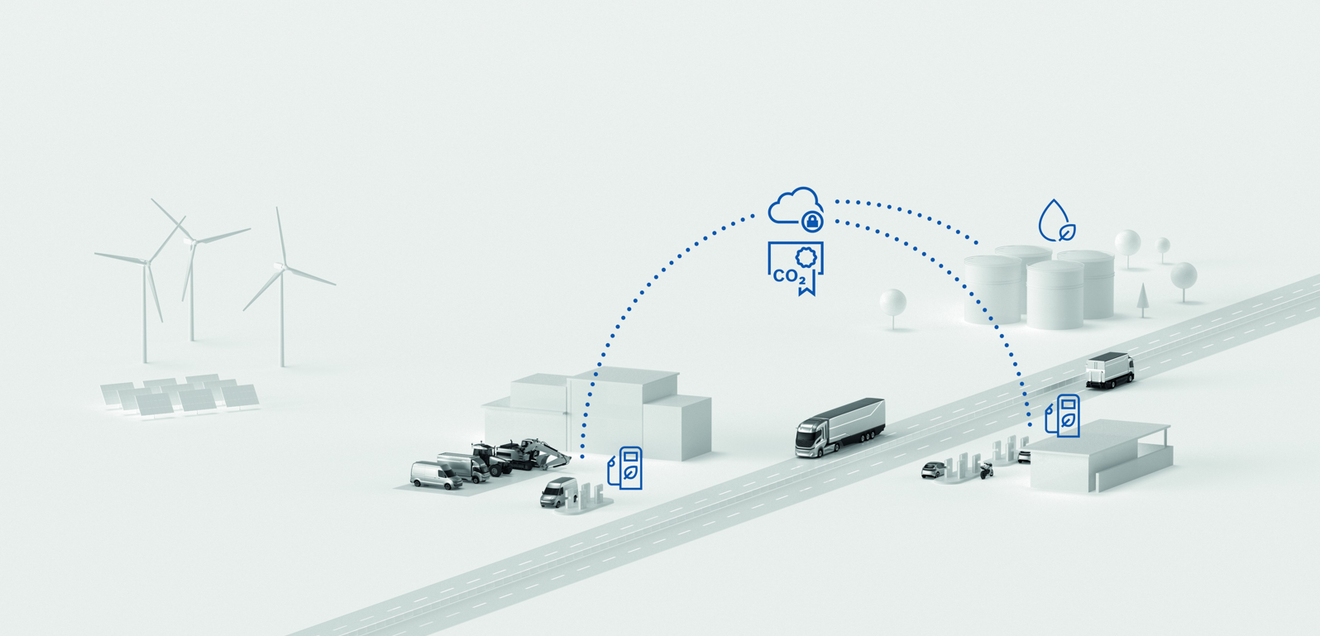
The mobility transition is often associated with one buzzword: electrification. But at the same time, companies are working on other ways to reduce CO₂ emissions in transportation. Bosch, Toyota Motor Europe, the BMW Group, and Repsol now want to show that even existing vehicles can make a contribution—using gasoline that does not come from fossil fuels.
In a joint pilot project, the four companies are testing the use of fully renewable gasoline under real-world conditions. Starting in July 2026, approximately 20 Toyota and BMW vehicles will be operated exclusively on Repsol’s Nexa 95 renewable gasoline in Spain over a six-month period. The trial is supported by Bosch’s Digital Fuel Twin, a technology for digitally capturing, tracking, and validating fuel data.
The idea behind this is that renewable fuels should not only work in the lab, but also with the vehicles, gas stations, and digital certification systems that are already available today.
Tracking the digital trail from refueling to the consumer
Bosch’s Digital Fuel Twin serves as a kind of digital memory for the fuel. The system collects and verifies data from various sources—including vehicle data, information from gas stations, and fuel card transactions. This is intended to make it possible to track which renewable fuel was used, when, and where.
“Bosch’s Digital Fuel Twin ensures complete digital transparency throughout the entire value chain, enabling renewable fuels to be reliably tracked and verified from market entry all the way to the end consumer. By precisely monitoring the fuel consumption of individual vehicles in real time, we lay the foundation for trust and regulatory compliance. This, in turn, promotes the acceptance of renewable fuels in the transportation sector,” says Dr. Marko Babic, product line manager at Bosch and responsible for the Digital Fuel Twin.
The aim is to establish a prerequisite that is crucial for the wider use of renewable fuels: transparency regarding their origin, use, and climate impact.
Existing Vehicles Instead of New Infrastructure
The pilot project deliberately does not rely on a new fleet of vehicles or additional infrastructure. It uses vehicles from the existing fleet: Toyota and Lexus passenger cars from Toyota España’s fleet, as well as vehicles from the BMW fleet.
According to the project partners, this is a key advantage. Renewable fuels could serve as a short-term solution on the path to decarbonizing road transportation, without requiring the replacement of millions of vehicles or a fundamental overhaul of gas stations.
Repsol's Nexa 95 gasoline is produced from RED-compliant feedstocks. Compared to fossil fuels, it produces significantly fewer greenhouse gas emissions and is fully compatible with today's gasoline engines and existing infrastructure.
Spain was chosen as the location for the project because renewable gasoline is available there, the participating partners work closely together, and Toyota España is supporting the operational implementation.
Three questions the project is intended to answer
The pilot project focuses on three key areas:
First, there is the issue of the availability of renewable gasoline on the market. According to Repsol, it is currently the only provider of 100 percent renewable gasoline at public gas stations in Spain.
Second, the goal is to demonstrate that digital tracking and certification technologies are already ready for use today. Bosch’s Digital Fuel Twin is designed to help document renewable fuels throughout their entire life cycle.
Third, the focus is on field testing: The companies want to demonstrate that vehicles in their fleets can run on up to 100 percent renewable fuels using the existing infrastructure.
Technology Neutrality as Part of the Mobility Strategy
The project partners also view the trial as a contribution to the European debate on the future of transportation. While the political discussion is heavily focused on electrification, Bosch, Toyota, BMW, and Repsol want to demonstrate that renewable fuels can play a complementary role in reducing CO₂ emissions.
“Openness to technology is one of the BMW Group’s strategic pillars—at the same time, we want to increase the share of environmentally friendly and efficient vehicles on the road. BMW and MINI are providing vehicles for this forward-looking pilot project and helping to collect valuable data so that we can continue to offer our customers worldwide the best and most efficient powertrains in the future,” says Stefan Heller, head of development for the BMW Group’s VEEF program.
Repsol also sees renewable fuels as a way to reduce the carbon footprint of existing vehicles.
“At Repsol, we are convinced that every gram of reduced emissions counts toward the decarbonization of road transport. This project underscores the importance of renewable fuels as an alternative for consumers to reduce their carbon footprint using their current vehicles and existing infrastructure. As the only company in Spain currently offering 100 percent renewable gasoline at public gas stations, we are proud to contribute our expertise and infrastructure alongside Toyota, BMW, and Bosch. “Real-world data will once again demonstrate how important a technology-neutral approach is for the mobility transition in Europe,” emphasizes Estíbaliz Pombo, Head of Energy Products for Mobility at Repsol.
Real-world traffic data instead of assumptions
Ultimately, the goal is to gain reliable insights from real-world applications. The project aims to demonstrate how renewable fuels can be used in existing fleets and what data is needed for future scaling.
This includes insights into validation and monitoring procedures in research and development, as well as experience with digital concepts for tracking refueling operations. The potential link between fuel consumption and individual vehicles will also be investigated.
“We are convinced that renewable fuels can significantly reduce CO₂ emissions alongside electrification. As the energy transition progresses, it is gradually becoming clear that we may not be able to fully achieve the zero-emissions target for vehicles by 2035. Here, renewable fuels—especially in combination with hybrid and plug-in hybrid technologies—could bridge the gap toward CO₂ neutrality. The pilot project shows that renewable fuels can already make a significant and sustainable contribution to decarbonization in both new and existing vehicles,” says Pascal Ruch, Vice President of Corporate & Governmental Affairs at Toyota Motor Europe.
The project’s findings are therefore not intended to answer merely a technical question. The broader question is which technologies can collectively help make transportation more climate-friendly in the future.


You might also be interested in
A quantum computer that performs calculations using oscillations
When it comes to storing information, quantum computers have so far run up against technical limitations. Instead of electromagnetic storage, researchers are now using mechanical vibrations. Their vibrating memory can store significantly more...
 read more...
Digital twin in battery production
Faster to more powerful batteries
The battery factory of the future is increasingly working digitally: simulations accompany the development of new cells, and intelligent sensors monitor production in real time. Researchers at the Fraunhofer Institute for Industrial Mathematics ITWM...
read more...6 Criteria for the objective comparison of humanoid robots in industry
A new benchmark from Fraunhofer IPA is intended to enable the first standardized and neutral analysis of humanoid robots for industrial use based on six key criteria.
read more...Giving lightweight construction a profile
Pultrusion: A process that forms fibers under tension
Pultrusion is developing from a niche process into a key process for lightweight construction and sustainable fiber composite structures. The Fraunhofer IWU shows applications from energy to mobility.
read more...Automated restoration of windows from old buildings
The Chair of Production Systems at Ruhr University Bochum is working with the company Kilivations to develop a robot-based process for the restoration of windows potentially contaminated with asbestos in old and listed buildings. The aim is to make...
read more...New location in Leipzig for defense and security research
The Fraunhofer FKIE is opening a new site for defense and security research in Leipzig. The focus is on cyber security, resilience and industrial innovation.
read more...Development of self-adaptive industrial robots
Intelligent robotics on the way to industrial applications
The EU-funded "RoboSAPIENS" project aims to develop self-adaptive industrial robots for safe human-robot collaboration. Initial results from the Fraunhofer IFF show successful tests with digital twins in real production environments.
read more...Europe is increasingly losing touch in chip research
The research and development of semiconductor technologies is increasingly taking place outside Europe, particularly in Asia. This is shown by evaluations of semiconductor patents by EconPol Europe.
read more...Why a data-secure Germany needs joint implementation
Is 2026 a key year for a data-secure and networked Germany? Michael Fritz from the Fraunhofer Cluster CCIT explains why the coming year will be crucial for secure data spaces, common technical standards and Germany's digital future.
read more...