
Industrial Mandate for the Capital Region
Siemens and Stadler to Deliver 350 New Trains for Berlin
The Berlin S-Bahn will undergo extensive modernization in the coming years. S-Bahn Berlin, Siemens Mobility, and Stadler Deutschland have won the contract award process for the Berlin S-Bahn network. The award is now legally binding following receipt of the notice of award.
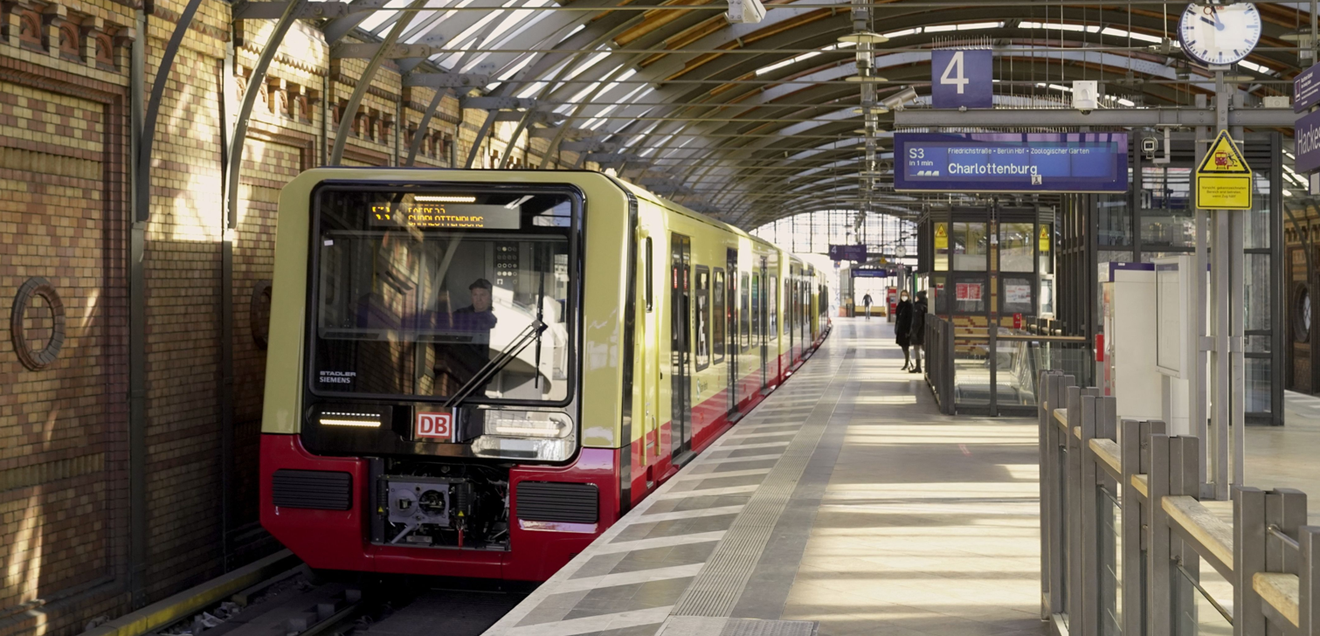
The consortium, consisting of an operator, a vehicle manufacturer, and a technology company, will thus take on several tasks that were previously handled separately: It will supply new vehicles, manage their long-term maintenance, and operate two subnetworks.
The plan is to deploy 350 four-car, end-to-end trains. Maintenance is scheduled for a period of 30 years. Operation of the North-South and light rail subnetworks is to be taken over for 15 years.
“For more than 100 years, the S-Bahn has been ensuring the mobility of 1.4 million people every day. Together with our employees and our strong partners, I am very much looking forward to continuing to tackle this important task with passion in the future,” says Heiko Büttner, CEO of S-Bahn Berlin GmbH.
A mission that extends beyond the rails
The contract award affects more than just local public transportation in the capital region. It also has implications for industry: The vehicles will be manufactured in Berlin, and maintenance is to remain permanently based in the region. This will help secure jobs and generate economic value throughout the entire supply and operations chain.
For Siemens Mobility, the contract also marks a continuation of its partnership with the capital. Michael Peter, CEO of Siemens Mobility, says:
“Berlin deserves an efficient, sustainable, and future-oriented S-Bahn system. As a technology company with roots in Berlin, we have felt a connection to this city for generations. Together with our partners, we are making an important contribution to advancing the mobility of millions of Berliners well into the future. With digital technologies, smart maintenance, and sustainable mobility solutions, we are laying the foundation for a high-performance and future-proof S-Bahn system in Berlin.”
Further Development Instead of a Fresh Start
For the new vehicles, Siemens and Stadler are relying on a proven design. The basis is the current series that both companies developed and delivered for the Berlin S-Bahn’s ring network. According to the companies, the trains were delivered on time and have covered more than 120 million kilometers since entering service.
This concept has been further developed for the new light rail and North-South lines. Changes include, among other things, the driver's cab, fire safety, and cybersecurity. The propulsion system has also been redesigned. The goal is to reduce energy consumption over the entire service life.
The exterior appearance of the trains will remain unchanged. As a result, a design that passengers have primarily been familiar with on the Ringbahn will gradually become visible throughout the entire S-Bahn network.
Peter Spuhler, Chairman of the Board of Directors of Stadler Rail AG, says:
“I am extremely pleased about this important contract, which Stadler—together with our partners at S-Bahn Berlin and Siemens—will now implement with full commitment and great enthusiasm. During the negotiations, I personally advocated for Berlin to receive, as quickly as possible, the modern S-Bahn trains that this great city deserves. With this order, Stadler will manufacture all of Berlin’s modern subway and S-Bahn trains in the future. The 350 trains will be built in Berlin and for Berlin.”
More space for a variety of needs
The design of the interiors focused primarily on accessibility and flexible use. To this end, Stadler developed a new interior concept designed to accommodate various passenger groups.
Among other features, the multipurpose area offers a wheelchair-accessible space, a seating area for people of short stature, and additional options for companions of passengers with limited mobility.
The air conditioning system has also been redesigned. A system using an environmentally friendly, halogen-free refrigerant and cold-water technology is designed to maintain stable temperatures inside the vehicle—even when outside temperatures are high. In addition, USB-C charging ports will be provided at every other seat.
Maintenance Based on Data Rather Than Fixed Intervals
Digital maintenance is a key component of the project. Siemens Mobility uses the "Railigent X" system for this purpose, a platform for data-driven management of operations and maintenance.
The vehicles, infrastructure, and Train-IT are all interconnected. Condition data will be continuously analyzed to identify maintenance needs early on. To this end, Railigent Fleet Manager monitors vehicle condition in real time, analyzes operational data, and supports the planning of work orders.
This approach is based on the principle of predictive maintenance: Maintenance should not be triggered only after a failure occurs; rather, insights from operational data should help identify potential problems early on. Digital processes are designed to help plan materials, equipment, and personnel more efficiently.
Supplementary cybersecurity services, such as software maintenance and vulnerability monitoring, are intended to ensure the secure operation of systems and vehicles.


You might also be interested in
New Corporate Structure Separates Feeding...
Köberlein & Seigert will operate under the name Köberlein Technologies going forward
Köberlein & Seigert GmbH, a specialist in feeding technology, has been operating under the name Köberlein Technologies GmbH since March 31, 2026. At the same time, a sister company, Köberlein Solutions GmbH & Co. KG, was founded to handle...
 read more...
Hummel Expands Its Plant in Denzlingen
Hummel is beginning the expansion of its plant in Denzlingen. The 35-million-euro project includes new production facilities, a nickel-plating plant, and a fuel recovery system.
read more...Wago Appoints Björn Twiehaus as New CEO
Effective September 15, 2026, Björn Twiehaus (48) will assume the position of Chief Executive Officer (CEO) of the Wago Group. Twiehaus succeeds Jürgen Koopsingraven, who is currently serving as interim CEO in addition to his role as Chief Financial...
read more...Hendrik Rawe heads the Trade and Consumer Trade Shows Division
Hendrik Rawe took over as head of Deutsche Messe's Trade and Consumer Trade Shows division effective July 1, 2026. He reports directly to CEO Dr. Jochen Köckler.
read more...Eric Goos Appointed to the Board of Sumitomo Drive Technologies
Sumitomo Drive Technologies EMEIA continues to expand its leadership team: Eric Goos has been appointed to the board and will serve as managing director of Cyclo Drive Germany GmbH.
read more...Commvault Appoints Brian Lanigan as Chief Partner Officer
Commvault has appointed Brian Lanigan to the position of Chief Partner Officer. He is responsiblefor thecompany’s global partner strategy and is tasked with further expanding the global partner networkof the data security, backup, and recovery...
read more...Dr. Achim Degner to Become the New CFO of the Röchling Group
The Röchling Group will have a new CFO as of July 6, 2026: Dr. Achim Degner will assume the position at the Mannheim-based, internationally active plastics specialist. He succeeds Evelyn Thome, who left the company on June 30, 2026, at her own...
read more...Joachim Bürkle is the new managing director of the AI Quality & Testing Hub
The AI Quality & Testing Hub (AIQ) is getting new leadership: Joachim Bürkle is taking over as managing director of the AI competence center run by VDE and the State of Hesse.
read more...VDMA Electrical Automation Division
Mathias Wolpiansky Elected to the Board of Directors
Mathias Wolpiansky, managing director of Rose Systemtechnik, has been elected to the board of the VDMA Electrical Automation Division through 2030.
read more...