

Intelligent 3D glasses
Framos develops 3D glasses for the visually impaired
Together with the CDTM Institute at the Technical University of Munich, Framos has developed a wearable that uses 3D real-time technology to support the visually impaired in everyday life. The glasses are equipped with the latest Intel RealSense stereo cameras, and intelligent algorithms translate the visual signals into haptic and acoustic information.

The audio information is based on the recognition of objects and lettering, while the visually impaired receive haptic feedback on positions and distances via a wristband equipped with vibration motors. This new type of perception enables blind and visually impaired people to fully understand their surroundings and navigate safely.
Visual impressions and information remain hidden for over 108 million blind and visually impaired people worldwide. The names of stores, streets, public transport lines and traffic signs are invisible, and navigating without this information is a real challenge for those affected. The 3D glasses developed by Framos represent a new way for the visually impaired to explore their surroundings and benefit from the most advanced technology.
Dr. Christopher Scheubel, Framos Business Development: "We are proud to have developed an application with state-of-the-art technology that has a great impact on the daily lives of visually impaired people. This project captures the true meaning of innovation by truly empowering people and improving their lives. The extraordinary thing about the technology is its ability to provide visual information that is normally output by the human eye and to retranslate it. Our technology thus creates a new way of perception."
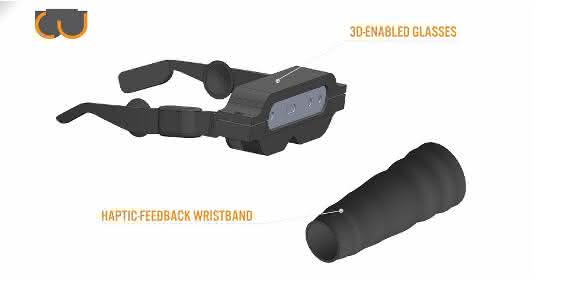
The 3D-enabled wearable creates a new type of perception by transmitting visual information in real time as haptic feedback to a wristband. Based on the exact position and movement of the vibration on the arm, the visually impaired person is informed about the position and distance of things in their environment. The prototype contains an Intel RealSense 3D camera and speakers for audio feedback. The setup is controlled by a processing hub with a GPS sensor for positioning and an LTE module for mobile data connection. A microchip sends the data via Bluetooth to the wristband, which is powered by a 2D array and vibration motors. Voice control facilitates interaction and rechargeable batteries enable all-day use.
The glasses are therefore an intelligent assistant that supports the blind and visually impaired in everyday life. Intelligent algorithms enable text and object recognition and thus offer a new level of safety and knowledge. The first prototype uses state-of-the-art vision technology and reflects the company's mission to make machines see and think. kp


You might also be interested in
New Chief Revenue Officer at ProGlove
ProGlove has appointed Charlie Grieco as Chief Revenue Officer. The North American sales manager is taking on a global role to introduce the glove scanners to more companies.
 read more...
Assisted reality in production
Digitalization and Industry 4.0 are constantly giving rise to new business models and production processes. Smart assistants help with their implementation. One example of this is assisted reality solutions.
read more...New Head of Software at Proglove
Keith Andrew Ball is the new Vice President of Software Engineering at industrial wearables specialist Proglove.
read more...Cooperation with accelerator M.Tech
Festo expands cooperation with start-ups
With the Stuttgart-based M.Tech program, automation specialist Festo is working with other companies to promote the growth of start-ups.
read more...Embedded vision product range with sensor modules
The Framos Group is launching its own embedded vision product range to facilitate the development of imaging solutions.
read more...New Corporate Structure Separates Feeding...
Köberlein & Seigert will operate under the name Köberlein Technologies going forward
Köberlein & Seigert GmbH, a specialist in feeding technology, has been operating under the name Köberlein Technologies GmbH since March 31, 2026. At the same time, a sister company, Köberlein Solutions GmbH & Co. KG, was founded to handle...
read more...Hummel Expands Its Plant in Denzlingen
Hummel is beginning the expansion of its plant in Denzlingen. The 35-million-euro project includes new production facilities, a nickel-plating plant, and a fuel recovery system.
read more...Wago Appoints Björn Twiehaus as New CEO
Effective September 15, 2026, Björn Twiehaus (48) will assume the position of Chief Executive Officer (CEO) of the Wago Group. Twiehaus succeeds Jürgen Koopsingraven, who is currently serving as interim CEO in addition to his role as Chief Financial...
read more...