
Torsion-resistant precision gearbox
Precise gears for free-form bending
High positioning accuracy and reproducibility thanks to reduced backlash and high torsional rigidity, coupled with the option of individual optimization for special installation situations - these are the demands placed on the planetary and angular gearboxes in 6-axis free-form bending machines. As a result, the gearboxes enable the precise forming of tubes and profiles at high processing speeds.
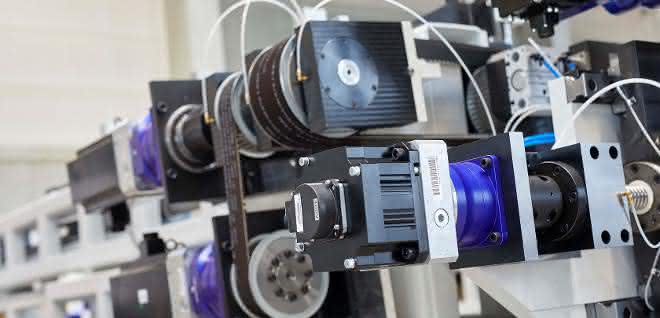
Planetary and right-angle gearboxes for all axes and requirements - that is what the Wittenstein Alpha portfolio offers. This ranges from the Basic and Value to the Advanced and Premium segments and covers a wide variety of technical and economic performance requirements, enabling machine manufacturers to implement their respective applications in a technically suitable and economically coherent manner. Such as J. Neu GmbH, a manufacturer of tube and profile processing machines. "High quality and power density, particularly expressed in terms of minimal torsional backlash, torsional rigidity, dynamics, torque and compact design, are the key requirements for the gearboxes for our free-form bending machines," says Lothar Kummermehr, responsible for sales at J. Neu. The Advanced Line gearboxes used - TP+, SP+ and TK+ - as well as the Premium Line gearbox XPK+ guarantee the highest possible dimensional accuracy of the tubes and profiles bent on the machines in 2D and 3D.
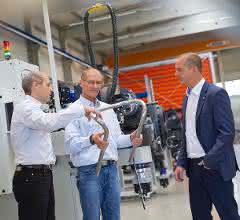
The company J. Neu - founded in 1995 and based in Grünstadt in Rhineland-Palatinate since 2001 - is involved in the development, design, manufacture and supply of machines for tube and profile processing. "We bend almost everything for almost everyone," answers Managing Director Jörg Neu when asked about his clientele and their requirements. "Parts for car manufacturers and suppliers make up the majority, but we also bend baby swings, stirring hooks for sausage and baking machines, frames for motorcycle cases, grab rails for rail vehicle entrances, components for wheelchairs, stair lifts and elevators and, of course, some for the furniture industry."
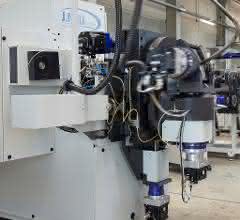
Pioneer of a special bending technique
Over the years, freeform bending has become the company's main source of revenue. "One reason for this," says Lothar Kummermehr, "is that it is a special, patented bending technique that only a few people in the world have mastered." In contrast to rotary draw bending, symmetrical and asymmetrical parts are not bent around a fixed shape by drawing, but are formed by pushing them through a bending head. This has various advantages for the end product: The part is handled more gently - important for visible exterior parts on cars or even furniture. The wall thickness in the bends also remains virtually the same - no safety margins need to be taken into account for the walls. And with feed speeds of up to 300 mm/s, the bending process is significantly faster and more flexible and ultimately becomes more economical the more 2D and 3D forming operations are carried out on a part. "The highest precision is required for almost every part, which is expressed in tolerances in the hundredths of a millimetre range," explains Lothar Kummermehr, before moving directly on to the resulting requirements for the gearboxes: "In order to be able to form with this precision, we rely on particularly low-backlash, torsionally rigid and at the same time torque-tight gearboxes in our machines, which guarantee high reproducibility of the bending shapes and availability of the bending processes and at the same time enable short cycle times thanks to their high dynamics."
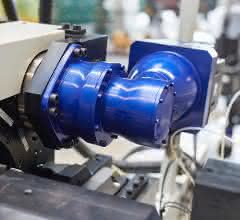
In total, several planetary and angular gearboxes are used in the five axes of the free-form bending machines for the workpiece feed and mandrel retraction. "From a process engineering perspective, the high torsional rigidity and positioning accuracy in the bending head spoke in favor of using the TP+ 110 gearbox with output flange," says Kummermehr. "The torsional backlash of less than three angular minutes ensures high precision and reproducibility across all bent components, even with the extremely high number of load changes in the bending head, so that the user can continue to process them in production without any problems." Another aspect is the compactness of the TP+, which minimizes the interfering contours in the bending area of the machine and allows more design freedom.
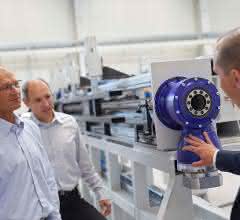
As tubes and profiles made of normal and high-strength steels, stainless steel and aluminum with outer diameters of up to 90 mm are formed on the free-form bending machines, very high forces must be controlled on the feed axis. "We have synchronized two SP+ 210 gearboxes as a gantry in order to generate the required torques and the resulting feed forces," says Kummermehr. "At the same time, these gearboxes are also characterized by minimal backlash and high reproducibility during material feed." Two further SP+-140 gearboxes ensure precise and dynamic height and lateral adjustment of the bending head. The TK+ 110 angular gearbox on the axis for mandrel retraction was modified to suit the customer and application. "Here, Wittenstein Alpha has integrated a planetary roller spindle into the hollow flange shaft on the output side so that we can connect the gearbox to the retraction axis without additional components. The angled design also reduces the mounting space required in the extension of this axis without significantly affecting the torsional rigidity and positioning accuracy."
Low torsional rigidity
A gearbox from the Premium Line - the XPK+ - is used on the torsion axis, which allows the part to be formed around its own axis during the bending process if required. A special feature of the gearbox is the output interface. It is designed for very high torques and enables power transmission that exceeds the industry standard. In addition, it can also absorb high radial and axial forces. Finally, the XPK+ is characterized in the application - due to the high-quality gearing - by a permanently low backlash of less than one angular minute as well as maximum torsional rigidity. "Here too, Wittenstein Alpha made an application-specific adaptation," explains Lothar Kummermehr, "so the gearbox does not protrude into the bending space." With the high-performance and power-dense planetary and angular gearboxes from Wittenstein Alpha, machine manufacturer J. Neu optimally meets the requirements of the individual axes.
Michael Stutzer, Field Sales, Wittenstein Alpha / am


You might also be interested in
Cyber attack!
The risk of cyber attacks has increased rapidly in recent years. Internal IT employees are often unable to efficiently prevent an attack or respond adequately to an attack.
 read more...
Mobile robotics with 5G
Mobile Industrial Robots (MiR) will be showcasing highlights from its current range at Logimat.
read more...Taken on the hook
MiR launches the MiR250 Hook for automated material transport with trailers.
read more...Where IT meets OT
The u-control 2000 web control system integrates real-time automation and communication for the Internet of Things and is therefore the interface between Information Technology (IT) and Operational Technology (OT).
read more...Ergonomics coach with seal of approval
The design of healthy workplaces promotes economic efficiency. Ergonomics is at the heart of this. Some Krieg Workflex specialists have been trained as certified ergonomics coaches in order to provide better advice on what optimal workplace systems...
read more...Anti-rotation bolts with beveled edge
The new anti-rotation locking bolts from Norelem enable directional, independent locking thanks to a bevel.
read more...4 tips for challenging employees without overwhelming them
The digitalization of the world of work is accompanied by new demands on employees. The change is that employees are now expected to be self-organized and permanently in learning mode. For companies, it is now a question of challenging employees...
read more...Interview on predictive maintenance
"Predictive maintenance holds great potential"
Predictive maintenance will have a major impact on traditional service culture, if not revolutionize it. Simon Noggler, IoT expert and Senior Business Consultant at the consulting and software company DoubleSlash, is convinced of this.
read more...Compact plug-in
The Omnimate BLF 3.5 signal conductor connectors with push-in connection technology from Weidmüller meet the demand for compact devices that require precisely fitting connection technology for devices in industrial automation technology.
read more...