
Interview on predictive maintenance
"Predictive maintenance holds great potential"
SCOPE: Mr. Noggler, what is the difference between condition monitoring and predictive maintenance?

Simon Noggler: Condition monitoring refers to the systematic monitoring of machines and systems. Data on the actual situation is recorded and evaluated for this purpose. It serves as a basis for intervening if something is not working as desired. Condition monitoring is therefore reactive.
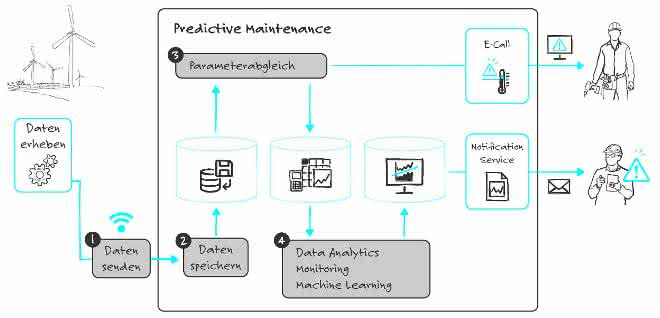
Predictive maintenance, on the other hand, relies on anticipatory action. To this end, the current status data from condition monitoring is enriched with additional information. For example, on average consumption, wear and tear and the expected service life of machines and their components. But also on operating conditions such as temperature, humidity or other circumstances that affect wear and service life. As a rule, data is also recorded that shows how the machine behaves in the application. Continuous analysis of this data allows predictions to be made about the expected development, including statements about when a component should be replaced.
SCOPE: Why is predictive maintenance not yet very widespread in companies?
Noggler: The prerequisite for predictive maintenance is the networking of machines, plants and systems - keyword IoT. And as we all know, not too many companies are really implementing IoT consistently yet. And when they do, there is often a lack of data from the past. However, this is important in order to be able to assess future developments well. The more empirical data, the more accurate the forecasts. Another point is that when it comes to predictive maintenance for mass-market products for end customers, the database has simply been lacking until now. This is currently being created in the automotive industry, for example, which is pushing ahead with the networking of vehicles. However, relatively few e-bikes or freezers are still networked, to name just two examples.
What's more, predictive maintenance relies on large amounts of data. However, keeping this data has been quite expensive up to now. This has only recently changed, mainly due to economies of scale. In addition, until recently there were hardly any standardized predictive maintenance software solutions. These are now gradually coming onto the market and are giving the topic of predictive maintenance additional momentum because they lower the entry threshold and the overall cost.
SCOPE: What requirements must a company fulfill in order to introduce predictive maintenance?
Noggler: The first prerequisite is, of course, networking. Then the business cases have to fit. The faster the costs are amortized, the easier it is for companies to introduce predictive maintenance. It is also essential that the company is able to implement predictive maintenance on a day-to-day basis. Today's service processes have grown without predictive maintenance, so they need to be rethought. This can lead to the development of completely new business models. The value creation potential of predictive maintenance is undoubtedly high. If you want to make the most of it, you need to adapt your organizational and service structures to the new possibilities.
SCOPE: What role do new technologies such as big data analytics, artificial intelligence and machine learning play in this?
Noggler: I'm cautious about artificial intelligence, we're still a few steps too early. Big data analytics, on the other hand, is what makes predictive maintenance possible in the first place. And machine learning components help to identify patterns and derive appropriate measures. In short, both technologies play a key role in predictive maintenance.
SCOPE: How and in which areas does predictive maintenance demonstrate its advantages?
Noggler: Where you can't and don't want to afford system and machine downtime. For example, in production lines where downtime is really expensive. And where the service life of machines is essential for their amortization. Wind turbines, for example, are only worthwhile if they produce a certain amount of energy over a defined period of time. If they break down before then, the entire business case can quickly collapse.
SCOPE: What are the benefits for companies that work with predictive maintenance?
Noggler: According to McKinsey, predictive maintenance can halve plant and machine downtimes and reduce maintenance costs by 20 to 40 percent. Predictive maintenance also increases the reliability of machines. This allows manufacturers to extend their warranty periods, for example. And they gain in productivity. This ensures greater customer satisfaction in the long term - and makes leasing models more profitable.
SCOPE: How much effort does it take to implement predictive maintenance in a company from scratch?
Noggler: You shouldn't fool yourself, this is definitely a big project. A lot of sensor technology is needed to network the machines. And systems that collect and process the data have to be installed. The interaction between IT and specialist departments is also important in order to draw the right conclusions from the data and derive the appropriate measures. And, of course, you have to bear in mind that predictive maintenance will logically also change the service processes in the company.
SCOPE: What advice would you give to companies that want to introduce predictive maintenance?
Noggler: First of all, they should clarify which business cases they want to start with and which are likely to bring the greatest benefit. And they should actively involve the teams that are involved. Ultimately, it's also about developing new ideas and identifying business areas that are made possible by predictive maintenance. It is also helpful to implement a prototype together with a pilot customer using a lean approach. Important: Consult your data protection officer. After all, vast amounts of data are collected and processed here. And it is usually not clear at the start of the project exactly how and for what purpose this data will be used. It usually makes sense to involve a service provider with expertise in the field of predictive maintenance. They bring the necessary know-how in-house and, with their experience, can often act as a bridge builder between the specialist departments and IT.


You might also be interested in
Cyber attack!
The risk of cyber attacks has increased rapidly in recent years. Internal IT employees are often unable to efficiently prevent an attack or respond adequately to an attack.
 read more...
Mobile robotics with 5G
Mobile Industrial Robots (MiR) will be showcasing highlights from its current range at Logimat.
read more...Taken on the hook
MiR launches the MiR250 Hook for automated material transport with trailers.
read more...Where IT meets OT
The u-control 2000 web control system integrates real-time automation and communication for the Internet of Things and is therefore the interface between Information Technology (IT) and Operational Technology (OT).
read more...Torsion-resistant precision gearbox
Precise gears for free-form bending
High positioning accuracy and reproducibility thanks to reduced backlash and high torsional rigidity coupled with the possibility of individual optimization for special installation situations - these are the demands placed on the planetary and...
read more...Ergonomics coach with seal of approval
The design of healthy workplaces promotes economic efficiency. Ergonomics is at the heart of this. Some Krieg Workflex specialists have been trained as certified ergonomics coaches in order to provide better advice on what optimal workplace systems...
read more...Anti-rotation bolts with beveled edge
The new anti-rotation locking bolts from Norelem enable directional, independent locking thanks to a bevel.
read more...4 tips for challenging employees without overwhelming them
The digitalization of the world of work is accompanied by new demands on employees. The change is that employees are now expected to be self-organized and permanently in learning mode. For companies, it is now a question of challenging employees...
read more...Compact plug-in
The Omnimate BLF 3.5 signal conductor connectors with push-in connection technology from Weidmüller meet the demand for compact devices that require precisely fitting connection technology for devices in industrial automation technology.
read more...