
Separation technology
More sustainability in laser cutting
With the new Nanojoints technology, components can be nested directly next to each other on the metal sheet. Users save time and material with greater process reliability. Mini-joints generally make reworking superfluous.
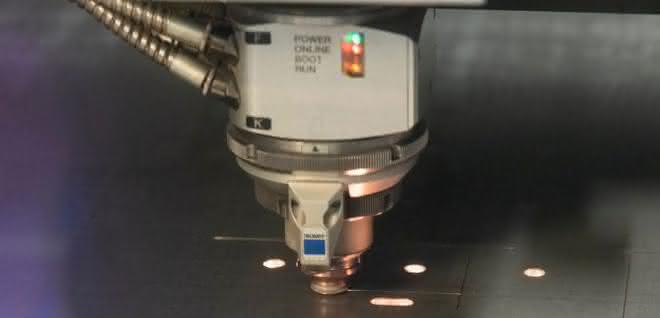
The machine tool manufacturer Trumpf has developed a new process for greater efficiency and process reliability in laser cutting, which will be presented to the public for the first time in May at the in-house trade fair "Intech". The nanojoint process involves tiny holding points at which the laser does not completely cut through the sheet metal during cutting. The nanojoints ensure that the components do not tilt while the laser is cutting them out.
"With our nanojoints, users can improve process reliability in laser cutting and make several work steps more efficient. The solution is an example of how Trumpf has mastered the entire sheet metal process chain and offers every customer solutions to improve their production," says Patrick Schüle, Product Manager at Trumpf.
With the nanojoints, users save material and costs as the parts can be nested more tightly. Depending on the shape of the components, users can even nest without residual skeleton. In addition, employees can remove the cut parts from the cut sheet much more quickly and easily. Trumpf offers nanojoints on its laser cutting machines from the TruLaser 5000 fiber, TruLaser 3000 fiber and TruLaser 1000 fiber series. The process can be retrofitted with a software update.
Higher process speed, less rework
Until now, bars were needed to hold the sheet metal in place during cutting - so-called "microjoints". The employee breaks off these bars when he picks up the components. Nanojoints have many advantages over conventional microjoints. The process speed is increased as the mini-joints can be produced much faster during cutting than conventional bars.
The employee hardly needs to exert any force to remove parts with Nanojoints. This saves time and relieves the strain on production staff. Manual reworking is also usually completely eliminated, as the nanojoints only leave a barely visible mark when separating the components. Microjoints, on the other hand, leave a larger contour mark, which the employee then has to remove manually.


You might also be interested in
Sustainability Through Simulation
Digital material selection reduces CO2 emissions by 40 percent
The use of digital material simulations can significantly reduce CO₂ emissions during the development and manufacturing of components. A real-world project by Schunk and Cadfem demonstrates how data-driven material selection can yield savings of up...
 read more...
From ERP System to AI Platform
RNA, based in Aachen, manufactures up to 2,000 custom-designed feeding systems annually and handles all order processing through a central ERP platform.
read more...Cybus Brings in Siemens Executive Stefan Schwab to Lead the Company
The Hamburg-based software provider Cybus will have a dual leadership structure going forward: Stefan Schwab will join co-founder Peter Sorowka as co-CEO.
read more...Artificial Intelligence for the Physical Space
Alibaba Expands Qwen Model Family with a Robotics Suite for Physical AI
Alibaba is expanding its Qwen model family with a robotics suite for Physical AI. The three models—for manipulation, navigation, and simulation—are designed to assist autonomous robots with complex tasks in real-world environments.
read more...5 Challenges for AI Projects in Manufacturing
Manufacturing companies have high hopes for AI. IFS highlights the five most common reasons why AI projects fail.
read more...Implementing Manufacturing Software: 5 Practical Tips
To remain competitive in the market in the future, more and more companies are considering digitizing their CNC manufacturing processes. The right software solutions can make process knowledge transparently accessible and significantly reduce the...
read more...AI automation specialist reorganizes...
Generation change at Insiders Technologies
After almost 30 years at the helm, Werner Weiss is handing over the management of Insiders Technologies. Andree Albrecht takes over the management after a transition phase.
read more...Intelligent brownfield networking
Many industrial companies are struggling with established plant structures and proprietary interfaces. Stefan Klaus' presentation will show in a practical way how brownfield environments can be efficiently networked with open technologies and made...
read more...Factory-X in practice
How can set-up processes in highly variant production be automated efficiently? Markus Benndorff from soffico shows how Factory-X, industrial data rooms and modular architectures create new possibilities for flexible production concepts.
read more...