

Self-propelled industrial trucks
LiIon battery pack system for a wide range of applications
Self-propelled industrial trucks and complete material handling transport systems are being used in more and more industrial applications and are currently in particularly high demand in the intralogistics sector.
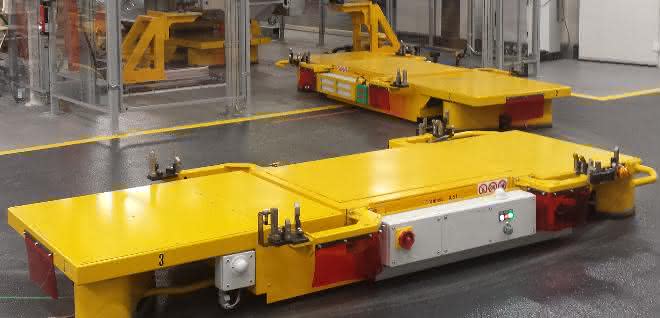
The growing market offers many opportunities, but also places increasing and more specialized demands on the performance of the systems. The battery in particular, as a central component, must therefore always be able to meet new challenges, some of which are highly application-dependent. Diehl & Eagle-Picher has therefore developed lithium-ion battery packs with an integrated battery management system that are based on a modular system and can be flexibly adapted to the respective application in terms of size, design and features.
In addition to safety functions, such as short circuit or overvoltage, and communication via CAN 2.0 B (optional CANopen or Profinet), the accumulators are equipped with a cell balancing system and a pre-charging function, for example. The so-called COM box makes it possible to read out the battery data on a PC and perform remote maintenance, while the WLAN box can be used to switch the battery on and off via WLAN.
Self-propelled industrial trucks, also known as AGVs (Automated Guided Vehicles) or AGVs (Automated Guided Vehicles), are suitable for a wide variety of tasks - from assembly support in automotive factories and pick-up tasks in the warehouses of large online retailers to transporting laundry and food in hospitals. "The vehicle equipment required varies accordingly, depending on the application for which it is intended," says Rolf Pechloff, Head of Sales for battery packs at Diehl & Eagle-Picher GmbH. "The spectrum ranges from large models that are used to move casting ladles in the foundry sector, for example, to small vehicles that only transport a 30 kg crate."
Flexibly designable battery packs
A major challenge for manufacturers is therefore to design and configure the AGVs optimally for their respective tasks. This also applies to the energy supply of the vehicles, which is usually provided by lithium-ion batteries. Diehl & Eagle-Picher has developed a modular system that allows battery packs to be flexibly adapted to the respective application in order to meet the requirements of a wide range of industries and tasks. In this way, it is also possible to implement small series without any problems. "As the vehicles generally require a voltage of 24-48 V, we cover this range with our batteries as standard," explains Pechloff. "Thanks to the flexible system, we are able to realize very high currents, for example in the range of 500 A."
For its batteries, the company uses standard round cells, often 18650 or 21700 cells, which are usually installed in an extruded aluminum profile and offer advantages over the larger prismatic variants in terms of heat regulation, among other things. As the cells are not directly next to each other, air can circulate and dissipate heat. Prismatic cells, on the other hand, are not only installed close together, but are also larger. This means that their surface area is significantly smaller in comparison to their volume than the 18650 or 21700 type. The smaller cells also offer a greater degree of freedom when it comes to the geometry of the pack and integration into the vehicle. For example, an L-shaped battery that makes clever use of corners can also be implemented. Due to the flexible design, the client is also very free in other areas such as the arrangement of the outlets or the placement of connectors.
The battery packs are given additional flexibility by the integrated battery management system (BMS), which can be equipped with various additional options in addition to the standard features. The electronics developed in-house, which are mounted on the battery, guarantee the usual shutdown parameters. These include overvoltage, overcurrent and overtemperature, short circuit, undervoltage and undertemperature. In order to be able to measure the temperature in the battery, Diehl & Eagle-Picher models have temperature sensors located directly on the cells. Their data ensures that the battery is switched off if the temperature rises too high.
This data is communicated to the vehicle's master controller via CAN 2.0 B as standard, or optionally via CANopen or Profinet. "The BMS also monitors the charge status of the battery, for example, which allows the vehicle's computer to decide whether and when to send an AGV to the charging station based on the forwarded data," explains the sales manager. In addition to temperatures and remaining capacity, various individual voltages as well as pack voltage, current and charging cycles are also forwarded.
Special electronics with pre-charging function
In contrast to other battery systems, Diehl & Eagle-Picher has integrated a pre-charging function into the electronics, which comes into effect when the batteries are switched on for the first time. If a battery is switched on without this function, very high currents in the range of several hundred amperes flow briefly to charge the vehicle's capacitors. This would result in a safety shutdown, as currents of this magnitude are not permitted. To prevent this, a resistor ensures that the capacitors are reliably pre-charged. The battery is only fully connected when the voltage is equal before and after the resistor. The electronics of Diehl & Eagle-Picher's batteries also feature a balancing system: the battery's construction from small individual cells means that minimal manufacturing deviations are possible, which can cause the performance of the cells to drift apart. The balancing function ensures that all cells are always at the same level and therefore the maximum capacity is always available.
The electronics of the accumulators have been designed to achieve a performance level between C and D according to ISO 13849-1, depending on the safety features. "With our electronics, it is also possible to connect external sensors and actuators; this determines the exact performance level," explains Pechloff. This is why there are several processors on the electronics, which open up the option of measuring the current at two different points and having it evaluated by different processors, each with separate input signals. The two output signals make it possible to switch two switch-off components (also of different types, e.g. MOSFET and relay) - thus two completely independent switch-off mechanisms can be realized. This redundant design significantly increases the safety of the battery system.
Additional options such as remote maintenance via COM box
Optional accessories are also available. With the help of the COM box, all relevant statuses and measured values such as currents, voltages and temperatures can be displayed and read out in a software program. This unit also allows remote maintenance of the battery using Team Viewer. The WLAN box, on the other hand, is used to switch the battery on and off via WLAN. "We originally developed this unit for a car manufacturer in order to bridge plant shutdowns lasting several weeks," says Pechloff. To avoid having to switch on each vehicle individually - which would be very time-consuming with 30 vehicles in a circuit system - the component, which is equipped with its own small battery, makes contact with the main computer at regular intervals. If a command is received, it powers up the battery and the vehicle can be used. If all vehicles are equipped with this box, they can be made ready for use at the touch of a button on the master control unit.
The possible variations of Diehl & Eagle-Picher's battery solutions are very comprehensive and extremely flexible. Systems can be created from existing components that are adapted precisely to the customer's requirements. Diehl & Eagle-Picher will be happy to advise you on the various possible solutions in each individual case.


You might also be interested in
Rethinking mobile energy
Electrification, battery storage and intelligent energy management are changing industry and construction sites. Lukas Krüger, product specialist for battery storage systems at Bredenoord, talks in an interview about trends, technologies and the...
 read more...
Solutions for surface treatment
Lasers make batteries safe
At the parts2clean trade fair, Trumpf will be presenting manufacturing solutions for surface processing in automotive production, including the TruPulse 5050 nano short-pulse laser and the PFO33 scanner optics.
read more...Electric motors and batteries in a circuit
Batteries and electric motors are electromobility components that contain valuable raw materials. The "Zirkel-Konsortium" has set itself the task of developing technologies to feed these raw materials into a circular economy. One key to an efficient...
read more...Production of high-voltage batteries
Electrically mobile - sustainable on the road
High-voltage batteries for electric cars are produced at the BMW plant in Leipzig. SEW-Eurodrive supplies proven and new drive solutions from the Movi-C modular system for all process steps - from cell preparation to end-of-line testing.
read more...Producing battery cells flexibly and sustainably
The industry needs more and more battery cells. However, their production in gigafactories consumes enormous amounts of energy. In addition, the large production lines are very inflexible. A possible alternative has now been successfully tested at...
read more...Battery technology for material transportation
Strong and robust for indoor and outdoor use
Farasis Energy, the developer and producer of high-performance battery technology and pouch cells, will be showcasing its products for electromobility at Logimat.
read more...Mobile labeling in a complete package
The P-touch E300VP mobile labeling device from Brother helps trade and industry to keep track of things. Weighing just 740 g, the P-touch E300VP with its long-life Li-ion batteries has been specially developed for use on the move.
read more...Yamaha shows robots, cobots and battery cell assembly
Yamaha will be bringing pioneering products and new application examples to Automatica 2023, such as the assembly of battery cells for electric cars.
read more...E-scooter with customizable damping
The startup Scuddy has significantly improved the flexibility, performance, customizability and ergonomics of its second-generation foldable e-scooter of the same name - thanks in part to damping technology from ACE.
read more...