

Virtual commissioning
How smart robot simulation works
More intelligent, more efficient, easier to operate - robots are developing rapidly. Among other things, great care is required when setting them up and operating them in order to avoid cost-intensive downtimes. Robot simulation tools are increasingly being used to support this.
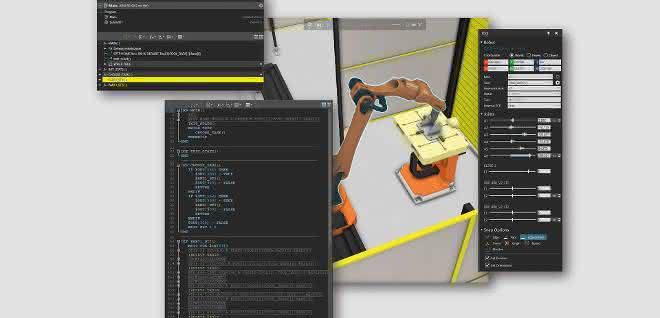
This allows processes to be tested, planned and calculated in advance. The new release 4.5 of Visual Components offers, among other things, a Kuka offline programming solution that enables virtual commissioning with more precise cycle times, robot paths and collisions. In addition, users of the 3D simulation software, which is offered by Dualis IT Solution as a sales partner, benefit from new features for process modeling, AGV features and more.
"Countless moving parts, unknown parameters and short cycle times. Planning and designing new robot cells can be a challenge even for very experienced engineers. To gain certainty, the use of simulation software with offline programming functions is helpful," explains Ralf Dohndorf, Vice President Factory Simulation at Dualis IT Solution.
With its software solutions, Dualis specializes in the planning and optimization of smart processes, systems and machines in networked factories. Among other things, the company develops add-ons and services for the 3D simulation platform Visual Components. The focus is on simplifying the operation of the software or modeling for certain use cases. For example, DUALIS has developed an AGV library for Visual Components that makes it easier and more precise to model the complexity of driverless transport systems in practice.
Visual Components is used for three-dimensional robot simulation, material flow and system planning, among other things. Systems can be planned precisely and errors can be identified and eliminated during the development process of a plant, hall or system.
New degrees of freedom for the simulation of robots
Release 4.5 of Visual Components includes the new KUKA OLP Solution feature for robot simulation. This allows users to program their robots in KRL (KUKA Robot Language) in the familiar syntax and transfer their projects directly to KUKA robot controllers, while integrated RCS modules enable cycle times, robot paths and possible collisions to be mapped precisely and virtual commissioning can now be carried out even more efficiently and in greater detail.
An update to the Process Modeling feature provides users with additional options for mapping more complex production processes and thus simulating them in a more practical way. With the help of new Boolean modelling functions, the possible manipulations of CAD data are extended in order to visualize and simulate applications such as cutting, machining, drilling, punching, etc.. These functions make it possible to easily merge or cut out geometry. Manufacturing applications can thus be better visualized and simulated.
The new release also includes optimized rendering. Improvements to the material shaders increase the quality of the visual representations generated by Visual Components. The need to use external renderers to create marketing materials has been reduced. In addition to these enhancements, there is an improvement in the connectivity plugin and updated CAD importers and exporters.
"Particularly with regard to Industry 4.0 and automated production, in which machines and products also communicate and interact with each other, other factors should also be taken into account in addition to robot simulation. Tools that can simulate all required resources such as workers, robots, transport systems, areas and material consumption on one platform have a clear advantage and can serve as a useful tool for future developments. These platforms can be used to map not only the logic of a robot, but also the behavior of other system-relevant components, the interaction between these components and the interaction with higher-level control systems," explains Ralf Dohndorf.


You might also be interested in
Cutting solutions in 2D and 3D
Microstep showed 2D and 3D cutting solutions in action on sheet metal, tubes, profiles and container bases, including bevel cutting with plasma or waterjet and dynamic fiber laser cutting, as well as drilling, milling and marking demonstrations.
 read more...
Precision machining of bores
Paul Horn is presenting an innovative extension for the Supermini system in the field of ultra-fine machining at EMO 2023. The system has been supplemented by a variant with an ultra-fine ground cutting surface.
read more...Deep drill holes optimized with PCD
When the Schlote Group built a new plant in Harzgerode in 2017, production was geared towards series production of a single component right from the start.
read more...Production goes digital
EMO, the world's leading trade fair for production technology, invites the industry to Hanover from September 18 to 23.
read more...Vibration-free groove turning process
Adjustable damped boring bar
Paul Horn is exhibiting innovations and product enhancements at the EMO in Hanover. Among other things, the company is exhibiting a boring bar that can be adjusted to the vibration amplitudes that occur.
read more...Efficiency with digital twins
Digitalization and automation are the way to increase efficiency and flexibility in machining. The Tebis team will be presenting suitable solutions for mechanical engineering at EMO.
read more...Many highlights in Leipzig
Ceratizit will be presenting the highlights from its portfolio at Intec. In addition to the latest tools for milling, turning and drilling, automation solutions will also be a top topic at the tool manufacturer's stand.
read more...Milling, turning and grinding center
Milling, turning, grinding and gear cutting on one and the same machine - in a single clamping operation: Soraluce's multitasking machines are the answer to technically complex workpieces with tight tolerances that require various machining...
read more...Own brand celebrates anniversary
Hahn+Kolb's own brand Atorn has stood for quality, innovation and emotion for 20 years, winning over customers. Quality is the top priority, all tools are made of high-quality materials and have a solid finish - for maximum reliability in everyday...
read more...