
Design software
You can no longer do without CAM
The Paul Kauth Group operates its own toolmaking facility in Frittlingen. This is where progressive tools with a length of up to 6 m and up to 50 stations are produced, which would be impossible to manufacture without a CAM system.
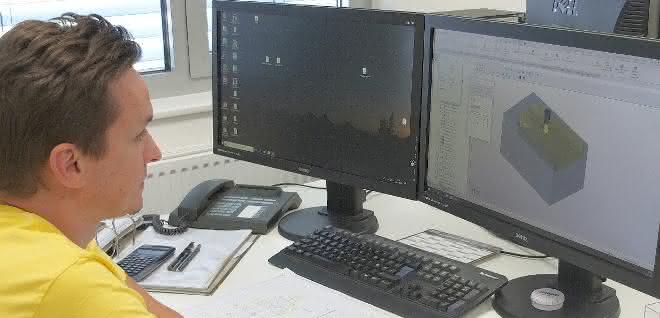
Paul Kauth GmbH & Co KG specializes in sheet metal formed parts for the automotive industry and tubes. The necessary tools were previously sourced externally. In mid-2012, however, the company decided to buy its own tool shop out of insolvency. Today, 15 employees work in the areas of tool design, NC programming and production, among others. "Kauth Werkzeugbau is run as an independent company, but currently works 100 percent for the parent company," as Operations Manager Alexander Schläfle reports.
Around 10 years ago, Kauth opted for Solidworks for strategic reasons. As the Solidcam CAM system is seamlessly integrated into Solidworks (same core, same user interface, fully associative connection of CAD model and toolpaths), the information and data can flow seamlessly from article design to CAM programming and finally to the machine via the postprocessor. "We could no longer do without CAM," emphasizes Schläfle.
Solidcam offers a range of machining options for mechanical cutting and eroding, including 2.5D milling, 3D milling HSS, 3D milling HSR/HSM, multi-sided machining with indexed axes, 5-axis simultaneous machining, turning and turning/milling/turning. In addition, there is CIMCO DNC, NC management, wire eroding with DCAMCUT, tool management via TDM and iMachining.
Step by step to the perfect tool
Back to toolmaking in Frittlingen. "The predecessor company was already using Solidcam. They initially continued to use it here and found that the system was easy to work with," reports Schläfle. In 2015, when they started their own production, they fundamentally reconsidered whether this or another system would be better in terms of future requirements. Schläfle: "It was clear that only a system with Solidworks integration would be an option." In the end, both sides, the designers and the NC programmers, voted in favor of the Solidworks/Solidcam duo. The supplier is DPS Software.
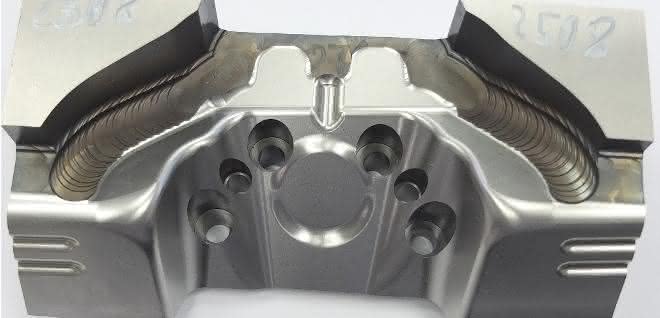
The process at Kauth Werkzeugbau begins with "colleagues from Denkingen approaching us with a new part," says Schläfle. In addition to general explanations, the geometry data is available in Solidworks format. The designer uses this to create a method plan and a suggestion as to how the strip layout should look. The Logopress software, which is also integrated in Solidworks and supplied by DPS, is also helpful at this point. Logopress supports tool design, strip layout, processing and free-form processing. Once the results mentioned so far are available, a calculation and quotation are prepared on this basis. "If our prices weren't right, for example if we were much more expensive than the competition, we wouldn't get the order either," says Alexander Schläfle confidently.
If approval is given, the tool is built in Solidworks. At a degree of completion of 80 percent, a control step takes place: the client receives the results and carries out a kind of preliminary acceptance. Only after the OK is given are the tools completely designed and the final acceptance follows. Once the design process and approval have been completed, the drawings are derived.
Then comes the transition to production, and Solidcam comes into play. There are now five workstations on site with the software installed - three for design and two for CAM milling. The NC programmer therefore no longer has to carry out any transfer measures, but can call up all the necessary workbars by clicking on the "CAM" button and start them directly.
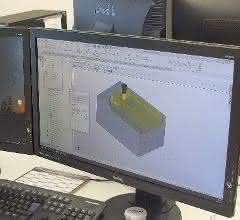
Another positive feature is that all machines and tools are stored in libraries. The operator simply drags them into the working plane and inserts them. This then allows a complete simulation: table in the way, holder in the way, vice in the way; everything comes out in the simulation. "Simulation is required for 5-axis milling at the latest. The possible movements are so complex that they can no longer be overlooked by the operator," explains Schläfle. Solidcam is mainly used at Kauth Werkzeugbau for the program supply of Hermle machining centers. The machining types are milling and drilling. The post-processors are done by DPS, so that the data flows smoothly to the machine. The resulting accuracies are sufficient to reliably machine even demanding tool parts.
Roughing in synchronization
For some years now, CAM manufacturers have been offering special programs for roughing in climb milling. One of these packages is iMachining from Solidcam, an automatic CNC program generator for high-speed milling for roughing, residual material roughing and rough finishing of prismatic and flat-shaped 3D parts.
The software uses the 3D raw model data and the CAD geometry of the finished part for input. The system does the rest itself. However, this is only possible using information stored in the database, including tool data, material data and machine data. From this information, iMachining creates a high-speed CNC program. The system's algorithm ensures that the same chip volume is always removed per milling tooth. This ensures that the tool is optimally utilized. At the end of the process, an average time saving of 70 percent is achieved. Of course, this value depends on the respective tasks. In addition to the time savings, the focus is on tool protection, which leads to an increase in tool life of up to a factor of 3, especially with difficult-to-cut materials.
Kauth Werkzeugbau also uses this software, but not across the board. "We also use so-called high-feed milling cutters for fast roughing, which are also very productive and represent an alternative," says Schläfle. The CAM programmer decides which type of roughing to use based on his experience.
Karl Obermann, freelance editor for Dassault Systèmes / ag


You might also be interested in
In-house exhibition Bielefeld 2026
How DMG Mori thinks about the factory of the future
DMG Mori will be showcasing turning and milling expertise, automation solutions and additive manufacturing along the Machining Transformation (MX) at the Bielefeld 2026 in-house exhibition.
 read more...
Up to 50 percent higher cutting speeds
The current market situation is putting pressure on companies that rely on carbide tools: Rising raw material costs, volatile supply chains and limited predictability are putting pressure on the industry. Fette Werkzeugtechnik, a member of the LMT...
read more...A robot for all occasions
Industrial robots take on many tasks. Even milling with accuracies in the sub-millimeter range is now possible.
read more...High metal removal rate for high maneuverability
Large module gears for ship drives place high demands on machining. Switching from skiving to 5-axis simultaneous milling with high-feed tools considerably shortens the roughing process. Process parameters and a well thought-out tool selection are...
read more...Schunk shows flexible systems for electronics production
Schunk Electronic Solutions will be exhibiting modular, flexible systems for electronics production at Productronica 2025 - from stand-alone depaneling systems to fully integrated inline solutions.
read more...Hydraulic 4-jaw chuck for automated workpiece clamping
HWR Spanntechnik presents a hydraulically actuated 4-jaw chuck for automated workpiece changing. The clamping device is designed to enable short set-up times, precise clamping and high productivity in automation.
read more...Corner, face and plunge milling
Paul Horn is expanding the DA milling system for corner, face and plunge milling. With the DA65 variant, the system offers a larger cutting insert compared to the existing DA62.
read more...World premieres at the EMO 2025
From September 22 to 26, 2025, Grob will be presenting several innovations at EMO Hannover. The focus of the trade fair appearance will be on the latest 4- and 5-axis universal machining centers and the associated automation solutions.
read more...Flexible and efficient processing
New high-performance CNC series
Fanuc's presentation at EMO will focus on the new FS500i-A CNC series. The new CNC generation offers high user-friendliness, process optimization as well as digital and network technologies.
read more...