

Leak test
The IP67 challenge
When manufacturing batteries for electric vehicles, as well as other industrial products, the manufacturer must comply with protection class IP67 against the ingress of water. Leak testing during the production process is not easy, especially as it has to be carried out quickly. By Mark Blaufuß
With electromobility, traction batteries are also becoming increasingly important. Quality assurance plays a central role in their production. Buyers expect operational reliability and a long service life. Unfortunately, water is one of the ubiquitous enemies of a lithium-ion traction battery in road traffic. If water enters the battery, there is a risk of a short circuit and therefore a fire hazard. Another component whose functional safety depends on the watertightness of its housing is the battery's control unit. Protection class IP67, which applies to many electronic components in the vehicle, specifies when a component meets the requirement for protection against water ingress. However, it is not trivial to translate IP67 into a meaningful leak rate for testing in the production process.
IP67 - functional after a half-hour immersion bath
The limit leakage rates required for IP67 protection can usually only be tested using modern test gas methods. In addition, the housing material itself has a significant influence on the tightness requirements, because water droplets are more easily detached from some materials - and thus penetrate the housing through a leakage channel - than from others. Battery housings for lithium-ion batteries or housings for control electronics are often designed in accordance with IP67. Testing according to this protection class requires that the component must have retained its full functionality after a 30-minute immersion bath at a depth of 1 meter. In some cases, this means that no water must have penetrated the component.
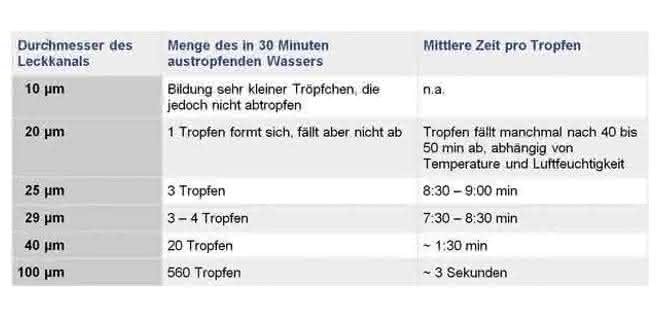
Using various glass capillaries with a defined diameter and a length of 10 mm each, a test set-up can be used to determine the diameter of a leakage channel at which a drop can still be seen - but without detaching. The differential pressure is 0.1 bar - as in a housing at a water depth of 1 m.
The result: while three drops still detach from a glass leakage channel with a diameter of 25 µm in half an hour, one drop still forms with a diameter of 20 µm, but only detaches after a period of more than 30 minutes. So if the diameter of a glass leakage channel is slightly less than 20 µm, the water pressure of 0.1 bar is in equilibrium with the forces that cause the water to adhere to the surface of the leakage channel. The limit leakage rate is then in the order of 10-3 mbar∙l/s. In practice, the length of a possible leakage channel also plays a role, as the number of droplets is inversely proportional to its length. Four times more droplets penetrate through a channel a quarter of the length.
Water droplets adhere even better to other materials such as steel or ABS than to glass. Before a leak here leads to water penetrating into a housing under a differential pressure of 0.1 bar, the leak channel diameter must be somewhat larger. This means that the requirements for the limit leakage rate for these materials are also less stringent than for glass. However, the situation is very different with aluminum housings. Here, the water droplet only adheres to the material if the leakage diameter is very small. Accordingly, an aluminum housing must be tested for complete watertightness in the half-hour IP67 scenario against a limit leakage rate that is a hundred times smaller, in the range of 10-5 mbar∙l/s.
Protection class IP67 requires unchanged, complete functionality after the defined immersion process. What it does not explicitly require is that no water penetrates into the component during a 30-minute immersion bath with a pressure difference of 0.1 bar. If a manufacturer decides that he can tolerate the ingress of a few drops of water because it does not impair the functionality of the component, he can choose lower leakage rates for the test.
Pressure drop process reaches its limits
In practice, leak rates in the order of 10-3 mbar∙l/s represent the limit of what can just about be detected with a conventional pressure drop test under ideal conditions. For their leak testing in production, many manufacturers therefore only use limit leak rates of up to 10-2 mbar∙l/s and tend to use the less reliable pressure drop test when testing for gross leaks. This is because even the smallest temperature fluctuations during the test process can have a significant impact on the measurement of pressure changes, especially with large component volumes. For this reason, the more reliable, test gas-based methods are more suitable for limit leak rates in the range of 10-3 mbar∙l/s or less. The choice of the specific test method also depends on the pressure difference a component can withstand. Many parts that are designed to comply with protection class IP67 can only withstand very small pressure differences of 0.1 or 0.2 bar. Otherwise the component or its seals would be damaged.
For example, if the manufacturer wants to test the integrity of the seals of a battery pack, too high a differential pressure could damage the seals. This is why tracer gas-based robotic sniffer leak detection is recommended. A tracer gas overpressure of just 0.1 bar is generated in the component and a robot arm automatically guides the tracer gas sensor along the seals to detect escaping tracer gas.
In this case, we are dealing with a mix of materials. In this scenario, any leakage channel consists of the housing material, usually aluminum, on one side and the polymer of the seal on the other. Accordingly, the limit leakage rate should also be averaged between the material-typical leakage rates. Another option for an integral leak test of the assembled and sealed battery pack is the accumulation test. A simple accumulation chamber is used to determine whether test gas escapes from the inside of the test part. Fans ensure that escaping tracer gas is distributed in the chamber and accumulates in it so that it can then be detected by the stationary sensor.
Vacuum method for short cycle times
Other components are significantly more robust against pressure differences than a finished battery pack. A cast aluminum housing that has not yet been assembled, for example, can also withstand high pressure differences. A helium leak test in the vacuum chamber is therefore ideal for pre-testing the tightness of such an aluminum housing. In addition to its sensitivity, the great advantage of the vacuum method is its high speed. It allows particularly short cycle times in the production line. The test part is first evacuated and then filled with the test gas helium at a pressure of 1 bar. The chamber is then evacuated. In this way, escaping helium can be detected immediately. Alternatively, you can even work with a pressure of up to 6 bar, but then reduce the helium concentration to 15 percent. In either case, the pressure difference with the vacuum method is so great that the limit leakage rate against which the test must be carried out increases - by a factor of approximately 10. To ensure that an aluminum housing is completely watertight, the test in the vacuum chamber is not carried out against a limit leakage rate in the range of 10-5 mbar∙l/s, but rather 10-4 mbar∙l/s. However, the basic correlation between the properties of the material with regard to adhesion to water and the corresponding limit leakage rate to be tested remains the same in the vacuum test.
The IP67 protection class, which regulates the protection against the ingress of water into a component, ultimately places the responsibility in the hands of the manufacturer. It is up to them to decide how stringent their leak test must be to ensure that their component is still fully functional after a half-hour water bath at a differential pressure of 0.1 bar. If a manufacturer wants to completely rule out any problems caused by water ingress or at least limit them to very few drops of water, there is ultimately no way around test gas-based methods. The decisive factor in deciding which specific test gas method is suitable is the differential pressure that the component can withstand. The very fast and precise helium test in the vacuum chamber is ideal for the preliminary testing of housings. Finally, the limit leakage rate against which a component must be tested depends crucially on the material from which it is made. Aluminum in particular places especially high demands here.
Mark Blaufuß, Application Engineer Alternative Drive Trains, Inficon / am


You might also be interested in
Rethinking mobile energy
Electrification, battery storage and intelligent energy management are changing industry and construction sites. Lukas Krüger, product specialist for battery storage systems at Bredenoord, talks in an interview about trends, technologies and the...
 read more...
Solutions for surface treatment
Lasers make batteries safe
At the parts2clean trade fair, Trumpf will be presenting manufacturing solutions for surface processing in automotive production, including the TruPulse 5050 nano short-pulse laser and the PFO33 scanner optics.
read more...Electric motors and batteries in a circuit
Batteries and electric motors are electromobility components that contain valuable raw materials. The "Zirkel-Konsortium" has set itself the task of developing technologies to feed these raw materials into a circular economy. One key to an efficient...
read more...Production of high-voltage batteries
Electrically mobile - sustainable on the road
High-voltage batteries for electric cars are produced at the BMW plant in Leipzig. SEW-Eurodrive supplies proven and new drive solutions from the Movi-C modular system for all process steps - from cell preparation to end-of-line testing.
read more...Producing battery cells flexibly and sustainably
The industry needs more and more battery cells. However, their production in gigafactories consumes enormous amounts of energy. In addition, the large production lines are very inflexible. A possible alternative has now been successfully tested at...
read more...Battery technology for material transportation
Strong and robust for indoor and outdoor use
Farasis Energy, the developer and producer of high-performance battery technology and pouch cells, will be showcasing its products for electromobility at Logimat.
read more...Mobile labeling in a complete package
The P-touch E300VP mobile labeling device from Brother helps trade and industry to keep track of things. Weighing just 740 g, the P-touch E300VP with its long-life Li-ion batteries has been specially developed for use on the move.
read more...Yamaha shows robots, cobots and battery cell assembly
Yamaha will be bringing pioneering products and new application examples to Automatica 2023, such as the assembly of battery cells for electric cars.
read more...E-scooter with customizable damping
The startup Scuddy has significantly improved the flexibility, performance, customizability and ergonomics of its second-generation foldable e-scooter of the same name - thanks in part to damping technology from ACE.
read more...