
Strategies for IT security
Cyber attacks are part of everyday life
Increasing digitalization in the industrial sector also increases the risk of falling victim to a hacker attack.
Production processes are extensively networked and intelligent machines are finding their way into production halls. Even the smallest gaps in IT or information security can bring the entire production of an industrial company to a standstill and jeopardize its existence. This is because the use of IT means that potential vulnerabilities and threats also jeopardize process controls. This is why companies are increasingly looking for well thought-out, company-specific security strategies. Among other things, appropriate and up-to-date emergency planning and company-wide awareness are essential.
By Marcus Henschel
Many industrial companies are still convinced that they are already sufficiently protected against cyber attacks. However, the situation is very different in practice, especially in small and medium-sized enterprises (SMEs). They usually lack the necessary means and resources to develop and implement an appropriate IT and information security strategy. Those responsible underestimate the risk and assume that a simple firewall and anti-virus software offer sufficient protection.
The digitalization of the company should take place as quickly as possible, so the solutions and systems are simply integrated into the company network - without carrying out appropriate security checks in advance. However, it is no longer an isolated case that security solutions have hidden backdoors ex works. If this is the case and the system is not checked before integration, cyber criminals have an easy time of it. They encrypt hard disks, pass on business-critical information to the competition or paralyze the entire production process.
Industrial groups on the right track
What is still in its infancy in SMEs is now being implemented in most corporations. They already have an appropriate budget for protective measures and their own security staff in the team. In order to build up and maintain an up-to-date level of IT and information security throughout the company, corporations are increasingly offering awareness training for their employees to make them aware of the dangers in everyday digital working life and sensitize them accordingly.
However, a trend can be seen in large industrial companies not only at an organizational level, but also at a technical level: Production systems are being completely sealed off at great expense and Security Operation Centers (SOC) are keeping a constant eye on IT security. In this way, it is possible to react immediately in the event of an emergency.
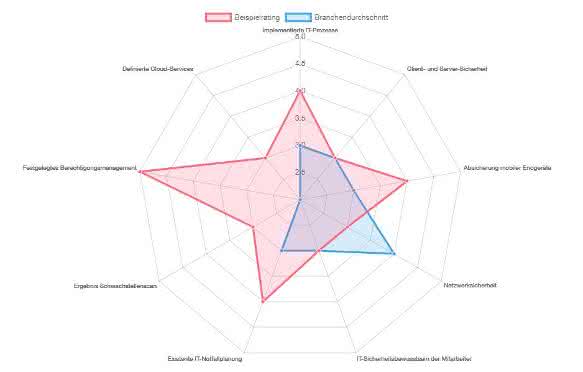
Security rating tools are also playing an increasingly important role with regard to IT and information security in the industry. A security rating, for example, enables a manufacturer to carry out a suitable risk assessment for its entire supply chain and derive appropriate measures from this. The results can also be incorporated into the drafting of contracts with partners and the conclusion of cyber insurance policies. These include the actual situation in their calculations and reduce the insurance premium accordingly if the level of protection is high.
Proactively protect against cyber threats
However, everyone should be aware of this: Hacker attacks cannot be prevented and it is only a matter of time before it is your own company's turn. New cases are constantly appearing in the media, making it clear that cyberattacks are now also part of everyday life in industry. For example, malware is infiltrated into the entire network via a simple employee account, bringing production to a standstill.
Another problem is that a hacker attack is not always immediately noticeable. Particularly perfidious attacks such as Winnti, for example, infiltrate malicious code into the network unnoticed in order to access sensitive data and carry out targeted industrial espionage.
In order to act proactively and prepare your own company for a cyber attack in the best possible way, the current security status should be put to the test and a company-wide security strategy developed. For example, what is the security and availability of the process systems, and how can the physical protection of employees, machines and the environment be guaranteed?
What organizational solutions are recommended to ensure productive and secure collaboration between IT and OT (operational technology)? And how can the probability of occurrence and the consequences of widespread attacks such as WannaCry or NotPetya be minimized and potentially fatal consequences of attacks such as TRISIS (targeted attacks on industrial security control systems) be prevented?
Industrial security: not tomorrow, but today!
Generally speaking, there is never 100% security. However, an appropriate and comprehensive security strategy helps to optimally prepare the company for an emergency. In this way, production downtimes can be prevented and safety within the automation process can be guaranteed. This not only plays an important role for your own company, as the entire supply chain depends on the availability of each individual partner.
A cyber attack and the resulting delays in the supply chain or even a complete production shutdown can therefore also result in long-term reputational damage. Proof of secure processes (e.g. certification in accordance with IEC 62443) can strengthen the trust of partners and customers in the long term.
In everyday working life, however, they often lack the resources to familiarize themselves independently with the topic of industrial security and consider all relevant factors. At this point, security companies such as Allgeier Core and its partner Bluecept support industrial companies with various measures. For example, employees are not faced with the challenge alone, but are given a basic understanding of the complex topic of industrial security in introductory workshops. However, it is important to build on this to develop an individual security strategy in order to protect the company from network threats in the long term.
Marcus Henschel is Managing Director of Allgeier Core


You might also be interested in
Sustainability Through Simulation
Digital material selection reduces CO2 emissions by 40 percent
The use of digital material simulations can significantly reduce CO₂ emissions during the development and manufacturing of components. A real-world project by Schunk and Cadfem demonstrates how data-driven material selection can yield savings of up...
 read more...
From ERP System to AI Platform
RNA, based in Aachen, manufactures up to 2,000 custom-designed feeding systems annually and handles all order processing through a central ERP platform.
read more...Cybus Brings in Siemens Executive Stefan Schwab to Lead the Company
The Hamburg-based software provider Cybus will have a dual leadership structure going forward: Stefan Schwab will join co-founder Peter Sorowka as co-CEO.
read more...Artificial Intelligence for the Physical Space
Alibaba Expands Qwen Model Family with a Robotics Suite for Physical AI
Alibaba is expanding its Qwen model family with a robotics suite for Physical AI. The three models—for manipulation, navigation, and simulation—are designed to assist autonomous robots with complex tasks in real-world environments.
read more...5 Challenges for AI Projects in Manufacturing
Manufacturing companies have high hopes for AI. IFS highlights the five most common reasons why AI projects fail.
read more...Implementing Manufacturing Software: 5 Practical Tips
To remain competitive in the market in the future, more and more companies are considering digitizing their CNC manufacturing processes. The right software solutions can make process knowledge transparently accessible and significantly reduce the...
read more...AI automation specialist reorganizes...
Generation change at Insiders Technologies
After almost 30 years at the helm, Werner Weiss is handing over the management of Insiders Technologies. Andree Albrecht takes over the management after a transition phase.
read more...Intelligent brownfield networking
Many industrial companies are struggling with established plant structures and proprietary interfaces. Stefan Klaus' presentation will show in a practical way how brownfield environments can be efficiently networked with open technologies and made...
read more...Factory-X in practice
How can set-up processes in highly variant production be automated efficiently? Markus Benndorff from soffico shows how Factory-X, industrial data rooms and modular architectures create new possibilities for flexible production concepts.
read more...