
Automotive engineering
More scope for design optimizations
The wave springs and retaining rings from US manufacturer Smalley, distributed by TFC, are used in the assemblies of gearboxes and clutches.
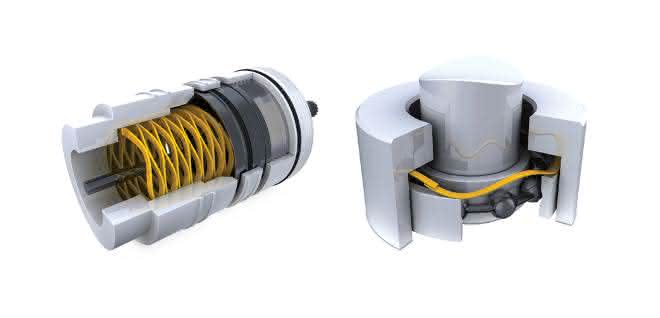
They preload rolling bearings, fix gears and shafts, lock swivel joints and much more: the flat wire wave springs and Spirolox retaining rings from the multi-tier supplier Smalley in TFC's portfolio now cover a wide range of applications in automotive engineering. They are used by product developers and designers in the industry in particular: Both products clear the way for design simplifications and the reduction of installation spaces; they therefore offer automotive designers optimization potential in two crucial disciplines.
Only half the space
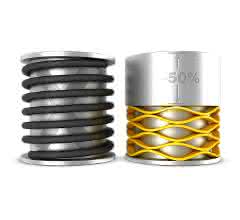
The flat wire wave springs from Smalley - especially those in the Crest-to-Crest series - require up to 50 percent less axial installation space than conventional round wire springs for the same spring travel and load capacity. This is thanks to their special geometry, which also supports the realization of modern lightweight designs. Where less installation space is required, the amount of material required and the weight of the overall design are also reduced.
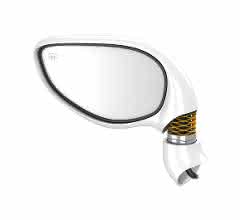
One example of this is the design of a new swivel joint for a car wing mirror. Here, a customized crest-to-crest spring was integrated directly into the design of the mirror. With its spring force, it counteracts the pivoting mirror head against the fixed support on the vehicle. This ensures that the mirror is held firmly in place, but also allows it to be turned manually via the flange.
The use of crest-to-crest wave springs inside Gandini pistons or valves is technically more demanding, but functionally related. Here, the flat wire wave spring regulates the amount of oil dispensed via a preset spring force. It serves as an innovative replacement for conventional compression springs and offers a defined resistance in a small space. This reduces the overall size of the valve. Other component examples for the use of these wave springs are pressure valves (valve piston adjustment), plug connectors (snap connection) or shift levers (mechanical back pressure) and floating constructions (gearbox construction).
The flat wire wave springs from Smalley and TFC are manufactured using the no-tooling-cost or circular-grain process. With this special edge winding technique, a pre-hardened, rolled flat wire is wound over a high edge to produce a virtually perfect circle. As the technology experts at Smalley are constantly optimizing this method, it can now also be used to produce springs with tiny diameters. Crest-to-crest wave springs are therefore currently available in many sizes in both metric and inch dimensions: As standard parts with minimum diameters of just five millimetres and as a special solution with a diameter of just four millimetres. This benefits all automotive designers who need to produce particularly small and compact assemblies with preload or reset functions - for example, gear knobs.
When every tenth counts
Smalley also uses no-tooling-cost or circular-grain technology to manufacture its Spirolox series retaining rings, which are also used in many automotive components. These rings are made from rolled stainless steel, spring steel, titanium or special alloy materials and offer design engineers a significant advantage over other retaining rings in accordance with DIN 471/472: they have no lugs, eyelets or holes and no gap. They therefore close flush all round and are therefore suitable for creating space-optimized designs.
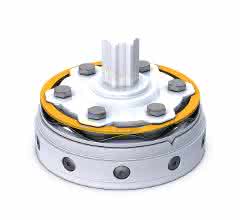
Within the automotive sector, transmission and clutch construction are among the major areas of application for Spirolox retaining rings. There are now a large number of examples of this. For example, they are used to preload roller bearings, to secure bearings on shafts or as locking elements in gear assemblies or slipping clutches. When securing drive shafts, the eyelet-free Spirolox rings - depending on the type and variant - are suitable for speeds of up to 8,000 revolutions per minute as standard. This means that the US manufacturer and its German sales partner TFC cover a wide range of applications. However, if this is not enough, the no-tooling-cost or circular-grain method proves to be sufficiently flexible for the rapid implementation of design adjustments and even completely new developments.
TFC supplies Smalley's Spirolox retaining rings from stock in 6,000 different versions with diameters from six to 400 millimetres, both as snap, hoopster and flat wire retaining rings as well as with multiple threads. All types can be fitted and removed using standard screwdrivers, which simplifies installation and maintenance work. as


You might also be interested in
New Trade Show for the Turned Parts Industry
The Association of the German Turned Parts Industry has given a positive assessment of the first Make-to-Order (MTO) Days: With 184 exhibitors and approximately 1,400 trade visitors, the inaugural event proved to be a successful platform for...
 read more...
In-house exhibition Bielefeld 2026
How DMG Mori thinks about the factory of the future
DMG Mori will be showcasing turning and milling expertise, automation solutions and additive manufacturing along the Machining Transformation (MX) at the Bielefeld 2026 in-house exhibition.
read more...Association of the German Turned Parts...
Turned parts industry looks cautiously to the future
Rising order intake, new members, cautious optimism: the members of the Association of the German Turned Parts Industry are confident. At the spring conference in Leipzig, around 150 participants discussed current market developments, strategic...
read more...World premieres at the EMO 2025
From September 22 to 26, 2025, Grob will be presenting several innovations at EMO Hannover. The focus of the trade fair appearance will be on the latest 4- and 5-axis universal machining centers and the associated automation solutions.
read more...Efficient complete machining
Index-Werke will be bringing the Index G220 turn-mill center and the Traub TNA400 universal lathe to Intec.
read more...Digitization of process chains
CAM system Hypermill in practice
At EMO 2023, Open Mind will focus on turning, milling and the importance of CAM software and MES in networked production environments.
read more...High-speed spindle in handbag format
Modules for milling and turning
At Weiss, the focus is on the new 1.5 kilogram micro-mill spindle, which rotates at up to 60,000 revolutions per minute.
read more...Handling and workpiece clamping
Networked production starts with the component
Schunk is coming to Hanover with a 360-degree portfolio covering all aspects of machine tools. The focus will be on more sustainable production, connectivity and e-mobility.
read more...Stroll through the city
DMG Mori is inviting visitors to take a stroll through the city at EMO: In a specially constructed DMG Mori City, the machine tool manufacturer is concentrating on its focus topic of Machining Transformation (MX).
read more...