
Leantechnik positioning system
Different variants on one line
Leantechnik has developed the AFP modular system, with which different variants of a product can be produced economically on a single production line. The system was commissioned by a customer from the automotive industry.
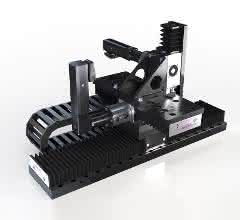
Previously, the production lines had to be modified for each car variant. This often resulted in production interruptions. To avoid this, one manufacturer has now restructured the body-in-white production in its plant and developed a fully flexible system for the production of the future. One component of the body-in-white concept is the new AFP (Actuator Flexible Position) positioning system from Leantechnik, which was specially designed for the car manufacturer.
A positioning system for all cases
Engineer Mario Dobnik remembers the request: "We needed to be able to manufacture many different car models continuously on one line." In order to meet the complex requirements, Leantechnik developed a new modular system together with the car manufacturer. It consists of axles, drives and fasteners that can be combined with each other in almost any way. In this way, the user receives a completely individual positioning system that can be flexibly adapted to changing production conditions.
At the heart of the AFP axes are the lifgo-linear rack and pinion gearboxes from Leantechnik, which convert rotary movements into linear ones. With a lifting force of up to 25,000 newtons, lifting speeds of three meters per second and an acceleration of 50 meters per square second, they are suitable for applications such as in the automotive industry, where components need to be moved quickly over long distances.
As the gears also run absolutely synchronously, they enable precise positioning on the assembly line. This accuracy is essential in highly automated car production, as the robots can only process the components correctly if they are delivered accurately. Thanks to the special design of the gears, the AFP system works with high precision even at high speeds and long travel distances.
The drive unit of the positioning system is just as modular as the rack and pinion gears and the axes of the AFP. It consists of a brushless 24-volt DC servo drive with integrated controller, a holding brake, the gearbox and a clamping coupling. The controller is freely programmable and has a CAN bus interface (CANopen Drives profile DSP402). The axes are available as straight or angled drive units with stroke speeds of 35 or 90 millimetres per second.
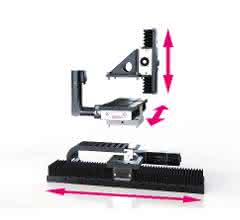
Combination options for high flexibility
The modular system offers the user countless options and, thanks to its modularity, allows the production of different product variants on one and the same line. In future, companies will therefore only need to set up several parallel production lines if they want to increase their production volume. With the new positioning system, they not only save changeover times and therefore time, but also increase the productivity per unit area of their production thanks to the reduced space requirements of the systems.
The axles are suitable for all companies that want to manufacture a large number of product variants on one production line. In addition to vehicle manufacturers, this also includes battery producers. The AFP modular system enables the flexible positioning of holders, clamps and centring devices and the flexible mounting of different types of components.
In addition to a longitudinal axis, the system includes a transverse axis and a lifting axis as well as drive units. Each axis and each drive unit are defined separately and configured precisely according to the customer's requirements. The standard version of the longitudinal axis is designed for lifting distances of 60, 150, 300 and 400 millimetres. The axes are also available with special parameters in the "Light" and "Single" versions. The transverse axis for strokes of 60, 90 and 180 millimetres and the lifting axis for strokes of 60, 90 and 150 millimetres. AFP positioning systems are available as 1-, 2- or 3-axis systems and can be equipped with customer-specific accessories (gripper systems, welding robots, gluing devices).
The precise adjustment of the axes means that they can also be used for electronic shimming. This means that the original underlay with shim plates to compensate for manufacturing tolerances is no longer necessary, as this compensation can be dynamically controlled with the help of the corresponding software. as


You might also be interested in
Soft grippers for delicate foods
Irregularly shaped, fragile, and varying in size and weight: products such as potatoes, baked goods, and dairy products push mechanical grippers to their limits.
 read more...
Development Collaboration for Humanoid Robotic Hands Launched
Schunk is entering into a new development partnership with Robert Bosch Robotics. Their shared goal is to develop an industrial-grade robotic hand that can be integrated into various humanoid robot systems.
read more...Robot-controlled packaging of rolls
Koch Robotersysteme, a company specializing in the integration of robotic systems, has developed a complete, automated packaging line for packaging rolls based on Tentoma’s RoRo StretchPack packaging machine.
read more...Robotics and autonomous order picking
Locus Robotics acquires Nexera Robotics and expands autonomous warehouse logistics
Locus Robotics takes over Nexera Robotics and may have taken a decisive step towards truly universal warehouse automation. A new gripping technology should now make possible what was previously considered difficult to automate.
read more...Gentle wheel handling
The newly founded Eisenmann Robotics division develops new robotics concepts to increase the level of automation in modern production facilities.
read more...Gripping systems and vacuum generators
Schmalz is presenting new gripping systems and vacuum generators at Automatica. Exoskeletons, which allow employees to move heavy workpieces effortlessly, will also be on display.
read more...Smart universal gripper for power electronics
The power electronics manufacturer Semikron Danfoss uses the EGU 50 mechatronic parallel gripper from Schunk in a robotic cell. It handles different components and feeds them to a measuring line. With its functionalities, it meets all requirements...
read more...Schmalz takes over finger gripper from Soft Robotics
The vacuum specialist Schmalz is expanding its gripper portfolio and acquiring the mGrip product family from the US company Soft Robotics (SRI), including all finger gripper configurations, patents and the associated know-how.
read more...Soldering with special gripper
In order to make the mini wave soldering of large panels stable and reproducible, Eutect developed a special gripper that prevents the panel from bending, among other things.
read more...